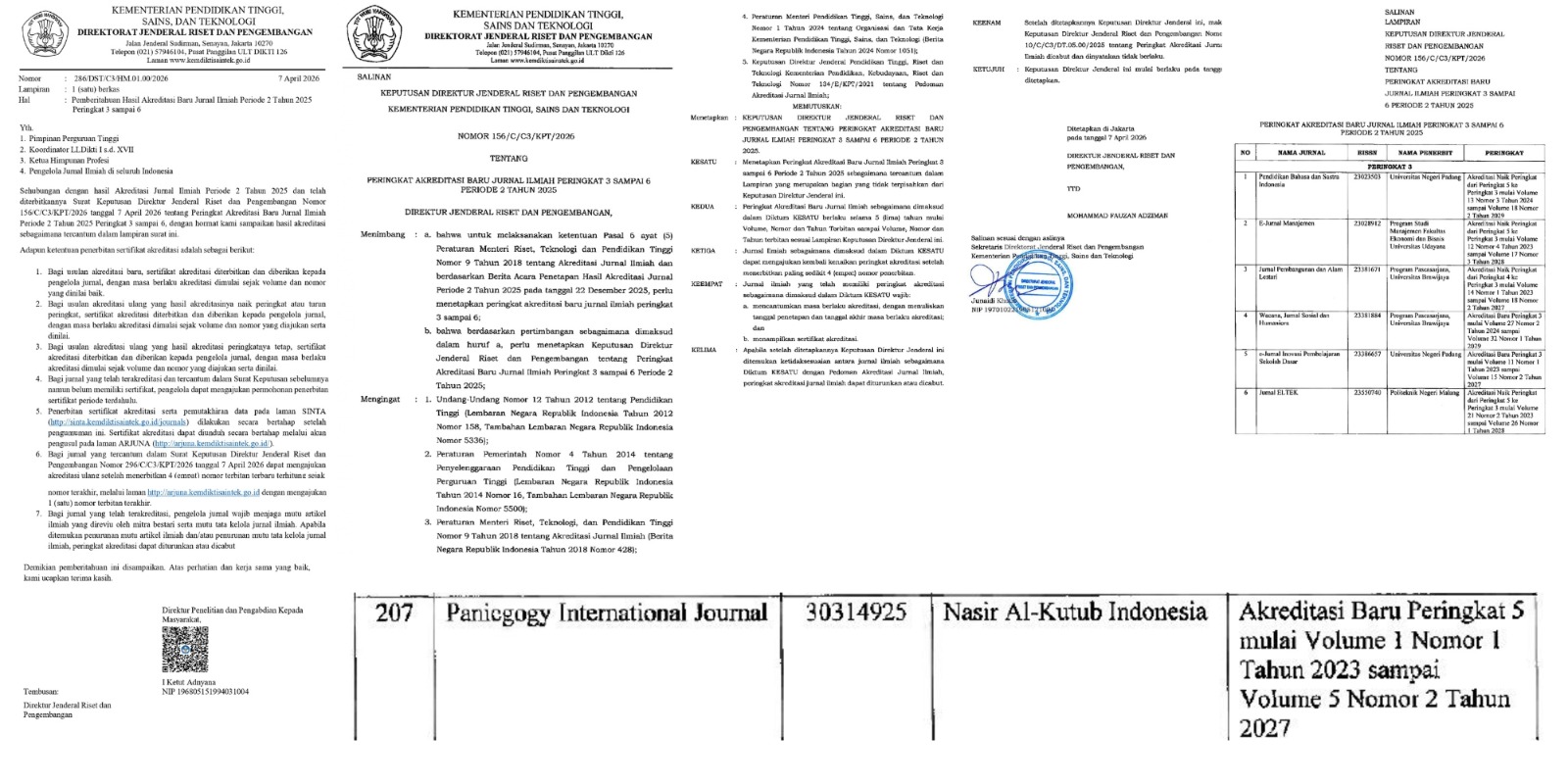
Adiwiyata Program Management at SDN 3 Muara Ciujung Timur: Governance, Participation, and Partnership
DOI:
https://doi.org/10.59965/pij.v3i2.282Keywords:
Adiwiyata School Programme, Environmental Education Management, Student Participation, School Committee PartnershipAbstract
This study investigates the management of the Adiwiyata School Program at SDN 3 Muara Ciujung Timur, Rangkasbitung Sub-district, Lebak Regency, Banten Province—the first and only public primary school in Lebak Regency to attain Adiwiyata Provincial recognition. Employing a qualitative descriptive approach with a constructivist paradigm, data were collected through passive-participant observation, semi-structured in-depth interviews with twelve purposively selected informants (principal, Adiwiyata team coordinator, subject teachers, school staff, students, school committee members), and document analysis, during January–August 2017. Data were analysed using Miles et al.’s (2014) interactive model. Findings reveal that effective programme management operated across four Adiwiyata components: (1) an environmentally conscious school policy, including a 20% budget allocation from the School Activity and Budget Plan (RKAS) and revision of school vision–mission; (2) an environment-based curriculum integrating ecological values across all subjects and through the Cultivation and Crafts subject (“from waste to blessing” philosophy); (3) participatory environmental activities featuring a consistent Jumat Bersih (Friday Clean-Up) routine, monthly action on the 9th, and the innovative “environmental virus” peer-influence strategy; and (4) management of eco-friendly facilities used as dual-purpose learning media. Active student involvement was achieved through competitive three-stage selection for the Student Adiwiyata Team, school waste-bank entrepreneurship, and a zone-based duty system. School committee participation occurred at the strategic level of policy formulation and through facilitation of external partnerships with BLH Lebak, BPBD, and the Puskesmas. Success is explained by five determinants: transformational leadership, an organically formed environmental school culture, strong social capital, programme consistency, and creative resourcefulness under material constraints. These findings contribute to school management literature by demonstrating that social capital and transformational leadership can effectively compensate for material resource limitations in community-based environmental education programmes.
Downloads
References
Adler, P. S., & Kwon, S.-W. (2002). Social capital: Prospects for a new concept. Academy of Management Review, 27(1), 17–40. https://doi.org/10.5465/amr.2002.5922314
Andini, T. M., & Sumarmi, S. (2021). Implementasi program Adiwiyata dalam membentuk karakter peduli lingkungan siswa sekolah dasar. Jurnal Pendidikan: Teori, Penelitian, dan Pengembangan, 6(3), 370–379. https://doi.org/10.17977/jptpp.v6i3.14652
Arthur, J., Kristjánsson, K., Walker, D., Sanderse, W., & Jones, C. (2017). Character education in UK schools: Research report. Jubilee Centre for Character and Virtues, University of Birmingham.
Bandura, A. (2018). Toward a psychology of human agency: Pathways and reflections. Perspectives on Psychological Science, 13(2), 130–136. https://doi.org/10.1177/1745691617699280
Bicchieri, C. (2017). Norms in the wild: How to diagnose, measure, and change social norms. Oxford University Press.
Christakis, N. A., & Fowler, J. H. (2013). Social contagion theory: Examining dynamic social networks and human behavior. Statistics in Medicine, 32(4), 556–577. https://doi.org/10.1002/sim.5408
Creswell, J. W., & Poth, C. N. (2018). Qualitative inquiry and research design: Choosing among five approaches (4th ed.). SAGE Publications.
Day, C., Gu, Q., & Sammons, P. (2016). The impact of leadership on student outcomes: How successful school leaders use transformational and instructional strategies. Educational Administration Quarterly, 52(2), 221–258. https://doi.org/10.1177/0013161X15616863
Denzin, N. K. (1978). The research act: A theoretical introduction to sociological methods (2nd ed.). McGraw-Hill.
Ellen MacArthur Foundation. (2019). Completing the picture: How the circular economy tackles climate change. Ellen MacArthur Foundation.
Epstein, J. L., Sanders, M. G., Sheldon, S. B., Simon, B. S., Salinas, K. C., Jansorn, N. R., Van Voorhis, F. L., Martin, C. S., Thomas, B. G., Greenfeld, M. D., Hutchins, D. J., & Williams, K. J. (2019). School, family, and community partnerships: Your handbook for action (4th ed.). Corwin Press.
Fajarisma, A. B. (2014). Analisis implementasi kebijakan kurikulum berbasis lingkungan hidup pada program Adiwiyata Mandiri di SDN Dinoyo Malang. Jurnal Kebijakan dan Pengembangan Pendidikan, 2(2), 166–173. https://doi.org/10.22219/jkpp.v2i2.1979
Guba, E. G., & Lincoln, Y. S. (1994). Competing paradigms in qualitative research. In N. K. Denzin & Y. S. Lincoln (Eds.), Handbook of qualitative research (pp. 105–117). SAGE Publications.
Hargreaves, A., & O’Connor, M. T. (2018). Solidarity with solidity: The case for collaborative professionalism. Learning Professional, 39(2), 20–24.
Hart, R. A. (1992). Children’s participation: From tokenism to citizenship. UNICEF International Child Development Centre.
Intergovernmental Panel on Climate Change. (2022). Climate change 2022: Impacts, adaptation and vulnerability. Contribution of Working Group II to the Sixth Assessment Report of the IPCC. Cambridge University Press. https://doi.org/10.1017/9781009325844
Kementerian Lingkungan Hidup dan Kementerian Pendidikan dan Kebudayaan. (2012). Panduan Adiwiyata: Sekolah peduli dan berbudaya lingkungan. Badan Lingkungan Hidup.
Kementerian Lingkungan Hidup dan Kehutanan. (2022). Indeks kualitas lingkungan hidup Indonesia 2022. KLHK.
Landriany, E. (2014). Implementasi kebijakan Adiwiyata dalam upaya mewujudkan pendidikan lingkungan hidup di SMA Kota Malang. Jurnal Kebijakan dan Pengembangan Pendidikan, 2(1), 82–88.
Leal Filho, W., Salvia, A. L., Frankenberger, F., Akib, M. N. A. M., & Will, M. (2021). An assessment of attitudes and perceptions of international students on sustainability. International Journal of Sustainability in Higher Education, 22(2), 197–218. https://doi.org/10.1108/IJSHE-09-2020-0353
Lincoln, Y. S., & Guba, E. G. (1985). Naturalistic inquiry. SAGE Publications.
Lin, N. (2017). Building a network theory of social capital. In N. Lin, K. Cook, & R. S. Burt (Eds.), Social capital: Theory and research (pp. 3–29). Routledge.
Miles, M. B., Huberman, A. M., & Saldaña, J. (2014). Qualitative data analysis: A methods sourcebook (3rd ed.). SAGE Publications.
Moleong, L. J. (2017). Metodologi penelitian kualitatif (Edisi revisi). Remaja Rosdakarya.
Mufidah, N., Supriadi, U., & Mubarak, A. (2019). Pengelolaan program Adiwiyata dalam meningkatkan karakter peduli lingkungan peserta didik. Jurnal Administrasi Pendidikan, 26(1), 1–13. https://doi.org/10.17509/jap.v26i1.17516
National Disaster Management Authority (Badan Nasional Penanggulangan Bencana/BNPB). (2022). Data informasi bencana Indonesia 2022. BNPB.
Patton, M. Q. (2015). Qualitative research & evaluation methods (4th ed.). SAGE Publications.
Peraturan Menteri Lingkungan Hidup Nomor 05 Tahun 2013 tentang Pedoman Pelaksanaan Program Adiwiyata [Regulation of the Minister of Environment No. 05 of 2013 on Guidelines for the Adiwiyata Programme].
Peraturan Menteri Pendidikan dan Kebudayaan Nomor 75 Tahun 2016 tentang Komite Sekolah [Regulation of the Minister of Education and Culture No. 75 of 2016 on School Committees].
Rubin, K. H., Bukowski, W. M., & Bowker, J. C. (2015). Children in peer groups. In R. M. Lerner (Ed.), Handbook of child psychology and developmental science (7th ed., Vol. 4). Wiley.
Ryan, R. M., & Deci, E. L. (2020). Intrinsic and extrinsic motivation from a self-determination theory perspective: Definitions, theory, practices, and future directions. Contemporary Educational Psychology, 61, Article 101860. https://doi.org/10.1016/j.cedpsych.2020.101860
Sobel, D. (2004). Place-based education: Connecting classrooms and communities (2nd ed.). Orion Society.
Spillane, J. P., & Zoltners Sherer, J. (2004). A distributed perspective on school leadership: Leadership practice as stretched over people and place. In W. K. Hoy & C. G. Miskel (Eds.), Educational administration: Theory, research, and practice (7th ed.). McGraw-Hill.
Sterling, S. (2010). Transformative learning and sustainability: Sketching the conceptual ground. Learning and Teaching in Higher Education, 5(1), 17–33.
Terry, G. R. (2010). Dasar-dasar manajemen (G. A. Ticoalu, Trans.). Bumi Aksara.
Tisdall, E. K. M., & Davis, J. M. (2004). Making a difference? Bringing children’s and young people’s views into policy-making. Children & Society, 18(2), 131–142. https://doi.org/10.1002/chi.819
UNESCO. (2017). Education for sustainable development goals: Learning objectives. UNESCO.
Wahyuningtyas, D., & Harsastro, P. (2013). Evaluasi program Adiwiyata di SMA Negeri 11 Semarang. Jurnal Ilmu Pemerintahan, 1(1), 1–10.
Weiss, C. H. (2016). How can theory-based evaluation make greater headway? Evaluation Review, 41(4), 309–330. https://doi.org/10.1177/0193841X16673410
Wigfield, A., & Eccles, J. S. (2020). 35 years of research on students’ subjective task values and motivation: A look back and a look forward. In A. Elliot (Ed.), Advances in motivation science (Vol. 7, pp. 162–193). Elsevier.
Yin, R. K. (2018). Case study research and applications: Design
Downloads
Published
How to Cite
Issue
Section
License
Copyright (c) 2025 Sri Melly Mulyati, Ino Sutisno Rawita, Rinda Noviyanti

This work is licensed under a Creative Commons Attribution-ShareAlike 4.0 International License.