Redesigning number pattern instruction: A didactical design grounded in learning obstacle analysis for junior high school students
DOI:
https://doi.org/10.59965/pij.v3i2.41Abstract
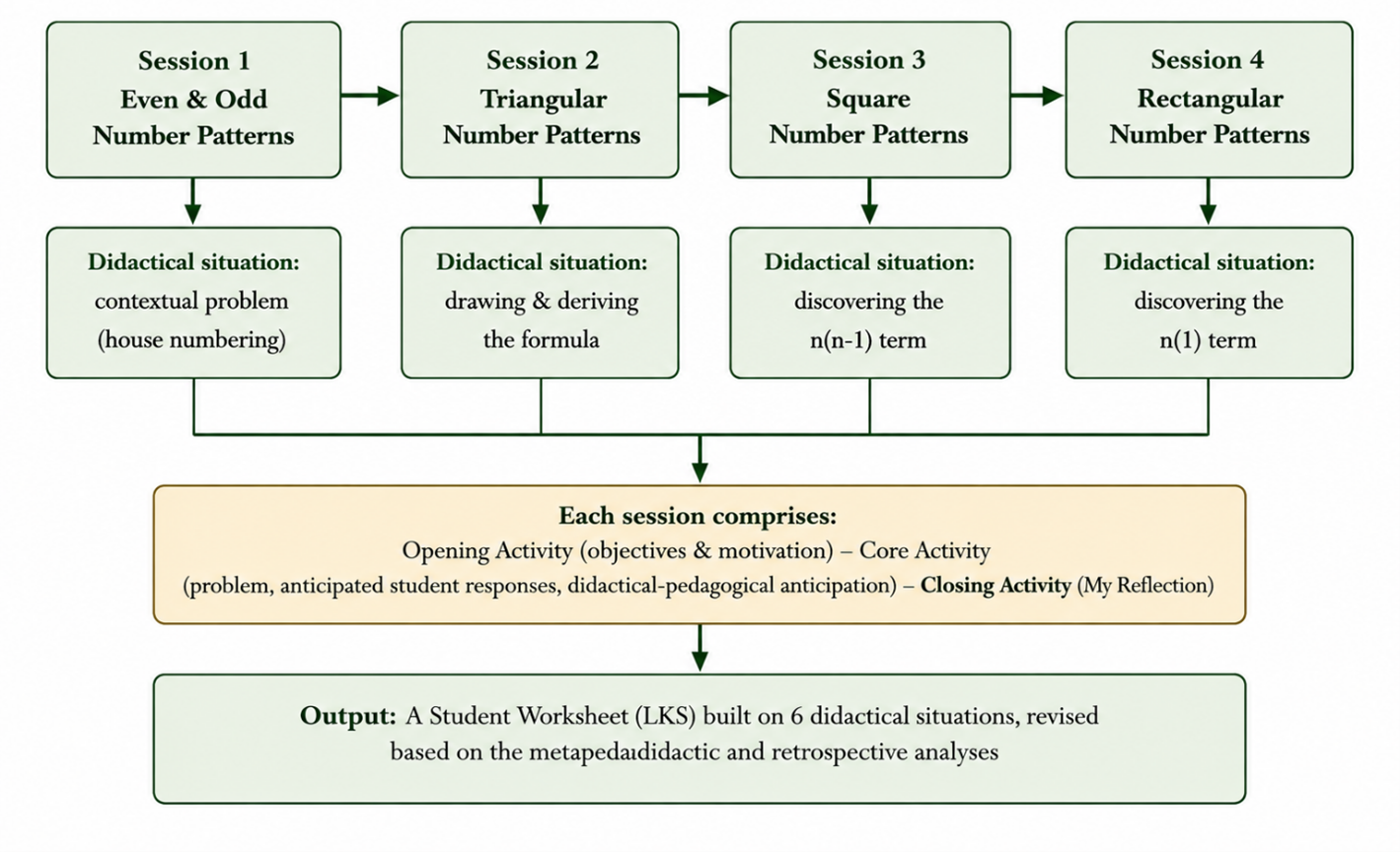
The concept of number patterns is an essential prerequisite for arithmetic sequences and series, yet a preliminary study of 15 eighth-grade students at SMP Islam Riyadhussolihin NW Bukit Tengger revealed that most students still experienced learning obstacles when solving problems on even-odd, triangular, square, and rectangular number patterns. This study aimed to identify the types of learning obstacles experienced by students, to design a hypothetical didactical design grounded in these findings, and to examine its effectiveness through classroom implementation. A qualitative approach using Didactical Design Research (DDR)—comprising prospective, metapedadidactic, and retrospective analysis—was employed. Data were collected through a learning-obstacle diagnostic test, classroom observation, and semi-structured interviews with selected students, then analysed using source and method triangulation. The findings revealed that the dominant obstacle was ontogenic-psychological in nature, reflected in students’ carelessness and haste in completing tasks, alongside conceptual obstacles related to the prerequisite concept of even and odd numbers. Based on these findings, a Hypothetical Learning Trajectory (HLT) comprising four sequential didactical situations, anticipated student responses, didactical-pedagogical anticipations, and a Student Worksheet (LKS) was developed. Implementation of the HLT reduced learning obstacles, although new difficulties emerged and were subsequently accommodated through a revised didactical design. This study contributes to enriching Didactical Design Research literature on number patterns while producing a classroom-ready instructional package for secondary mathematics teachers.
Downloads
References
Andini, R. I., Lidinillah, D. A. M., & Apriani, I. F. (2025). Desain didaktis pola bilangan di kelas IV sekolah dasar. Jurnal Ilmiah Profesi Pendidikan, 10(3), 2838–2851. https://doi.org/10.29303/jipp.v10i3.3640
Arigawati, N. H., & Kusnandi, K. (2021). Students critical thinking reviewed from field-dependent and field-independent on number pattern material. JTAM (Jurnal Teori dan Aplikasi Matematika), 5(1), 236–245. https://doi.org/10.31764/jtam.v5i1.3923
Astriani, L., Mujib, & Firmansyah. (2022). Didactic design for overcoming obstacles in mathematics of junior high school students. International Journal of Education Research Excellence, 1(1), 58–66. https://doi.org/10.55299/ijere.v1i1.97
Astuti, W., & Wijaya, A. (2020). Learning trajectory berbasis proyek pada materi definisi himpunan. Jurnal Riset Pendidikan Matematika, 7(2), 129–141. https://doi.org/10.21831/jrpm.v7i2.16483
Bahamonde, N. (2017). Mathematical modelling and the learning trajectory: Tools to support the teaching of linear algebra. International Journal of Mathematical Education in Science and Technology, 48(sup1), S66–S77. https://doi.org/10.1080/0020739X.2016.1241436
Chevallard, Y., & Bosch, M. (2020a). Didactic transposition in mathematics education. In S. Lerman (Ed.), Encyclopedia of Mathematics Education (2nd ed., pp. 214–218). Springer. https://doi.org/10.1007/978-94-007-4978-8_48
Chevallard, Y., & Bosch, M. (2020b). Anthropological theory of the didactic (ATD). In S. Lerman (Ed.), Encyclopedia of Mathematics Education (pp. 53–61). Springer. https://doi.org/10.1007/978-3-030-15789-0_100034
Contreras, J. N. (2025). Connecting procedural and conceptual knowledge. Mathematics Teacher: Learning and Teaching PK–12, 118(4), 250–252. https://doi.org/10.5951/MTLT.2025.0120
DeCaro, M. S. (2016). Inducing mental set constrains procedural flexibility and conceptual understanding in mathematics. Memory & Cognition, 44(7), 1138–1148. https://doi.org/10.3758/s13421-016-0614-y
Fauzan, A., & Diana, F. (2020). Learning trajectory for teaching number patterns using RME approach in junior high schools. Journal of Physics: Conference Series, 1470(1), 012019. https://doi.org/10.1088/1742-6596/1470/1/012019
Fauzan, A., Musdi, E., & Afriadi, J. (2018). A learning trajectory for teaching social arithmetic using RME approach. IOP Conference Series: Materials Science and Engineering, 335, 012121. https://doi.org/10.1088/1757-899X/335/1/012121
Fernández-Enríquez, R., & Delgado-Martín, L. (2020). Augmented reality as a didactic resource for teaching mathematics. Applied Sciences, 10(7), 2560. https://doi.org/10.3390/app10072560
Fuadiah, N. F., & Suryadi, D. (2019). Teaching and learning activities in classroom and their impact on student misunderstanding: A case study on negative integers. International Journal of Instruction, 12(1), 407–424. https://doi.org/10.29333/iji.2019.12127a
Garcia-Manrubia, B. (2024). Editorial: Advances in the contributions of mathematics in the field of education and psychology. Frontiers in Psychology, 15, 1379669. https://doi.org/10.3389/fpsyg.2024.1379669
Hasibuan, D. S., Parta, I. N., & Qohar, A. (2023). Profil penalaran induktif siswa SMP dalam memecahkan masalah numerasi pada materi pola bilangan. Aksioma: Jurnal Program Studi Pendidikan Matematika, 12(3), 3387–3395. https://doi.org/10.24127/ajpm.v12i3.7279
Hausberger, T. (2017). The (homo)morphism concept: Didactic transposition, meta-discourse and thematisation. International Journal of Research in Undergraduate Mathematics Education, 3(3), 417–443. https://doi.org/10.1007/s40753-017-0052-7
Helsa, Y., Juandi, D., & Turmudi. (2023). Computational thinking skills indicators in number patterns. Jurnal Pendidikan Matematika, 17(2), 167–188. https://doi.org/10.22342/jpm.17.2.20042.167-188
Hendriyanto, A., Suryadi, D., Juandi, D., Dahlan, J. A., Hidayat, R., Wardat, Y., Sahara, S., & Muhaimin, L. H. (2024). The didactic phenomenon: Deciphering students’ learning obstacles in set theory. Journal on Mathematics Education, 15(2), 517–544. https://doi.org/10.22342/jme.v15i2.pp517-544
Hidayat, W., & Suryadi, D. (2016). Didactical design research on students’ learning obstacles in mathematics. Infinity Journal, 5(2), 117–128. https://doi.org/10.22460/infinity.v5i2.p117-128
Jamilah, J., Priskila, P., & Oktaviana, D. (2024). Didactical design to overcome learning obstacles in cuboid volume. Jurnal Elemen, 10(2), 324–340. https://doi.org/10.29408/jel.v10i2.25244
Kiger, M. E., & Varpio, L. (2020). Thematic analysis of qualitative data: AMEE Guide No. 131. Medical Teacher, 42(8), 846–854. https://doi.org/10.1080/0142159X.2020.1755030
Larson, C. (2017). A hypothetical learning trajectory for conceptualizing matrices as linear transformations. International Journal of Mathematical Education in Science and Technology, 48(6), 809–829. https://doi.org/10.1080/0020739X.2016.1276225
Lundberg, A. L. V., & Kilhamn, C. (2018). Transposition of knowledge: Encountering proportionality in an algebra task. International Journal of Science and Mathematics Education, 16(3), 559–579. https://doi.org/10.1007/s10763-016-9781-3
Meika, I., Mulyanah, M., Sartika, N. S., & Sujana, A. (2025). Desain e-didaktis aljabar untuk mengatasi learning obstacle siswa MTs. SJME (Supremum Journal of Mathematics Education), 9(1), 103–115. https://doi.org/10.35706/sjme.v9i1.119
Pauji, I., Suryadi, D., Setambah, M. A. B. B., & Hendriyanto, A. (2023). Learning obstacle in the introduction to number: A critical study within didactical design research framework. Indonesian Journal of Science and Mathematics Education, 6(3), 430–451. https://doi.org/10.24042/ijsme.v6i3.19792
Pertiwi, C. M., Rohaeti, E. E., & Hidayat, W. (2020). The students’ mathematical problem-solving abilities, self-regulated learning, and VBA Microsoft Word in new normal: A development of teaching materials. Infinity Journal, 10(1), 17–30. https://doi.org/10.22460/infinity.v10i1.p17-30
Prabowo, I. (2022). Learning obstacles in the making of lesson plans by prospective mathematics teacher students. Education Research International, 2022, 2896860. https://doi.org/10.1155/2022/2896860
Prahmana, R. C. I. (2016). The hypothetical learning trajectory on research in mathematics education using research-based learning. Pedagogika, 123(3), 42–54. https://doi.org/10.15823/p.2016.32
Sartika, N. S., Sujana, A., & Fitriyani, G. (2022). Analisis kesulitan belajar matematika siswa pada pokok bahasan pola bilangan. SJME (Supremum Journal of Mathematics Education), 6(2), 203–209. https://doi.org/10.35706/sjme.v6i2.5702
Suryadi, D., Itoh, T., & Isnarto. (2023). A prospective mathematics teacher’s lesson planning: An in-depth analysis from the anthropological theory of the didactic. Journal on Mathematics Education, 14(4), 723–740. https://doi.org/10.22342/jme.v14i4.pp723-740
Susanta, A., Sumardi, H., Susanto, E., & Retnawati, H. (2023). Mathematics literacy task on number pattern using Bengkulu context for junior high school students. Journal on Mathematics Education, 14(1), 85–102. https://doi.org/10.22342/jme.v14i1.pp85-102
Sutarni, S., Sutama, S., Prayitno, H. J., Sutopo, A., & Laksmiwati, P. A. (2024). The development of realistic mathematics education-based student worksheets to enhance higher-order thinking skills and mathematical ability. Infinity Journal, 13(2), 285–300. https://doi.org/10.22460/infinity.v13i2.p285-300
Umasugi, S. M., Sugiman, S., Jana, P., & Kraiviset, P. (2022). Realistic mathematics education (RME)-based learning trajectory for arithmetic social using culinary context of Yogyakarta. Jurnal Kependidikan, 8(4). https://doi.org/10.33394/jk.v8i4.6176
Van den Heuvel-Panhuizen, M., & Drijvers, P. (2020). Realistic mathematics education. In S. Lerman (Ed.), Encyclopedia of Mathematics Education. Springer. https://doi.org/10.1007/978-3-030-15789-0_170
Yunianta, T. N. H., Suryadi, D., Dasari, D., & Herman, T. (2023). Textbook praxeological-didactical analysis: Lessons learned from the Indonesian mathematics textbook. Journal on Mathematics Education, 14(3), 503–524. https://doi.org/10.22342/jme.v14i3.pp503-524
Downloads
Published
How to Cite
Issue
Section
License
Copyright (c) 2025 Moh. Zaenudin Dedi Ismatullah, Muhamad Galang Isnawan, Abdul Aziz, Sudirman Sudirman, Riska Juniar Suprihatin

This work is licensed under a Creative Commons Attribution-ShareAlike 4.0 International License.