
Enhancing mathematical disposition and learning outcomes through Team Games Tournament: A two-cycle action research on probability instruction in indonesian secondary education
DOI:
https://doi.org/10.59965/pijme.v3i2.205Keywords:
Team Games Tournament, TGT, Mathematical Dispotition, Learning OutcomesAbstract
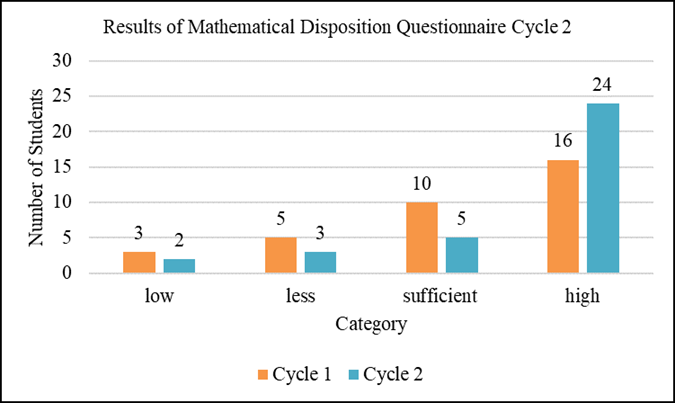
Despite growing recognition of mathematical disposition's importance for long-term STEM success, traditional teacher-centered instruction often fails to develop students' affective engagement, leading to mathematics anxiety and diminished self-efficacy. Team Games Tournament (TGT) offers a promising cooperative learning approach, yet systematic investigation of its effects on both cognitive and affective outcomes remains limited. This two-cycle action research investigated TGT implementation effects on probability learning outcomes and mathematical disposition across four NCTM dimensions: attention to accuracy and precision, perseverance in facing challenges, reflection and evaluation abilities, and openness to diverse strategies. Thirty-four Grade 10 students in Aceh, Indonesia, participated in seven-week TGT instruction following Kemmis and McTaggart's spiral model. Data collection employed validated achievement tests (α = 0.82) and mathematical disposition questionnaires (α = 0.89) at three time points, supplemented by classroom observations and field notes. Paired t-tests, effect size calculations, and chi-square analyses examined changes across baseline, Cycle 1, and Cycle 2. TGT implementation produced substantial improvements in achievement (M = 67.3 to 87.7; Cohen's d = 2.35) and mastery rates (32.4% to 88.2%). Mathematical disposition improved markedly, with high-disposition students increasing from 12% to 70%. Iterative refinements in Cycle 2 generated additional significant gains (d = 0.79), demonstrating cumulative benefits of sustained implementation. Dimension-specific analysis revealed differential growth patterns, with tournament structures rapidly developing accuracy attention while strategic flexibility required sustained exposure. Well-designed TGT implementation simultaneously enhances cognitive achievement and cultivates productive mathematical dispositions essential for 21st-century competencies, offering scalable approaches for transforming mathematics instruction in contexts where students exhibit low engagement.
Downloads
References
American Educational Research Association. (2011). Code of ethics. Educational Researcher, 40(3), 145-156. https://doi.org/10.3102/0013189X11410403
Amri, S., Zakaria, E., & Suryadi, D. (2022). The effect of Teams Games Tournament (TGT) learning model on mathematical problem solving ability. Journal of Physics: Conference Series, 2193(1), Article 012034. https://doi.org/10.1088/1742-6596/2193/1/012034
Asanre, A., Sondlo, A., & Adedeji, A. (2025). Evaluating the impact of the flipped classroom model on senior secondary students’ mathematics achievement: a quasi-experimental study in Nigeria. International Journal of Didactic Mathematics in Distance Education, 2(2), 128–140. https://doi.org/10.33830/ijdmde.v2i2.11774
Capinding, A. T. (2021). Effects of team game tournament in mathematics achievement and motivation of students. International Journal of Advance Research and Innovative Ideas in Education, 7(1), 1382-1392.
Capar, G., & Tarim, K. (2015). Efficacy of the cooperative learning method on mathematics achievement and attitude: A meta-analysis research. Educational Sciences: Theory & Practice, 15(2), 553-559. https://doi.org/10.12738/estp.2015.2.2098
Chan, S. W., & Idris, N. (2017). Cooperative learning in mathematics education. International Journal of Academic Research in Business and Social Sciences, 7(3), 539-553. https://doi.org/10.6007/IJARBSS/v7-i3/2758
Cohen, L., Manion, L., & Morrison, K. (2018). Research methods in education (8th ed.). Routledge.
Creswell, J. W. (2012). Educational research: Planning, conducting, and evaluating quantitative and qualitative research (4th ed.). Pearson.
Creswell, J. W., & Creswell, J. D. (2018). Research design: Qualitative, quantitative, and mixed methods approaches (5th ed.). SAGE Publications.
DeVellis, R. F. (2017). Scale development: Theory and applications (4th ed.). SAGE Publications.
DeVries, D. L., & Edwards, K. J. (1972). Learning games and student teams: Their effects on classroom process. Center for Social Organization of Schools, Johns Hopkins University.
Dimatacot, E. B., & Parangat, P. L. (2022). The effectiveness of cooperative learning on students' mathematics achievement and attitude. Journal of Educational Research and Practice, 12(1), 45-58.
Efron, S. E., & Ravid, R. (2020). Action research in education: A practical guide (2nd ed.). Guilford Press.
Fatihah, J. J., Sudirman, S., & Mellawaty, M. (2023). Improving geometric thinking skills through learning cycles assisted by interactive geometry books. International Journal of Mathematics and Sciences Education, 1(2), 81–85. https://doi.org/10.59965/ijmsed.v1i2.74
Farrell, T. S. C. (2019). Reflective practice in ELT. Routledge.
Fitriani, N., Suryadi, D., & Darhim, D. (2024). The effect of Teams Games Tournament learning model on students' mathematical communication ability. Journal of Mathematics Education, 9(1), 45-58.
Grootenboer, P., & Lomas, G. (2015). Affective perspectives on primary mathematics education. In X. Sun, B. Kaur, & J. Novotná (Eds.), The proceedings of the ICMI study 23: Primary mathematics study on whole numbers (pp. 447-454). University of Macau.
Haladyna, T. M., & Rodriguez, M. C. (2013). Developing and validating test items. Routledge.
Hannula, M. S., Di Martino, P., Pantziara, M., Zhang, Q., Morselli, F., Heyd-Metzuyanim, E., Lutovac, S., Kaasila, R., Middleton, J. A., Jansen, A., & Goldin, G. A. (2016). Attitudes, beliefs, motivation and identity in mathematics education: An overview of the field and future directions (ICME-13 Topical Surveys). Springer. https://doi.org/10.1007/978-3-319-32811-9
Haris, D., & Abadi, A. M. (2013). Keefektifan model pembelajaran TGT dan TAI ditinjau dari prestasi belajar, kemampuan berpikir kreatif dan sikap siswa terhadap matematika [The effectiveness of TGT and TAI learning models in terms of learning achievement, creative thinking ability and students' attitudes towards mathematics]. Pythagoras: Jurnal Pendidikan Matematika, 8(2), 149-158. https://doi.org/10.21831/pg.v8i2.8499
Hattie, J. (2009). Visible learning: A synthesis of over 800 meta-analyses relating to achievement. Routledge.
Jabaka, J. M. (2025). Vygotsky's social constructivism and cooperative learning in mathematics education. Journal of Educational Theory and Practice, 10(1), 23-35.
Karlsson, N., Ajagbe, S., & Ghith, E. (2020). Cooperative learning and mathematical perseverance: Effects of heterogeneous grouping. Scandinavian Journal of Educational Research, 64(3), 412-428.
Kazak, S., Fujita, T., & Turmo, M. P. (2015). Students' informal statistical inferences through data modeling. In A. Zieffler & E. Fry (Eds.), Reasoning about uncertainty: Learning and teaching informal inferential reasoning (pp. 34-58). Springer.
Kemmis, S., & McTaggart, R. (1988). The action research planner (3rd ed.). Deakin University Press.
Kemmis, S., McTaggart, R., & Nixon, R. (2014). The action research planner: Doing critical participatory action research. Springer.
Kilpatrick, J., Swafford, J., & Findell, B. (Eds.). (2001). Adding it up: Helping children learn mathematics. National Academy Press.
Klang, N., Olsson, I., Wilder, J., Lindqvist, G., Fohlin, N., & Nilholm, C. (2020). A cooperative learning intervention to promote social inclusion in heterogeneous classrooms. Frontiers in Psychology, 11, Article 586489. https://doi.org/10.3389/fpsyg.2020.586489
McNiff, J. (2017). Action research: All you need to know. SAGE Publications.
Mertler, C. A. (2021). Action research: Improving schools and empowering educators (6th ed.). SAGE Publications.
Middleton, J. A., & Jansen, A. (2011). Motivation matters and interest counts: Fostering engagement in mathematics. National Council of Teachers of Mathematics.
Mills, G. E., & McAteer, M. (2020). Action research in education: A practical guide (2nd ed.). SAGE Publications.
Ministry of Education, Culture, Research, and Technology. (2022). Kurikulum Merdeka: Panduan pembelajaran dan asesmen [Independent curriculum: Learning and assessment guidelines]. Kementerian Pendidikan, Kebudayaan, Riset, dan Teknologi Republik Indonesia.
National Council of Teachers of Mathematics. (2000). Principles and standards for school mathematics. NCTM.
Netemeyer, R. G., Bearden, W. O., & Sharma, S. (2003). Scaling procedures: Issues and applications. SAGE Publications.
Muhardiffa, A., Zaura, B., & Elizar, E. (2025). Gamifying fractions: the development of ’fraction heroes’ for junior high learners. Polyhedron International Journal in Mathematics Education, 3(1), 55–66. https://doi.org/10.59965/pijme.v3i1.175
Nuraina, N. (2013). Pengaruh model pembelajaran kooperatif tipe TGT terhadap disposisi matematis siswa [The effect of TGT type cooperative learning model on students' mathematical disposition]. Prosiding Seminar Nasional Matematika dan Pendidikan Matematika, 978-979.
Organisation for Economic Co-operation and Development. (2019). PISA 2018 results (Volume I): What students know and can do. OECD Publishing. https://doi.org/10.1787/5f07c754-en
Prada Núñez, R., Hernández Suárez, C. A., & Avendaño Castro, W. R. (2023). The affective domain in mathematics education: A systematic review. Journal of Mathematics Education Research, 15(2), 123-145.
Rani, S. (2022). Improving mathematics learning outcomes through Teams Games Tournament (TGT) cooperative learning model. Journal of Educational Research and Evaluation, 6(2), 234-242.
Rasch, T., Schnotz, W., & Hanze, M. (2020). Fostering mathematical disposition through problem-based learning. Educational Psychology Review, 32(4), 985-1005. https://doi.org/10.1007/s10648-020-09542-x
Ridwan, R., Zulkardi, Z., & Darmawijoyo, D. (2022). Meta-analysis of cooperative learning effects on mathematics achievement in Indonesia. Indonesian Journal of Mathematics Education, 5(1), 34-48.
Riansyah, F., Suherman, S., & Rohaeti, E. E. (2023). The implementation of Teams Games Tournament to improve students' mathematical understanding and self-efficacy. Infinity Journal, 12(1), 89-102. https://doi.org/10.22460/infinity.v12i1.p89-102
Sadeghi, K., Barzegar, K., & Valizadeh, M. (2021). The relationship between traditional teaching methods and mathematics anxiety: A longitudinal study. Educational Research Review, 33, Article 100394. https://doi.org/10.1016/j.edurev.2021.100394
Salam, A., Hossain, A., & Rahman, S. (2015). Effects of using Teams Games Tournaments (TGT) cooperative technique for learning mathematics in secondary schools of Bangladesh. Malaysian Online Journal of Educational Technology, 3(3), 1-11.
Schoenfeld, A. H. (2016). Learning to think mathematically: Problem solving, metacognition, and sense making in mathematics. Journal of Education, 196(2), 1-38. https://doi.org/10.1177/002205741619600202
Schön, D. A. (1983). The reflective practitioner: How professionals think in action. Basic Books.
Siller, H., & Ahmad, J. (2024). Mathematics anxiety and its relationship with teaching approaches: An international perspective. International Journal of Science and Mathematics Education, 22(1), 145-162.
Slavin, R. E. (2011). Cooperative learning. In R. Mayer & P. Alexander (Eds.), Learning and cognition in education (pp. 160-166). Elsevier. https://doi.org/10.1016/B978-0-12-387691-1.00033-5
Solihah, A. (2016). Pengaruh model pembelajaran Teams Games Tournament (TGT) terhadap hasil belajar matematika [The effect of Teams Games Tournament (TGT) learning model on mathematics learning outcomes]. SAP (Susunan Artikel Pendidikan), 1(2), 121-130.
Sudirman, S., Mellawaty, M., Yaniawati, P., & Indrawan, R. (2021). Augmented reality application: What are the constraints and perceptions of the students during the covid 19 pendemic’s 3D geometry learning process?. In Journal of Physics: Conference Series (Vol. 1783, No. 1, p. 012007). IOP Publishing.
Sudirman, S., Rodríguez-Nieto, C. A. ., & Bonyah, E. (2024). Integrating ethnomathematics and ethnomodeling in Institutionalization of school mathematics concepts: A study of fishermen community activities. Journal on Mathematics Education, 15(3), 835–858. https://doi.org/10.22342/jme.v15i3.pp835-858
Stringer, E. T. (2014). Action research (4th ed.). SAGE Publications.
Taber, K. S. (2018). The use of Cronbach's alpha when developing and reporting research instruments in science education. Research in Science Education, 48(6), 1273-1296. https://doi.org/10.1007/s11165-016-9602-2
Taufan, M., Dejarlo, J. O., Rosa, A. J., Hidayat, R., & Sunanto, E. (2024). Involving students and prospective mathematics teachers through the use of the Think Pair Share design: The impact on increasing students’ activeness and learning outcomes in plane geometry. International Journal of Didactic Mathematics in Distance Education, 1(1), 47–53. https://doi.org/10.33830/ijdmde.v1i1.7876
Tavakol, M., & Dennick, R. (2011). Making sense of Cronbach's alpha. International Journal of Medical Education, 2, 53-55. https://doi.org/10.5116/ijme.4dfb.8dfd
Vankúš, P. (2021). Affective factors in mathematics education: The role of emotions, attitudes, and beliefs. European Journal of Contemporary Education, 10(1), 209-225.
Vygotsky, L. S. (1978). Mind in society: The development of higher psychological processes. Harvard University Press.
Worthington, R. L., & Whittaker, T. A. (2006). Scale development research: A content analysis and recommendations for best practices. The Counseling Psychologist, 34(6), 806-838. https://doi.org/10.1177/0011000006288127
Wright, T. (2020). Schön's reflective practice model and teacher development. Professional Development in Education, 46(2), 234-247.
Yahya, A., & Bakri, F. (2019). The effectiveness of Teams Games Tournament on students' mathematics achievement in junior high school. Journal of Physics: Conference Series, 1185(1), Article 012076. https://doi.org/10.1088/1742-6596/1185/1/012076
Yin, R. K. (2018). Case study research and applications: Design and methods (6th ed.). SAGE Publications.
Downloads
Published
How to Cite
Issue
Section
License
Copyright (c) 2025 Cintya Mayangsari, Abd. Qohar, Nurul Faridhac

This work is licensed under a Creative Commons Attribution-ShareAlike 4.0 International License.


