
Enhancing mathematical communication and learning independence through learning cycle 6E model with dynamic geometry software: A study of vocational high school students
DOI:
https://doi.org/10.59965/pijme.v3i2.262Keywords:
Learning Cycle 6E, Dynamic Geometry Software, Mathematical communication, Vocational educationAbstract
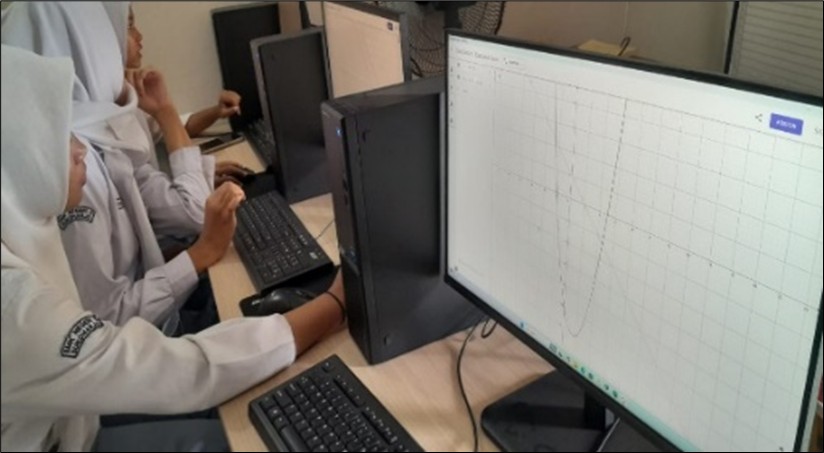
Mathematical communication ability and learning independence are essential 21st-century competencies that remain underdeveloped in vocational mathematics education, where students often perceive mathematics as irrelevant to their careers. This quasi-experimental study investigated the effectiveness of integrating the Learning Cycle 6E model with Dynamic Geometry Software (GeoGebra) in improving these competencies among vocational high school students. Sixty-nine tenth-grade students from the Marketing Skills Program were assigned to experimental (n=35) and control (n=34) groups through random sampling. The experimental group received instruction using the six-phase Learning Cycle 6E model (engage, explore, explain, elaborate, evaluate, extend) integrated with GeoGebra, while the control group received conventional expository instruction. Data were collected through mathematical communication tests and learning independence questionnaires administered as pretest and posttest. Normalized gain (N-Gain) analysis was employed to measure improvement effectiveness. Results demonstrated that the experimental group achieved significantly higher improvement in mathematical communication ability (N-Gain = 0.62) compared to the control group (N-Gain = 0.44), representing a 40.9% advantage. Similarly, learning independence improved significantly more in the experimental group (N-Gain = 0.51) versus the control group (N-Gain = 0.26), nearly doubling the control group's gain. Statistical analyses confirmed both differences were significant (p < 0.05) with large effect sizes. These findings provide empirical evidence that integrating constructivist pedagogy with dynamic technology effectively enhances both cognitive and metacognitive competencies in vocational mathematics education, offering a practical framework for revitalizing mathematics instruction to meet contemporary educational demands and career-relevant applications.
Downloads
References
Alam, M. A. (2023). From teacher-centered to student-centered learning: The role of constructivism and connectivism in pedagogical transformation. Journal of Education, 11(2), 154-167.
Arnanda, A. N., Dafik, D., Oktavianingtyas, E., Harmi, H., & Firmani, I. (2021). Analisis penerapan media pembelajaran geogebra dalam mengembangkan kemampuan komunikasi matematis siswa pokok bahasan sistem persamaan linier dua variabel. Journal of Mathematics Education and Learning, 1(1), 38-50. https://doi.org/10.19184/jomeal.v1i1.24374
Bahariniya, S., Ezatiasar, M., & Madadizadeh, F. (2021). A brief review of the types of validity and reliability of scales in medical research. Journal of Community Health Research, 10(2), 100-102. https://jhr.ssu.ac.ir/article-1-722-en.pdf
Diyyab, E. S., & Aly, E. (2021). A suggested program based on 7E instructional model and AWE systems to develop faculty of education ESP students' academic writing skills. Journal of Education-Sohag University, 88.
Emanet, E. A., & Kezer, F. (2021). The effects of student-centered teaching methods used in mathematics courses on mathematics achievement, attitude, and anxiety: A meta-analysis study. Participatory Educational Research, 8(2), 240-259.
Fahlevi, R., & Yuliani, A. (2021). Pengembangan game edukasi cermat berbasis android untuk meningkatkan keterampilan problem solving siswa SMA pada materi barisan dan deret geometri. JPMI (Jurnal Pembelajaran Matematika Inovatif), 4(5), 1191-1204. https://doi.org/10.22460/jpmi.v4i5.p%25p
Fata, I. A., Komariah, E., & Alya, A. R. (2022). Assessment of readability level of reading materials in Indonesia EFL textbooks. Lingua Cultura, 16(1), 97-104. https://doi.org/10.21512/lc.v16i1.8277
Firmansyah, D., & Dede. (2022). Teknik pengambilan sampel umum dalam metodologi. Jurnal Ilmiah Pendidikan Holistik (JIPH), 1(2), 85-114. https://sl1nk.com/kqulz
Heryadi, D., & Sundari, R. S. (2020). Expository learning model. International Journal of Education and Research, 8(1), 207-216.
Hudu, A., Kwakye, D. O., Bornaa, C. S., Churcher, K. A., & Atepor, S. (2023). Students' performance and ICT capabilities in quadratic functions using GeoGebra. Applied Sciences, 2(1), 219-231. https://core.ac.uk/reader/603903670
Illene, S., Feranie, S., & Siahaan, P. (2023). Create multiple-choice tests based on experimental activities to assess students' 21st century skills in the heat and heat transfer topic. Journal of Education and Learning (EduLearn), 17(1), 44-57. https://doi.org/10.11591/edulearn.v17i1.20540
Khasanah, U., & Nugraheni, E. A. (2022). Analisis minat belajar matematika siswa kelas VII pada materi segiempat berbantuan aplikasi geogebra di SMP Negeri 239 Jakarta. Jurnal Cendekia: Jurnal Pendidikan Matematika, 6(1), 181-190. https://doi.org/10.31004/cendekia.v6i1.813
Losada, R. J. R. (2021). High school mathematics teachers' learning experiences, during a professional development intervention to improve their understanding of linear and quadratic functions using GeoGebra [Doctoral dissertation, University of Stellenbosch]. CORE. https://core.ac.uk/reader/420305420
Makwana, D., Engineer, P., Dabhi, A., & Chudasama, H. (2023). Sampling methods in research: A review. International Journal of Trend in Scientific Research and Development, 7(3), 762-768. https://www.ijtsrd.com/papers/ijtsrd57470.pdf
Mallini, P. S., Purba, S. C., & Sihotang, H. (2023). Meningkatkan kemampuan pemahaman matematis melalui model problem based learning menggunakan software geogebra dan dampaknya terhadap kemandirian belajar siswa SMK. VOCATIONAL: Jurnal Inovasi Pendidikan Kejuruan, 1(1), 48-57. https://doi.org/10.51878/vocational.v1i1.81
Maryani, E. (2021). Meningkatkan kemampuan pemahaman matematis melalui model problem based learning menggunakan software geogebra dan dampaknya terhadap kemandirian belajar siswa SMK. VOCATIONAL: Jurnal Inovasi Pendidikan Kejuruan, 1(1), 48-57. https://doi.org/10.51878/vocational.v1i1.81
Maulyda, M. A. (2020). Paradigma pembelajaran matematika berbasis NCTM. CV IRDH.
Nissa, N. K., Ridhani, A. R., & Prasetia, M. E. (2024). The effectiveness of group guidance services based on Banjar oral culture in improving students' politeness behavior. Indonesian Journal of Guidance and Counseling Studies, 1(2), 52-64. https://doi.org/10.64420/ijgcs.v1i2.28
Pandian, V., Awang, M., Ishak, R., & Ming, G. K. (2023). Validity and reliability of organizational trust instrument. Development, 12(2), 84-96. http://dx.doi.org/10.6007/IJARPED/v12-i2/16564
Putri, A. D., Ahman, A., Hilmia, R. S., Almaliyah, S., & Permana, S. (2023). Pengaplikasian uji t dalam penelitian eksperimen. Jurnal Lebesgue: Jurnal Ilmiah Pendidikan Matematika, Matematika dan Statistika, 4(3), 1978-1987. https://doi.org/10.46306/lb.v4i3.527
Rahmy, S. N., Usodo, B., & Slamet, I. (2020). Students' mathematical communication ability using 7E learning cycle based on students thinking style. Journal of Physics: Conference Series, 1469(1), Article 012154. https://doi.org/10.1088/1742-6596/1469/1/012154
Ramesh, S. (2022). The theories of cognitive development. In The political economy of human behaviour and economic development: Psychology and economic development (pp. 143-180). Springer International Publishing. https://link.springer.com/chapter/10.1007/978-3-031-12666-6_4
Sholikha, D. I., & Siswono, T. Y. E. (2023). Analisis berpikir kritis siswa SMP dalam memecahkan masalah segitiga berbantuan geogebra. MATHEdunesa, 12(3), 982-996. https://doi.org/10.26740/mathedunesa.v12n3.p982-996
Sudirman, S., Kusumah, Y. S., & Martadiputra, B. A. P. (2022). The impact of 3D geometry assisted 6E instructional model to improve 3D geometry thinking skills of junior high school students. Jurnal Pendidikan MIPA, 23(1), 45-56. http://dx.doi.org/10.23960/jpmipa/v23i1.pp45-56
Sun, X. (2023). Enhancing teaching quadratic functions: The benefits, challenges, and recommendations of using GeoGebra. Academic Journal of Mathematical Sciences, 4(5), 23-30. https://doi.org/10.25236/AJMS.2023.040504
Suriani, N., & Jailani, M. S. (2023). Konsep populasi dan sampling serta pemilihan partisipan ditinjau dari penelitian ilmiah pendidikan. IHSAN: Jurnal Pendidikan Islam, 1(2), 24-36. https://doi.org/10.61104/ihsan.v1i2.55
Downloads
Published
How to Cite
Issue
Section
License
Copyright (c) 2025 Dian Mustikaningsih, Yumiati Yumiati, Sudirman Sudirman

This work is licensed under a Creative Commons Attribution-ShareAlike 4.0 International License.


