
Development of pose estimation machine learning media to introduce two-dimensional shapes
DOI:
https://doi.org/10.59965/ijmsed.v1i1.6Keywords:
Pose Estimation Machine Learning, Two-Dimensional Shapes, Young LearnersAbstract
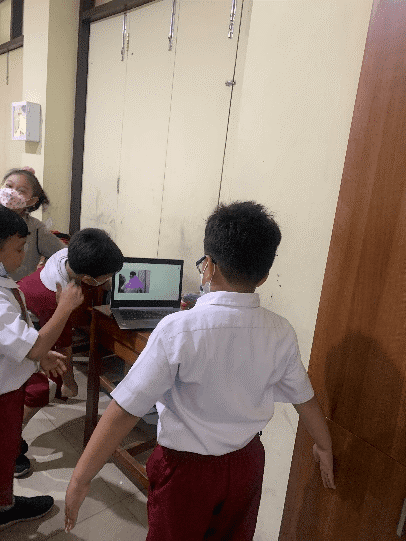
Most of the students needed help comprehending the geometry material concepts provided by the teacher. Learning media is one aspect that influences students' comprehension of geometry concepts. With the current situation, the use of the learning media such as pictures in a book or color-shaped paper does not relevant anymore. This project aims for a valid two-dimensional learning media, Pose Estimation Machine Learning (PEML), following students' characteristics and cognitive development. The developed online media facilitates visuals and allows students to move and perform motoric activities to represent the shapes. The method of the research was by using adjusted R&D steps: 1) preliminary investigation, 2) design, 3) realization, 4) test, evaluation, and revision, and 5) implementation. The participants of this study are second-grade students in a private elementary school in Central Jakarta. Data from the observation, students' worksheets, and interviews show that students were enthusiastic during the learning while they could still achieve the learning outcomes. The result indicates that PEML can be a medium for introducing two-dimensional topics.
References
Akpan, B., & Kennedy, T. (2020). Science education in theory and practice: an introductory guide to learning theory. Editorial: Cham, Switzerland Springer.
Ausubel, D. (1963). The psychology of meaningful verbal learning. New York: Grune & Stratton.
Brown, H. D. (2001). Teaching by Principles: An Interactive Approach to Language Pedagogy 2nd Edition. New York: Addison Wesley Longman, Inc.
Clements, D. H., and Sarama, J. (2011). Early childhood teacher education: The case of geometry. J. Math. Teach. Educ. 14, 133–148. doi: 10.1007/s10857-011- 9173-0
HAKI, O. (2007) Pembelajaran Berdasarkan Tahap Belajar Van Hiele Untuk Membantu Pemahaman Siswa SD dalam Konsep Geometri Datar. Unpublished thesis, PPS UPI.
Highfield, K., & Mulligan, J. (2007). The Role of Dynamic Interactive Technological Tools in Preschoolers’ Mathematical Patterning. In J. Watson & K. Beswick (Eds), Proceedings of the 30th annual conference of the Mathematics Education Research Group of Australasia (pp. 372–381). MERGA.
Hoffer, A. (1983). Van Hiele based research. In R. Lesh & M. Landau (Eds.), Acquisition of mathematical concepts and processes (pp. 205-228). New York, NY: Academic Press.
NUR’AENI, E. (2000) Model Pembelajaran Untuk Memahami Konsep Unsur-unsur Bangun Ruang Kubus dan Balok Berdasarkan Kesalahan Siswa Kelas V 9 Sekolah Dasar. Unpublished thesis, Pascasarjana Universitas Negeri Malang
Plomp, T. (2010). Educational Design Research: An Introduction. Netherlands: www.slo.nl.
Prensky, M. (2001). Digital Game-Based Learning. New York: McGraw Hill.
Rosiyanti, H., Eminita, V., & Riski, R. (2020). Desain Media Pembelajaran Geometri Ruang Berbasis Powtoon. FIBONACCI: Jurnal Pendidikan Matematika Dan Matematika, 6(1), 77 – 86. https://dx.doi.org/10.24853/fbc.6.1.77-86.
Sabil, H., Asrial, A., Syahrial, S., Robiansah, M. A., Zulkhi, M. D., Damayanti, L., Kiska, N., Silvia, N., & Ubaidillah, U. (2021). Online Geoboard Media Improves Understanding of Two-dimensional Flat Shape Concepts in Elementary School Students. International Journal of Elementary Education, 5(4), 685. https://doi.org/10.23887/ijee.v5i4.41785
Sinclair, N., de Freitas, E., & Ferrara, F. (2013). Virtual encounters: the murky and furtive world of mathematical inventiveness. ZDM—The International Journal on Mathematics Education, 45(2), 239–252.
Sinclair, N., & Moss, J. (2012). The more it changes, the more it becomes the same: the development of the routine of shape identification in dynamic geometry environments. International Journal of Education Research, 51&52, 28–44.
Timky, L. (2007). Method of Teaching Geometry in schools. The practice of Teaching perspective and strategies. Jos: Lecaps publisher Jos.
Van Hiele, P. M. (1984). English summary. [The problem of insight in connection with school children's insight into the subject matter of geometry.] In D. Fuys, D. Geddes, & R. Tischler (Eds. & Trans.), English translations of selected writings of Dina van Hiele-Geldorf and Pierre M. van Hiele (pp. 237-241). Columbus, OH: ERIC Information Analysis Center for Science, Mathematics, and Environmental Education. (ERIC Document Reproduction Service No. ED 287 697)
Van Hiele, P. M. (1986). Structure and insight: A theory of mathematics education. Orlando, FL: Academic Press.
Vojkuvkova. (2012). The Van Hiele Model of Geometric Thinking. WDS’12 Proceedings of Contributed Papers, (pp. 72-75). Prague, Czech Republic.
Widiasih, R., Widodo, J., & Kartini, T. (2018). Pengaruh Penggunaan Media Bervariasi dan Motivasi Belajar Terhadap Hasil Belajar Mata Pelajaran Ekonomi Siswa Kelas XI IPS SMA Negeri 2 Jember Tahun Pelajaran 2016/2017. JURNAL PENDIDIKAN EKONOMI: Jurnal Ilmiah Ilmu Pendidikan, Ilmu Ekonomi Dan Ilmu Sosial, 11(2), 103. https://doi.org/10.19184/jpe.v11i2.6454
Wu, D. & Ma, H. (2006). The Distributions of Van Hiele levels of Geometric Thinking Among 1st Through 6th Graders. Proceedings 30th Conference of the International Group for the Psychology of Mathematics Education, 5, 409-416.
Downloads
Published
How to Cite
Issue
Section
License
Copyright (c) 2023 Stevani Rebekka Saulina Manik, Desyarti Safarini TLS, Arya Harditya

This work is licensed under a Creative Commons Attribution-ShareAlike 4.0 International License.


