
Prompting for products more than pedagogy: Prompt styles of elementary school teachers generating plane-figure questions with ChatGPT
DOI:
https://doi.org/10.59965/pijme.v5i1.366Keywords:
ChatGPT, Elementary school teachers, Prompt engineering, Question generation, Teacher professional developmentAbstract
Background: Teachers increasingly use ChatGPT to generate mathematics questions, yet their prompting and verification practices remain poorly understood.
Purpose: This study examined elementary teachers’ prompting styles and verification practices when generating plane-figure questions with ChatGPT.
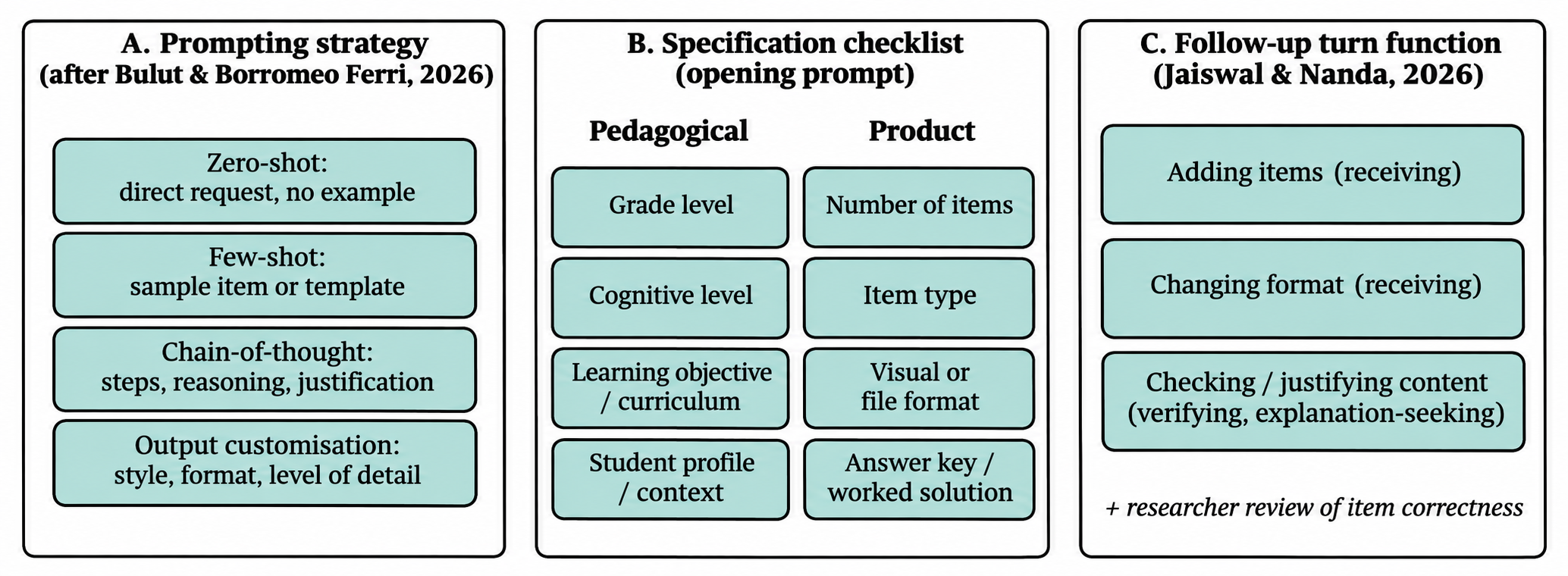
Method: Ten teachers from one public school in Depok, Indonesia, participated in a single session. Conversations underwent content analysis using four prompting strategies, eight specification elements, and follow-up classifications. Prompt profiles were derived through explicit rules, and generated items were reviewed for mathematical correctness.
Results: Nine opening prompts were analysable. All were brief, imperative, and zero-shot, with a median length of 14 words. Output customisation mainly concerned quantity, question type, and format. Only three prompts specified grade level and three specified cognitive level; none included learning objectives, student profiles, or examples. Four follow-up requests concerned additional items or formatting, without requesting verification or justification. One of ten fully reviewed multiple-choice items lacked a correct option. Four profiles emerged: level-labelled specification, format-focused, open delegation, and answer-key oriented.
Implications: Professional development should strengthen pedagogical specification and verification of AI-generated questions.
Contribution: The study identifies four prompting profiles and proposes a specify–generate–verify–revise cycle to support teachers’ critical engagement with ChatGPT, although its effectiveness remains untested.
Downloads
References
Almarashdi, H. S., Jarrah, A. M., Abu Khurma, O., & Gningue, S. M. (2024). Unveiling the potential: A systematic review of ChatGPT in transforming mathematics teaching and learning. Eurasia Journal of Mathematics, Science and Technology Education, 20(12), Article em2555. https://doi.org/10.29333/ejmste/15739
Braskén, M., Berts, K.-E., Wallin, S., & Frilund, S. (2025). Students' use of ChatGPT in an algebra class: A case study of prompts and attitudes. LUMAT, 13(1), Article 16. https://doi.org/10.31129/LUMAT.13.1.2877
Bulut, N., & Borromeo Ferri, R. (2026). AI-powered learning: Exploring secondary school students' use of ChatGPT for solving mathematical modelling problems. ZDM – Mathematics Education, 58, 993–1009. https://doi.org/10.1007/s11858-026-01803-6
Cain, W. (2024). Prompting change: Exploring prompt engineering in large language model AI and its potential to transform education. TechTrends, 68(1), 47–57. https://doi.org/10.1007/s11528-023-00896-0
Celik, I. (2023). Towards Intelligent-TPACK: An empirical study on teachers' professional knowledge to ethically integrate artificial intelligence (AI)-based tools into education. Computers in Human Behavior, 138, Article 107468. https://doi.org/10.1016/j.chb.2022.107468
Celik, I., Dindar, M., Muukkonen, H., & Järvelä, S. (2022). The promises and challenges of artificial intelligence for teachers: A systematic review of research. TechTrends, 66(4), 616–630. https://doi.org/10.1007/s11528-022-00715-y
Dasari, D., Hendriyanto, A., Sahara, S., Suryadi, D., Muhaimin, L. H., Chao, T., & Fitriana, L. (2024). ChatGPT in didactical tetrahedron, does it make an exception? A case study in mathematics teaching and learning. Frontiers in Education, 8, Article 1295413. https://doi.org/10.3389/feduc.2023.1295413
Elo, S., & Kyngäs, H. (2008). The qualitative content analysis process. Journal of Advanced Nursing, 62(1), 107–115. https://doi.org/10.1111/j.1365-2648.2007.04569.x
Feng, S. (2025). Group interaction patterns in generative AI-supported collaborative problem solving: Network analysis of the interactions among students and a GAI chatbot. British Journal of Educational Technology, 56, 2125–2145. https://doi.org/10.1111/bjet.13611
Getenet, S. (2024). Pre-service teachers and ChatGPT in multistrategy problem-solving: Implications for mathematics teaching in primary schools. International Electronic Journal of Mathematics Education, 19(1), Article em0766. https://doi.org/10.29333/iejme/14141
Güner, H., & Er, E. (2025). AI in the classroom: Exploring students' interaction with ChatGPT in programming learning. Education and Information Technologies, 30, 12681–12707. https://doi.org/10.1007/s10639-025-13337-7
Gurl, T. J., Markinson, M. P., & Artzt, A. F. (2025). Using ChatGPT as a lesson planning assistant with preservice secondary mathematics teachers. Digital Experiences in Mathematics Education, 11, 114–139. https://doi.org/10.1007/s40751-024-00162-9
Jaiswal, A., & Nanda, G. (2026). More than getting the answer: How students engage with generative AI in technical problem solving. International Journal of STEM Education, 13, Article 58. https://doi.org/10.1186/s40594-026-00646-7
Kasneci, E., Seßler, K., Küchemann, S., Bannert, M., Dementieva, D., Fischer, F., Gasser, U., Groh, G., Günnemann, S., Hüllermeier, E., Krusche, S., Kutyniok, G., Michaeli, T., Nerdel, C., Pfeffer, J., Poquet, O., Sailer, M., Schmidt, A., Seidel, T., … Kasneci, G. (2023). ChatGPT for good? On opportunities and challenges of large language models for education. Learning and Individual Differences, 103, Article 102274. https://doi.org/10.1016/j.lindif.2023.102274
Kim, J., Lee, H., & Cho, Y. H. (2022). Learning design to support student-AI collaboration: Perspectives of leading teachers for AI in education. Education and Information Technologies, 27, 6069–6104. https://doi.org/10.1007/s10639-021-10831-6
Klar, M. (2025). Using ChatGPT is easy, using it effectively is tough? A mixed methods study on K-12 students' perceptions, interaction patterns, and support for learning with generative AI chatbots. Smart Learning Environments, 12, Article 32. https://doi.org/10.1186/s40561-025-00385-2
Knoth, N., Tolzin, A., Janson, A., & Leimeister, J. M. (2024). AI literacy and its implications for prompt engineering strategies. Computers and Education: Artificial Intelligence, 6, Article 100225. https://doi.org/10.1016/j.caeai.2024.100225
Kock, Z.-J., Salinas-Hernández, U., & Pepin, B. (2025). Engineering students' initial use schemes of ChatGPT as an instrument for learning. Digital Experiences in Mathematics Education, 11, 192–218. https://doi.org/10.1007/s40751-025-00169-w
Liu, J., Keane, T., Sun, D., Yang, Y., & Yang, Y. (2025). Design and evaluation of ChatGPT-MWPS: An AI-enhanced learning system for improving primary students' mathematical word problem solving. Smart Learning Environments, 12, Article 68. https://doi.org/10.1186/s40561-025-00419-9
Lo, C. K. (2023). What is the impact of ChatGPT on education? A rapid review of the literature. Education Sciences, 13(4), Article 410. https://doi.org/10.3390/educsci13040410
McGalliard, W., & Otten, S. (2025). AI responses to challenging problems and educator responses to AI availability. Digital Experiences in Mathematics Education, 11, 319–332. https://doi.org/10.1007/s40751-024-00167-4
Mishra, P., Warr, M., & Islam, R. (2023). TPACK in the age of ChatGPT and generative AI. Journal of Digital Learning in Teacher Education, 39(4), 235–251. https://doi.org/10.1080/21532974.2023.2247480
Monike, R. S., Sudirman, S., Kandaga, T., & Rodríguez-Nieto, C. A. (2026). Effectiveness of ChatGPT-integrated discovery learning on mathematical literacy in three-variable linear equation systems: A quasi-experimental study. International Journal of Didactic Mathematics in Distance Education, 3(1), 64–82. https://doi.org/10.33830/ijdmde.v3i1.13157
Ng, D. T. K., Leung, J. K. L., Chu, S. K. W., & Qiao, M. S. (2021). Conceptualizing AI literacy: An exploratory review. Computers and Education: Artificial Intelligence, 2, Article 100041. https://doi.org/10.1016/j.caeai.2021.100041
Ng, D. T. K., Tan, C. W., & Leung, J. K. L. (2024). Empowering student self-regulated learning and science education through ChatGPT: A pioneering pilot study. British Journal of Educational Technology, 55, 1328–1353. https://doi.org/10.1111/bjet.13454
Noster, N., Gerber, S., & Siller, H.-S. (2024). Pre-service teachers' approaches in solving mathematics tasks with ChatGPT. Digital Experiences in Mathematics Education, 10, 543–567. https://doi.org/10.1007/s40751-024-00155-8
Pardos, Z. A., & Bhandari, S. (2024). ChatGPT-generated help produces learning gains equivalent to human tutor-authored help on mathematics skills. PLOS ONE, 19(5), Article e0304013. https://doi.org/10.1371/journal.pone.0304013
Pepin, B., Buchholtz, N., & Salinas-Hernández, U. (2025). A scoping survey of ChatGPT in mathematics education. Digital Experiences in Mathematics Education, 11, 9–41. https://doi.org/10.1007/s40751-025-00172-1
Rahe, C., & Maalej, W. (2025). How do programming students use generative AI? Proceedings of the ACM on Software Engineering, 2(FSE), Article FSE045. https://doi.org/10.1145/3715762
Song, Y., Huang, L., Zheng, L., Fan, M., & Liu, Z. (2025). Interactions with generative AI chatbots: Unveiling dialogic dynamics, students' perceptions, and practical competencies in creative problem-solving. International Journal of Educational Technology in Higher Education, 22, Article 12. https://doi.org/10.1186/s41239-025-00508-2
Su, C. S., Hsu, C. C., & González Campos, J. A. (2026). ChatGPT as a resource to strengthen mathematics teaching and learning: A systematic review. Journal of Computer Assisted Learning, 42, Article e70241. https://doi.org/10.1002/jcal.70241
Tlili, A., Shehata, B., Adarkwah, M. A., Bozkurt, A., Hickey, D. T., Huang, R., & Agyemang, B. (2023). What if the devil is my guardian angel: ChatGPT as a case study of using chatbots in education. Smart Learning Environments, 10, Article 15. https://doi.org/10.1186/s40561-023-00237-x
Turmuzi, M., Azmi, S., & Kertiyani, N. M. I. (2026). ChatGPT in school mathematics education: A systematic review of opportunities, challenges, and pedagogical implications. Teaching and Teacher Education, 170, Article 105286. https://doi.org/10.1016/j.tate.2025.105286
van den Berg, G., & du Plessis, E. (2023). ChatGPT and generative AI: Possibilities for its contribution to lesson planning, critical thinking and openness in teacher education. Education Sciences, 13(10), Article 998. https://doi.org/10.3390/educsci13100998
Vears, D. F., & Gillam, L. (2022). Inductive content analysis: A guide for beginning qualitative researchers. Focus on Health Professional Education, 23(1), 111–127. https://doi.org/10.11157/fohpe.v23i1.544
Walter, Y. (2024). Embracing the future of artificial intelligence in the classroom: The relevance of AI literacy, prompt engineering, and critical thinking in modern education. International Journal of Educational Technology in Higher Education, 21, Article 15. https://doi.org/10.1186/s41239-024-00448-3
Wang, D., Shan, D., Ju, R., Kao, B., Zhang, C., & Chen, G. (2025). Investigating dialogic interaction in K12 online one-on-one mathematics tutoring using AI and sequence mining techniques. Education and Information Technologies, 30, 9215–9240. https://doi.org/10.1007/s10639-024-13195-9
Wardat, Y., Tashtoush, M. A., AlAli, R., & Jarrah, A. M. (2023). ChatGPT: A revolutionary tool for teaching and learning mathematics. Eurasia Journal of Mathematics, Science and Technology Education, 19(7), Article em2286. https://doi.org/10.29333/ejmste/13272
Yanar, A. N., & Ergene, Ö. (2025). Integrating artificial intelligence in education: How pre-service mathematics teachers use ChatGPT for 5E lesson plan design. Journal of Pedagogical Research, 9(2), 158–176. https://doi.org/10.33902/JPR.202533163
Yang, M., Jiang, S., Li, B., Herman, K., Luo, T., Chappell Moots, S., & Lovett, N. (2025). Analysing nontraditional students' ChatGPT interaction, engagement, self-efficacy and performance: A mixed-methods approach. British Journal of Educational Technology, 56, 1973–2000. https://doi.org/10.1111/bjet.13588
Yoon, H., Hwang, J., Lee, K., Roh, K. H., & Kwon, O. N. (2024). Students' use of generative artificial intelligence for proving mathematical statements. ZDM – Mathematics Education, 56, 1531–1551. https://doi.org/10.1007/s11858-024-01629-0
Zhou, R., He, X., Fan, Q., Li, Y., Li, Y., Xiao, X., & Fang, J. (2025). Exploring ChatGPT-facilitated scaffolding in undergraduates' mathematical problem solving. Journal of Computer Assisted Learning, 41, Article e70077. https://doi.org/10.1111/jcal.70077
Downloads
Published
Issue
Section
License
Copyright (c) 2027 Valeria Yekti Kwasaning Gusti

This work is licensed under a Creative Commons Attribution-ShareAlike 4.0 International License.


