Why geometry feels difficult: A phenomenological inquiry into junior high school students’ learning experiences in Indonesia
DOI:
https://doi.org/10.59965/pij.v3i2.177Keywords:
geometry, learning difficulties, contextual learning, phenomenology, Van Hiele theoryAbstract
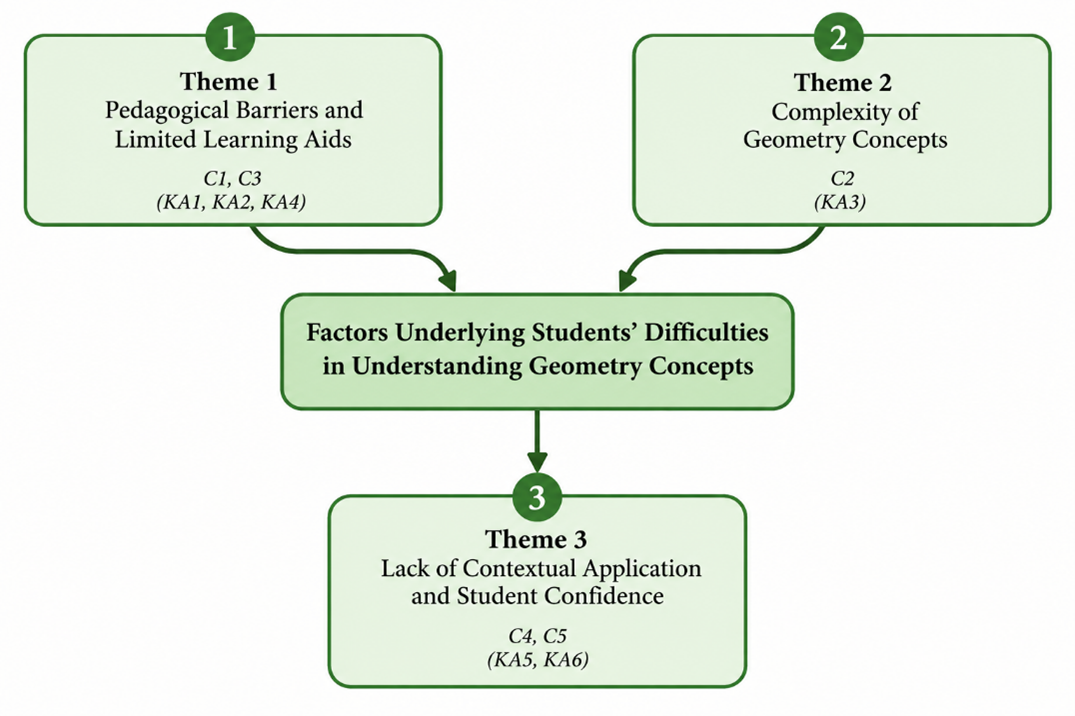
Geometry is an essential component of mathematics that supports students in developing logical, critical, and spatial thinking skills, yet many students continue to find this material difficult to master. This study explored, in depth, eighth-grade students’ experiences of learning geometry through a hermeneutic phenomenological approach. Data were collected using an open-ended questionnaire completed by ten eighth-grade students (5 males and 5 females, aged 13-15) from a private junior high school in Mataram City, West Nusa Tenggara, Indonesia, and were analyzed following Braun and Clarke’s thematic analysis, assisted by an artificial intelligence tool (ChatGPT) during initial coding and subsequently verified manually by the researchers. The analysis produced six initial codes, condensed into five categories and, ultimately, three overarching themes: (1) pedagogical barriers and limited use of learning aids, (2) the complexity of geometry concepts, and (3) the lack of contextual application and student confidence. These findings indicate that geometry learning difficulties are not caused solely by students’ cognitive limitations but are closely related to instructional strategies, the nature of the material itself, and students’ psychological readiness. By foregrounding students’ own voices, this study offers a more holistic account of geometry learning difficulties than achievement-score data alone can provide. It recommends implementing more contextual, adaptive, and supportive learning strategies, using visual media aligned with students’ Van Hiele levels of thinking, to strengthen their spatial reasoning skills and confidence.
Downloads
References
Abdurrahman, A., & Nofriyandi, N. (2022). Profile of students’ difficulties to learn geometry of mathematics education study program. EDUKATIF: Jurnal Ilmu Pendidikan, 4(1), 1075–1082. https://doi.org/10.31004/edukatif.v4i1.2102
Amalia, Y. (2023). Analisis kesulitan siswa dalam memahami konsep geometri transformasi pada kelas VII di SMP Negeri 2 Kuala Kabupaten Nagan Raya
Ananda Dwi Putri, & Hanifah Fitriyani. (2024). Analisis kesulitan belajar matematika materi geometri pada siswa kelas 4 sekolah dasar. Jurnal Pendidikan Matematika, 2(1). https://doi.org/10.47134/ppm.v2i1.1112
Ayu P.AE., Zulkarnaen, R., & Ihsan Imami, A. (2024). Analisis kemampuan berpikir geometri siswa SMP berdasarkan teori Van Hiele dalam materi teorema Pythagoras. Jurnal Didactical Mathematics, 6(2), 67-83. https://ejournal.unma.ac.id/index.php/dm
Azizah, A. N., Kusmayadi, T. A., & Fitriana, L. (2021). The effectiveness of software GeoGebra to improve visual representation ability. Journal of Physics: Conference Series, 1808(1), 012059. https://doi.org/10.1088/1742-6596/1808/1/012059
Bhagat, K. K., & Chang, C. Y. (2015). Incorporating GeoGebra into geometry learning: A lesson from India. Eurasia Journal of Mathematics, Science and Technology Education, 11(1), 77–86. https://doi.org/10.12973/eurasia.2015.1307a
Braun, V., & Clarke, V. (2006). Using thematic analysis in psychology. Qualitative Research in Psychology, 3(2), 77–101. https://doi.org/10.1191/1478088706qp063oa
Buckley, J., Seery, N., & Canty, D. (2019). Investigating the use of spatial reasoning strategies in geometric problem solving. International Journal of Technology and Design Education, 29(2), 341–362. https://doi.org/10.1007/s10798-018-9446-3
Budiarti, M. I. E., & Mahendra, F. E. (2020). Analisis pemecahan masalah geometri berdasarkan tingkat berpikir teori Van Hiele dan gender. Pi: Mathematics Education Journal, 3(1), 28-37.
Dian Angriani, A., & Tampa, A. (2022). Students’ difficulties in solving geometric literacy problems. ICSAT International Proceeding, 11(2), 34-56. https://ojs.unm.ac.id/icsat/article/view/39068
Fitry Burais, F. (2018). Peningkatan kemampuan pemecahan masalah geometri melalui pembelajaran kooperatif berbasis teori Van Hiele. Jurnal Peluang, 6(2), 45-65
Giorgi, A. (2008). Difficulties encountered in the application of the phenomenological method in the social sciences. Indo-Pacific Journal of Phenomenology, 8(1), 1–9. https://doi.org/10.1080/20797222.2008.11433956
Hasan, B. (2020). Kesulitan siswa dan scaffolding dalam menyelesaikan masalah geometri ruang. Jurnal Numeracy, 7(1).
Hendriyanto, A., Kusmayadi, T. A., & Fitriana, L. (2021). Geometric thinking ability for prospective mathematics teachers in solving ethnomathematics problem. IOP Conference Series: Earth and Environmental Science, 1808(1), 012040. https://doi.org/10.1088/1742-6596/1808/1/012040
Kinanti, M. A. H., Sujadi, I., Indriati, D., & Kuncoro, K. S. (2023). Examining students’ cognitive processes in solving algebraic numeracy problems: A phenomenology study. Jurnal Elemen, 9(2), 494–508. https://doi.org/10.29408/jel.v9i2.13266
Lestari, D. D. P., & Naila, I. (2021). Profil kemampuan spasial siswa sekolah dasar dalam pemecahan masalah geometri: Sebuah studi literatur. Jurnal Fundadikdas (Fundamental Pendidikan Dasar), 4(1), 9–20. https://doi.org/10.12928/fundadikdas.v4i1.3360
Mudhiah, S., & Shodikin, A. (2019). Pengaruh model pembelajaran berbasis masalah terhadap kemampuan pemahaman konsep dan penalaran geometris siswa. Jurnal Elemen, 5(1), 43–53. https://doi.org/10.29408/jel.v5i1.974
Naufal, M. A., Abdullah, A. H., Osman, S., Abu, M. S., Ihsan, H., & Rondiyah. (2021). Reviewing the Van Hiele model and the application of metacognition on geometric thinking. International Journal of Evaluation and Research in Education, 10(2), 597–605. https://doi.org/10.11591/ijere.v10i2.21185
Nowell, L. S., Norris, J. M., White, D. E., & Moules, N. J. (2017). Thematic analysis: Striving to meet the trustworthiness criteria. International Journal of Qualitative Methods, 16(1), 45-65. https://doi.org/10.1177/1609406917733847
Nurhidayah, A., Mawarsari, V. D., & Suprapto, R. (2025). Systematic literature review: Penggunaan media Articulate Storyline dalam kemampuan berpikir geometri siswa SMP. INNOVATIVE: Journal of Social Science Research, 5, 6866–6885.
Nuriah, S., & Siswoyo, A. A. (2025). Implementasi Model Pembelajaran Pbl Berbantuan Asesmen Projek Untuk Meningkatkan Pemahaman Konsep Bangun Datar Pada Siswa. Jurnal Media Akademik (JMA), 3(1), 67-78.
Nurjanah, N., & Juliana, A. (2020). Hambatan didaktis siswa SMP dalam penyelesaian masalah geometri berdasarkan kemampuan persepsi ruang. Kreano, Jurnal Matematika Kreatif-Inovatif, 11(2), 236–244. https://doi.org/10.15294/kreano.v11i2.26752
Pajares, F., & Miller, M. D. (1994). Role of self-efficacy and self-concept beliefs in mathematical problem solving: A path analysis. Journal of Educational Psychology, 86(2), 193–203. https://doi.org/10.1037/0022-0663.86.2.193
Papadam, M., & Agaliotis, I. (2021). An investigation of geometric knowledge in pupils with mild educational needs. Psychology, 26(1), 135–151. https://doi.org/10.12681/psy_hps.26234
Perkins, M., & Roe, J. (2024). Academic publisher guidelines on AI usage: A ChatGPT-supported thematic analysis. F1000Research, 12, 1398. https://doi.org/10.12688/f1000research.142411.2
Pittalis, M., & Christou, C. (2010). Types of reasoning in 3D geometry thinking and their relation with spatial ability. Educational Studies in Mathematics, 75(2), 191–212. https://doi.org/10.1007/s10649-010-9260-2
Roskawati, R., Ikhsan, M., & Juandi, D. (2015). Analisis penguasaan siswa sekolah menengah atas pada materi geometri. Jurnal Didaktik Matematika, 2(1), 45-67.
Silmi Juman, Z. A. M., Mathavan, M., Ambegedara, A. S., & Udagedara, I. G. K. (2022). Difficulties in learning geometry component in mathematics and active-based learning methods to overcome the difficulties. Shanlax International Journal of Education, 10(2), 41–58. https://doi.org/10.34293/education.v10i2.4299
Steinberg, L. (2005). Cognitive and affective development in adolescence. Trends in Cognitive Sciences, 9(2), 69–74. https://doi.org/10.1016/j.tics.2004.12.005
Sulistiowati, D. L., Herman, T., & Jupri, A. (2019). Student difficulties in solving geometry problem based on Van Hiele thinking level. Journal of Physics: Conference Series, 1157(4), 042118. https://doi.org/10.1088/1742-6596/1157/4/042118
Susanto, S., & Mahmudi, A. (2021). Tahap berpikir geometri siswa SMP berdasarkan teori Van Hiele ditinjau dari keterampilan geometri. Jurnal Riset Pendidikan Matematika, 8(1), 106–116. https://doi.org/10.21831/jrpm.v8i1.17044
Tambychik, T., & Meerah, T. S. M. (2010). Students’ difficulties in mathematics problem-solving: What do they say? Procedia – Social and Behavioral Sciences, 8, 142–151. https://doi.org/10.1016/j.sbspro.2010.12.020
Downloads
Published
How to Cite
Issue
Section
License
Copyright (c) 2025 Raodatul Ainiyah, Muh. Rusmayadi, Samsul Bahri

This work is licensed under a Creative Commons Attribution-ShareAlike 4.0 International License.