Narrative ecology of “Antu Banyu” in digital pedagogy: Internalizing the Pancasila student profile in junior high school
DOI:
https://doi.org/10.59965/pij.v4i1.296Keywords:
Digital Pedagogy, Educational Sociolinguistics, Folklore, Narrative Ecology, Pancasila Student ProfileAbstract
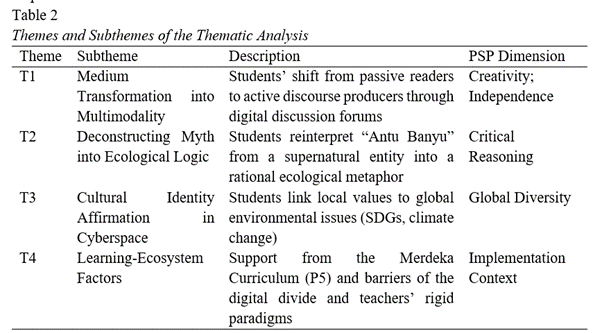
This study describes how the folktale “Antu Banyu,” integrated into digital pedagogy, internalizes the values of the Pancasila Student Profile among seventh-grade students of SMP Nahdlatul Wathan, Mataram, with internalization empirically indicated through a shift in students’ reflective language from descriptive to analytical-evaluative, and the consistency of this shift across interviews, observations, and reflective essays. A qualitative case study design was employed to examine the narrative ecology of this South Sumatran folktale as it transforms within a multimodal digital ecosystem. Data were gathered from seven purposively selected participants, an Indonesian language teacher, the school principal, and five students of varied academic ability, through in-depth interviews, classroom observations across six sessions, and document analysis, then analyzed using the interactive thematic model of Miles, Huberman, and Saldaña. The findings reveal that (1) the shift of medium repositioned students from passive readers into active discourse producers within a new digital speech community; (2) digital interaction encouraged students to deconstruct the myth into rational ecological reasoning, indicating the Critical Reasoning dimension; and (3) discussing local narratives in digital spaces triggered cultural identity affirmation underpinning the Global Diversity dimension. Digital recontextualization expands the relevance of folklore despite digital infrastructure gaps and rigid pedagogical paradigms. The findings offer a model of local folklore recontextualization adaptable to other Indonesian schools.
Downloads
References
Adiyawati, F. F., & Nuroh, E. Z. (2023). The influence of digital storytelling on story writing skills of class II elementary school students. Jurnal Pendidikan Dasar Nusantara, 8(2), 357–369.
Aini, K., Hidayatillah, Y., AR, M. M., Sama’, S., Bahri, S., & Astuti, Y. P. (2024). Projek Profil Pelajar Pancasila dalam Kurikulum Merdeka: Sebuah studi kepustakaan tentang penguatan karakter di sekolah dasar [The Pancasila Learner Profile Project in the Independent Curriculum: A library study of character strengthening in primary schools]. Jurnal Pendidikan dan Pembelajaran Indonesia, 4(2), 98–115. https://doi.org/10.53299/jppi.v4i2.1522
Birt, L., Scott, S., Cavers, D., Campbell, C., & Walter, F. (2016). Member checking: A tool to enhance trustworthiness or merely a nod to validation? Qualitative Health Research, 26(13), 1802–1811. https://doi.org/10.1177/1049732316654870
Bosio, E., & Schattle, H. (2021). Ethical global citizenship education: From neoliberalism to a values-based pedagogy. Prospects. https://doi.org/10.1007/s11125-021-09571-9
Braun, V., & Clarke, V. (2006). Using thematic analysis in psychology. Qualitative Research in Psychology, 3(2), 77–101. https://doi.org/10.1191/1478088706qp063oa
Bruner, J. (1991). The narrative construction of reality. Critical Inquiry, 18(1), 1–21. https://doi.org/10.1086/448619
Burnett, C., & Merchant, G. (2020). Digital pedagogy and narrative ecology in schools: Examining dynamic literacy practices. Journal of Early Childhood Literacy, 20(3), 567–588. https://doi.org/10.1177/1468798420924135
Chen, H.-I. (2017). Intercultural communication in online social networking discourse. Language and Intercultural Communication, 17(2), 166–189. https://doi.org/10.1080/14708477.2016.1211137
Creswell, J. W., & Poth, C. N. (2018). Qualitative inquiry and research design: Choosing among five approaches (4th ed.). SAGE Publications.
da Silva, C., Pereira, F., & Amorim, J. P. (2023). The integration of indigenous knowledge in school: A systematic review. Compare: A Journal of Comparative and International Education, 54(7), 1210–1228. https://doi.org/10.1080/03057925.2023.2184200
Druker-Ibáñez, S., & Cáceres-Jensen, L. (2022). Integration of indigenous and local knowledge into sustainability education: A systematic literature review. Environmental Education Research, 28(8), 1209–1236. https://doi.org/10.1080/13504622.2022.2083081
Ertmer, P. A., Ottenbreit-Leftwich, A. T., Sadik, O., Sendurur, E., & Sendurur, P. (2012). Teacher beliefs and technology integration practices: A critical relationship. Computers & Education, 59(2), 423–435. https://doi.org/10.1016/j.compedu.2012.02.001
Farnsworth, V., Kleanthous, I., & Wenger-Trayner, E. (2016). Communities of practice as a social theory of learning: A conversation with Etienne Wenger. British Journal of Educational Studies, 64(2), 139–160. https://doi.org/10.1080/00071005.2015.1133799
Fauziah, F. N., Saddhono, K., & Suryanto, E. (2023). Implementation of local wisdom-based Indonesian learning to strengthen Pancasila Student Profiles (P5): Case studies in vocational high schools. Journal of Curriculum and Teaching, 12(6), 283–297. https://doi.org/10.5430/jct.v12n6p283
Franch, S. (2020). Global citizenship education: A new “moral pedagogy” for the 21st century? European Educational Research Journal, 19(6), 506–524. https://doi.org/10.1177/1474904120929103
González-Salgado, I. de L., Rivera-Navarro, J., Gutiérrez-Sastre, M., Conde, P., & Franco, M. (2022). Conducting member checking within a qualitative case study on health-related behaviours in a large European city: Appraising interpretations and co-constructing findings. Qualitative Research, 24(1), 3–21. https://doi.org/10.1177/13634593221109682
Guest, G., Bunce, A., & Johnson, L. (2006). How many interviews are enough? An experiment with data saturation and variability. Field Methods, 18(1), 59–82. https://doi.org/10.1177/1525822X05279903
Guest, G., Namey, E., & Chen, M. (2020). A simple method to assess and report thematic saturation in qualitative research. PLoS ONE, 15(5), e0232076. https://doi.org/10.1371/journal.pone.0232076
Helm, F., Baroni, A., & Acconcia, G. (2023). Global citizenship online in higher education. Educational Research for Policy and Practice, 23, 1–18. https://doi.org/10.1007/s10671-023-09351-6
Hennink, M. M., Kaiser, B. N., & Marconi, V. C. (2017). Code saturation versus meaning saturation: How many interviews are enough? Qualitative Health Research, 27(4), 591–608. https://doi.org/10.1177/1049732316665344
Herleni, S. (2016). Antu Banyu: Cerita dari Sumatra Selatan. Badan Pengembangan dan Pembinaan Bahasa, Kementerian Pendidikan dan Kebudayaan.
Hudhana, W. D., Sumarlam, & Sumarwati. (2025). Digital comics of folktales as learning media to strengthen elementary school students’ ecoliteracy. Theory and Practice in Language Studies, 15(2), 443–451. https://doi.org/10.17507/tpls.1502.14
Jenkins, H., Purushotma, R., Weigel, M., Clinton, K., & Robison, A. J. (2009). Confronting the challenges of participatory culture: Media education for the 21st century. MIT Press. https://doi.org/10.7551/mitpress/8435.001.0001
Kanuka, H., & Garrison, D. R. (2004). Cognitive presence in online learning. Journal of Computing in Higher Education, 15(2), 21–39. https://doi.org/10.1007/BF02940928
Kemendikbudristek. (2022). Keputusan Kepala BSKAP No. 008/H/KR/2022 tentang Capaian Pembelajaran pada Pendidikan Anak Usia Dini, Jenjang Pendidikan Dasar, dan Jenjang Pendidikan Menengah pada Kurikulum Merdeka. Kementerian Pendidikan, Kebudayaan, Riset, dan Teknologi.
Kirshenblatt-Gimblett, B. (2004). Intangible heritage as metacultural production. Museum International, 56(1–2), 52–65. https://doi.org/10.1111/j.1350-0775.2004.00458.x
Kress, G. (2018). Multimodality and digital storytelling in education: A narrative ecology perspective. Linguistics and Education, 47, 10–18. https://doi.org/10.1016/j.linged.2018.03.001
Mar’atusshalihah, Zain, M. I., & Rahmatih, A. N. (2024). Nilai-nilai pendidikan karakter pada cerita rakyat Sasak Cupak Gerantang [The values of character education in the folklore of Sasak Cupak Gerantang]. Journal of Classroom Action Research, 6(1), 36–43. https://doi.org/10.29303/jcar.v6i1.6763
Masse, W. B., Barber, E. W., Piccardi, L., & Barber, P. T. (2007). Exploring the nature of myth and its role in science. In L. Piccardi & W. B. Masse (Eds.), Myth and geology (Geological Society, London, Special Publications, Vol. 273, pp. 9–28). https://doi.org/10.1144/GSL.SP.2007.273.01.02
McKenzie, J. (2022). Digital media as sites for cultural identity development: The case of Hmong American emerging adults. Journal of Adolescent Research. https://doi.org/10.1177/07435584221116312
Miles, M. B., Huberman, A. M., & Saldaña, J. (2014). Qualitative data analysis: A methods sourcebook (3rd ed.). SAGE Publications.
Mingga, R., Sumiyadi, & Nugroho, R. A. (2024). Media digital storytelling pada pembelajaran menulis cerpen siswa SMP di Bandung [Digital media storytelling on the learning of short story writing of junior high school students in Bandung]. Jurnal Onoma: Pendidikan, Bahasa, dan Sastra, 10(3), 3119–3126. https://doi.org/10.30605/onoma.v10i3.4052
Morris, B. S., Chrysochou, P., Christensen, J. D., Orquin, J. L., Barraza, J., Zak, P. J., & Mitkidis, P. (2019). Stories vs. facts: Triggering emotion and action-taking on climate change. Climatic Change, 154, 19–36. https://doi.org/10.1007/s10584-019-02425-6
Morse, J. M. (2015). Data were saturated. Qualitative Health Research, 25(5), 587–588. https://doi.org/10.1177/1049732315576699
Mulbar, U., Nasrullah, & Abbas, N. F. (2025). Scientific-based digital storytelling to enhance science literacy and environmental awareness in junior high school students. Formatif: Jurnal Ilmiah Pendidikan MIPA, 15(2), 47–58. https://doi.org/10.30998/zbqhn729
Nasir, W. M. F. W. M., Halim, L., & Arsad, N. M. (2024). Digital storytelling learning outcomes and critical factors: A scoping review. International Journal of Learning, Teaching and Educational Research, 23(5), 323–344. https://doi.org/10.26803/ijlter.23.5.17
New London Group. (1996). A pedagogy of multiliteracies: Designing social futures. Harvard Educational Review, 66(1), 60–93. https://doi.org/10.17763/haer.66.1.17370n67v22j160u
O’Byrne, W. I., Houser, K., Stone, R., & White, M. (2019). Corrigendum: Digital storytelling in early childhood: Student illustrations shaping social interactions. Frontiers in Psychology, 9, Article 2749. https://doi.org/10.3389/fpsyg.2018.02749
Palinkas, L. A., Horwitz, S. M., Green, C. A., Wisdom, J. P., Duan, N., & Hoagwood, K. (2015). Purposeful sampling for qualitative data collection and analysis in mixed method implementation research. Administration and Policy in Mental Health and Mental Health Services Research, 42(5), 533–544. https://doi.org/10.1007/s10488-013-0528-y
Pangrazio, L., & Selwyn, N. (2019). Personal data literacies: A socio-material approach to digital pedagogy. New Media & Society, 21(2), 419–437. https://doi.org/10.1177/1461444818799523
Primayanti, N. W., & Puspita, V. (2022). Local wisdom narrative in environmental campaign. Cogent Arts & Humanities, 9(1), 2090062. https://doi.org/10.1080/23311983.2022.2090062
Rahmadin, M. G., Marii, Efendi, M., & Musaddat, S. (2024). Eksplorasi nilai pendidikan pada cerita rakyat Sasak Cupak Gerantang karya Sagimun M.D [Exploration of the value of education in the folklore of Sasak Cupak Gerantang by Sagimun M.D]. Journal of Classroom Action Research, 6(2), 328–341. https://doi.org/10.29303/jcar.v6i2.7717
Smith, S. U., Hayes, S., & Shea, P. (2017). A critical review of the use of Wenger’s Community of Practice (CoP) theoretical framework in online and blended learning research, 2000–2014. Online Learning, 21(1), 209–237. https://doi.org/10.24059/olj.v21i1.963
Wahid, M., & Ain, R. (2023). Theoretical implementation as folklore digital reconstruction in Malaysian education. International Journal of Advanced Research in Education and Related Social Sciences, 13(4), 3439–3460. https://doi.org/10.46886/IJARPED/v13-i4/19186
Yang, B., Wu, N., Tong, Z., & Sun, Y. (2022). Narrative-based environmental education improves environmental awareness and environmental attitudes in children aged 6–8. International Journal of Environmental Research and Public Health, 19(11), 6483. https://doi.org/10.3390/ijerph19116483
Yin, R. K. (2018). Case study research and applications: Design and methods (6th ed.). SAGE Publications.
Downloads
Published
How to Cite
Issue
Section
License
Copyright (c) 2026 Velly Oxtaria, Ria Saputri, Purnawarman Purnawarman

This work is licensed under a Creative Commons Attribution-ShareAlike 4.0 International License.