Contextual teaching and learning assisted by E-modules: Enhancing mathematical communication ability and learning motivation on the Pythagorean Theorem
DOI:
https://doi.org/10.59965/pij.v4i1.313Keywords:
Contextual Teaching and Learning , e-module, learning motivation, mathematical communication ability, Pythagorean TheoremAbstract
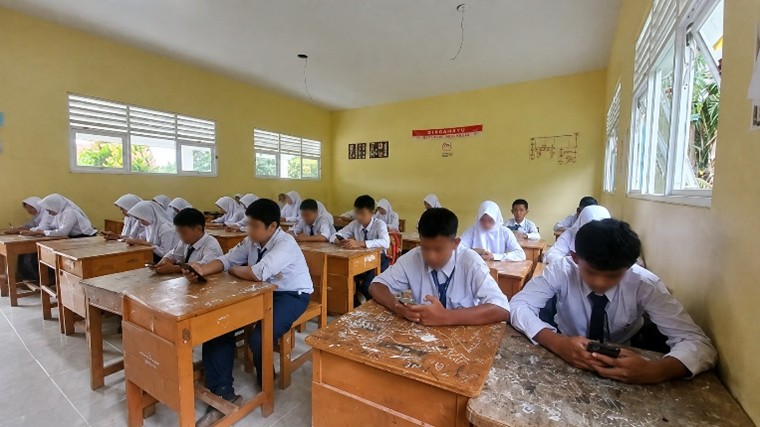
This study examined the effect of Contextual Teaching and Learning (CTL) assisted by an electronic module (e-module) on Grade VIII students’ mathematical communication ability and learning motivation in the Pythagorean Theorem. A quantitative quasi-experimental approach with a Nonequivalent Control Group Design involved 64 students at SMP Negeri 08 Tanjung Jabung Barat, Indonesia, divided equally into experimental and control classes (n = 32 each). The experimental class received e-module-assisted CTL across eight meetings, while the control class received conventional instruction. Data were collected using a mathematical communication essay test and a 32-item motivation questionnaire, both demonstrating high reliability (Cronbach’s alpha = 0.917 and 0.881). Baseline testing indicated no significant differences between groups in communication ability or motivation. After treatment, the experimental class achieved a significantly higher mathematical communication mean (82.42) than the control class (70.31), t(62) = 6.16, p < 0.0001, with a large effect (d = 1.54). A Mann–Whitney U test also showed significantly higher motivation in the experimental class (median = 88.00) than the control class (median = 78.00), Z = 6.87, p < 0.0001, r = 0.86. The experimental class also demonstrated substantially greater gains in both outcomes across the intervention period overall. These findings indicate that e-module-assisted CTL effectively enhances students’ mathematical communication ability and learning motivation, providing a practical technology-integrated alternative for junior secondary mathematics instruction.
Downloads
References
Bach, C. C., Bergqvist, E., & Jankvist, U. T. (2024). Students’ dynamic communication while transforming mathematical representations in a dynamic geometry environment. ZDM – Mathematics Education, 56(4), 543–557. https://doi.org/10.1007/s11858-024-01575-x
Booth, A., Wood, S., Patterson, M., Carroll, C., Rick, J., & Balain, S. (2007). A conceptual framework for implementation fidelity. Implementation Science, 2(1), 40. https://doi.org/10.1186/1748-5908-2-40
Brown, M. B., & Forsythe, A. B. (1974). Robust tests for the equality of variances. Journal of the American Statistical Association, 69(346), 364–367. https://doi.org/10.1080/01621459.1974.10482955
Dane, A. V., & Schneider, B. H. (1998). Program integrity in primary and early secondary prevention: Are implementation effects out of control? Clinical Psychology Review, 18(1), 23–45. https://doi.org/10.1016/S0272-7358(97)00043-3
de Leeuw, R. R., de Boer, A. A., & Minnaert, A. E. M. G. (2020). The proof of the intervention is in the implementation: A systematic review about implementation fidelity of classroom-based interventions facilitating social participation of students with social-emotional problems or behavioural difficulties. International Journal of Educational Research Open, 1, 100002. https://doi.org/10.1016/j.ijedro.2020.100002
Hidayat, W., & Aripin, U. (2023). How to develop an E-LKPD with a scientific approach to achieving students’ mathematical communication abilities. Infinity Journal, 12(1), 85–100. https://doi.org/10.22460/infinity.v12i1.p85-100
Hulukati, E., Pomalato, S. W. D., Hulukati, W., & Zakiyah, S. (2023). Developing students’ mathematical communication skills in junior high school with varying levels of mathematics achievement through a generative learning model. British Journal of Teacher Education and Pedagogy, 2(1), 31–37. https://doi.org/10.32996/bjtep.2023.2.1.5
Ingram, J., Andrews, N., & Pitt, A. (2019). When students offer explanations without the teacher explicitly asking them to. Educational Studies in Mathematics, 101(1), 51–66. https://doi.org/10.1007/s10649-018-9873-9
Kim, Y., & Steiner, P. (2016). Quasi-experimental designs for causal inference. Educational Psychologist, 51(3–4), 395–405. https://doi.org/10.1080/00461520.2016.1207177
Koçak, G. N., Çetin, M. Ç., Kara, M., Genç, M., Lekesiz, G., Açıkbaş, F. C., & Kara, N. Ş. (2025). A quasi-experimental research on developing students’ life skills through purposeful leisure time activities. Frontiers in Psychology, 16, Article 1634943. https://doi.org/10.3389/fpsyg.2025.1634943
Lakens, D. (2013). Calculating and reporting effect sizes to facilitate cumulative science: A practical primer for t-tests and ANOVAs. Frontiers in Psychology, 4, Article 863. https://doi.org/10.3389/fpsyg.2013.00863
Mahendra, I. W. E. (2016). Contextual learning approach and performance assessment in mathematics learning. International Research Journal of Management, IT & Social Sciences, 3(3), 7–15. https://doi.org/10.21744/irjmis.v3i3.88
Mahmuti, A., Hamzić, D. K., & Thaqi, X. (2025). The impact of contextual teaching and learning on improving student achievement in economics mathematics. International Electronic Journal of Mathematics Education, 20(3), em0833. https://doi.org/10.29333/iejme/16233
Mann, H. B., & Whitney, D. R. (1947). On a test of whether one of two random variables is stochastically larger than the other. The Annals of Mathematical Statistics, 18(1), 50–60. https://doi.org/10.1214/aoms/1177730491
Memon, M. A., Thurasamy, R., Ting, H., & Cheah, J.-H. (2025). Purposive sampling: A review and guidelines for quantitative research. Journal of Applied Structural Equation Modeling, 9(1), 1–23. https://doi.org/10.47263/JASEM.9(1)01
Mohr, L. B. (1982). On rescuing the nonequivalent-control-group design. Evaluation Review, 6(2), 213–238. https://doi.org/10.1177/0049124182011001003
Nguyen, H. T. M., Nguyen, G. T. C., Nguyen, B. N., Truong, D. T., & Thai, L. T. H. (2025). Mathematical communication skills for high school students: A comprehensive review of present practices, challenges, and prospective advancements. TEM Journal, 14(3), 2349–2360. https://doi.org/10.18421/TEM143-40
O’Donnell, C. L. (2008). Defining, conceptualizing, and measuring fidelity of implementation and its relationship to outcomes in K–12 curriculum intervention research. Review of Educational Research, 78(1), 33–84. https://doi.org/10.3102/0034654307313793
OECD. (2023). PISA 2022 results (Volume I): The state of learning and equity in education. OECD Publishing. https://doi.org/10.1787/53f23881-en
Purba, G. I. D., & Surya, E. (2020). The improving of mathematical understanding ability and positive attitudes of Unimed FMIPA students by using the Contextual Teaching Learning (CTL) approach. Journal of Physics: Conference Series, 1462(1), 012019. https://doi.org/10.1088/1742-6596/1462/1/012019
Rahmah, N. T. I., Putri, A., Ikram, M., & Sosa-Moguel, L. (2025). Profiling junior high school students’ conceptual understanding of the Pythagorean theorem across ability levels. Al-Jabar: Jurnal Pendidikan Matematika, 17(1), 249–268. https://doi.org/10.24042/ajpm.v17i1.30110
Ryan, R. M., & Deci, E. L. (2020). Intrinsic and extrinsic motivation from a self-determination theory perspective: Definitions, theory, practices, and future directions. Contemporary Educational Psychology, 61, Article 101860. https://doi.org/10.1016/j.cedpsych.2020.101860
Scott, M. B. (1999). Pythagorean theorem revisited. Teaching Mathematics and Its Applications: An International Journal of the IMA, 18(1), 10–11. https://doi.org/10.1093/teamat/18.1.10
Shang, J., Huang, W., & Li, X. (2026). Effects of gamified project-based learning on mathematics achievement and motivation: A comparative study in elementary education. International Journal of Science and Mathematics Education, 24, Article 4. https://doi.org/10.1007/s10763-025-10644-w
Shapiro, S. S., & Wilk, M. B. (1965). An analysis of variance test for normality (complete samples). Biometrika, 52(3–4), 591–611. https://doi.org/10.1093/biomet/52.3-4.591
Sudirman, S., Mellawaty, M., Yaniawati, P., & Indrawan, R. (2020). Integrating local wisdom forms in augmented reality application: Impact attitudes, motivations and understanding of geometry of pre-service mathematics teachers’. International Journal of Interactive Mobile Technologies, 14(11), 91–106. https://doi.org/10.3991/ijim.v14i11.12183
Sugianto, S., Waluya, St. B., Sukestiyarno, Y. L., & Wardono. (2025). Problem-based learning based on electronic module: Students’ mathematical communication process in terms of cognitive style. Educational Process: International Journal, 16, Article e2025222. https://doi.org/10.22521/edupij.2025.16.222
Sullivan, G. M., & Feinn, R. (2012). Using effect size—or why the P value is not enough. Journal of Graduate Medical Education, 4(3), 279–282. https://doi.org/10.4300/JGME-D-12-00156.1
van Laar, E., van Deursen, A. J. A. M., van Dijk, J. A. G. M., & de Haan, J. (2017). The relation between 21st-century skills and digital skills: A systematic literature review. Computers in Human Behavior, 72, 577–588. https://doi.org/10.1016/j.chb.2017.03.010
Weylin, W., Raharjo, H., Haqq, A. A., & Larsari, V. N. (2023). Empowering students in the digital era: An analysis of interactive e-modules’ effect on digital mathematical communication. International Journal of Mathematics and Mathematics Education, 1(2), 132–149. https://doi.org/10.56855/ijmme.v1i02.401
Downloads
Published
How to Cite
Issue
Section
License
Copyright (c) 2026 Meri Meri, Endang Wahyuningrum, Sudirman Sudirman, Ebenezer Bonyah

This work is licensed under a Creative Commons Attribution-ShareAlike 4.0 International License.