Realistic mathematics education and junior high school students' mathematical reasoning, communication, and self-efficacy: A quasi-experimental study
DOI:
https://doi.org/10.59965/pij.v4i1.327Keywords:
Realistic Mathematics Education, mathematical reasoning, mathematical communication, self-efficacy, quasi-experimentAbstract
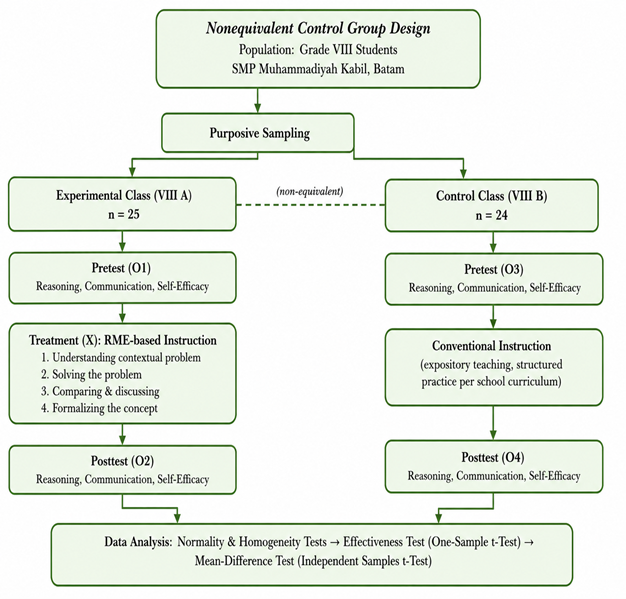
Mathematical reasoning, mathematical communication, and self-efficacy are three interrelated competencies in mathematics learning, yet they are frequently neglected in conventional instruction that emphasizes rote procedural memorization. This study examined the effect of the Realistic Mathematics Education (RME) approach on eighth-grade students’ mathematical reasoning ability, mathematical communication ability, and self-efficacy on the topic of circles. A quantitative approach with a nonequivalent control group quasi-experimental design was employed, involving 25 students in an experimental group who received RME-based instruction and 24 students in a control group who received conventional instruction, selected through purposive sampling at a private junior high school in Batam, Indonesia. Data were collected using essay-type tests of reasoning and communication ability together with a Likert-scale self-efficacy questionnaire, and were analyzed using one-sample and independent-samples t-tests after normality and homogeneity assumptions were confirmed. The results showed that the RME approach did not produce a statistically significant effect on mathematical reasoning ability (p = 0.419), but produced a significant effect on mathematical communication ability (p = 0.028) and self-efficacy (p = 0.002) compared with conventional instruction. These findings suggest that students’ engagement in contextual problems, group discussion, and presentation of solutions within the RME stages was more effective in fostering the ability to communicate mathematical ideas and self-confidence than in advancing formal reasoning within a relatively short intervention period. This study contributes to the RME literature by demonstrating that the effectiveness of an instructional approach is multidimensional and uneven across mathematical competencies, implying that teachers need to design additional reinforcement for reasoning when implementing RME over a short duration.
Downloads
References
Akosah, E. F., Dissou Arthur, A., & Adu Obeng, B. (2026). Effectiveness of realistic mathematics education: A meta-analysis. American Journal of STEM Education, 24, 361–380. https://doi.org/10.32674/dkrfgy81
Aksoy, E. C., & Bostan, M. I. (2021). Seventh graders’ statistical literacy: An investigation on bar and graphs. International Journal of Science and Mathematics Education, 19, 397–418. https://doi.org/10.1007/s10763-020-10052-2
Anggraini, R. S., & Fauzan, A. (2020). The effect of Realistic Mathematics Education approach on mathematical problem solving ability. Edumatika: Jurnal Riset Pendidikan Matematika, 3(2), 94–102. https://doi.org/10.32939/ejrpm.v3i2.595
Askari, G., Vajdi, M., Jafari-Nasab, S., & Golpour-Hamedani, S. (2024). Ethical guidelines for human research on children and adolescents: A narrative review study. Journal of Research in Medical Sciences, 29, 53. https://doi.org/10.4103/jrms.jrms_610_23
Bakker, A., Cai, J., English, L., Kaiser, G., Mesa, V., & Van Dooren, W. (2019). Beyond small, medium, or large: Points of consideration when interpreting effect sizes. Educational Studies in Mathematics, 102(1), 1–8. https://doi.org/10.1007/s10649-019-09908-4
Bandura, A. (1977). Self-efficacy: Toward a unifying theory of behavioral change. Psychological Review, 84(2), 191–215. https://doi.org/10.1037/0033-295X.84.2.191
Bandura, A. (2010). Self-efficacy. In I. B. Weiner & W. E. Craighead (Eds.), The Corsini Encyclopedia of Psychology. Wiley. https://doi.org/10.1002/9780470479216.corpsy0836
Boone, H. N., & Boone, D. A. (2012). Analyzing Likert data. Journal of Extension, 50(2), Article 48. https://doi.org/10.34068/joe.50.02.48
Capili, B., & Anastasi, J. K. (2024). An introduction to the quasi-experimental design (nonrandomized design). American Journal of Nursing, 124(11), 50–52. https://doi.org/10.1097/01.NAJ.0001081740.74815.20
Fauzan, A., & Diana, F. (2020). Learning trajectory for teaching number patterns using RME approach in junior high schools. Journal of Physics: Conference Series, 1470(1), 012019. https://doi.org/10.1088/1742-6596/1470/1/012019
Fauzan, A., Musdi, E., & Afriadi, J. (2018). Developing learning trajectory for teaching statistics at junior high school using RME approach. Journal of Physics: Conference Series, 1088(1), 012040. https://doi.org/10.1088/1742-6596/1088/1/012040
Herianto, H., Sofroniou, A., Fitrah, M., Rosana, D., Setiawan, C., Rosnawati, R., Widihastuti, W., Jusmiana, A., & Marinding, Y. (2024). Quantifying the relationship between self-efficacy and mathematical creativity: A meta-analysis. Education Sciences, 14(11), 1251. https://doi.org/10.3390/educsci14111251
Jeannotte, D., & Kieran, C. (2017). A conceptual model of mathematical reasoning for school mathematics. Educational Studies in Mathematics, 96(1), 1–16. https://doi.org/10.1007/s10649-017-9761-8
Kraft, M. A. (2020). Interpreting effect sizes of education interventions. Educational Researcher, 49(4), 241–253. https://doi.org/10.3102/0013189X20912798
Laurens, T., Batlolona, F. A., Batlolona, J. R., & Leasa, M. (2018). How does Realistic Mathematics Education (RME) improve students’ mathematics cognitive achievement? Eurasia Journal of Mathematics, Science and Technology Education, 14(2), 569–578. https://doi.org/10.12973/ejmste/76959
Lithner, J. (2008). A research framework for creative and imitative reasoning. Educational Studies in Mathematics, 67(3), 255–276. https://doi.org/10.1007/s10649-007-9104-2
Liu, R., Jong, C., & Fan, M. (2024). Reciprocal relationship between self-efficacy and achievement in mathematics among high school students. Large-scale Assessments in Education, 12(1), 1–16. https://doi.org/10.1186/s40536-024-00201-2
Norman, G. (2010). Likert scales, levels of measurement and the “laws” of statistics. Advances in Health Sciences Education, 15(5), 625–632. https://doi.org/10.1007/s10459-010-9222-y
Palinussa, A. L., Molle, J. S., & Gaspersz, M. (2021). Realistic mathematics education: Mathematical reasoning and communication skills in rural contexts. International Journal of Evaluation and Research in Education, 10(2), 522–534. https://doi.org/10.11591/ijere.v10i2.20640
Purnamatati, A. M. M., Usman, H., & Yunianingsih, E. (2023). Influence a Realistic Mathematics Education approach and motivation on students’ mathematical reasoning ability. Journal of Instructional Mathematics, 4(1), 13–20. https://doi.org/10.37640/jim.v4i1.1618
Rasyidah, R., Maisura, M., Saputra, S., Santi, Y., & Yeni, E. M. (2026). The effect of Realistic Mathematics Education (RME) on mathematical reasoning ability and critical thinking of elementary school students in plane figures material. Journal of Educational Sciences, 10(2), 2488–2505. https://doi.org/10.31258/jes.10.2.p.2488-2505
Rohid, N., & Rusmawati, R. D. (2019). Students’ mathematical communication skills (MCS) in solving mathematics problems: A case in Indonesian context. Anatolian Journal of Education, 4(2), 19–30. https://doi.org/10.29333/aje.2019.423a
Schöber, C., Schütte, K., Köller, O., McElvany, N., & Gebauer, M. M. (2018). Reciprocal effects between self-efficacy and achievement in mathematics and reading. Learning and Individual Differences, 63, 1–11. https://doi.org/10.1016/j.lindif.2018.01.008
Siregar, R. N., Suryadi, D., Prabawanto, S., & Mujib, A. (2022). Improving student learning: Mathematical reasoning ability through a Realistic Mathematic Education. AKSIOMA: Jurnal Program Studi Pendidikan Matematika, 11(4), 2698–2710. https://doi.org/10.24127/ajpm.v11i4.6250
Sullivan, G. M., & Artino, A. R. (2013). Analyzing and interpreting data from Likert-type scales. Journal of Graduate Medical Education, 5(4), 541–542. https://doi.org/10.4300/JGME-5-4-18
Sumirattana, S., Makanong, A., & Thipkong, S. (2017). Using realistic mathematics education and the DAPIC problem-solving process to enhance secondary school students’ mathematical literacy. Kasetsart Journal of Social Sciences, 38(3), 307–315. https://doi.org/10.1016/j.kjss.2016.06.001
Tongco, M. D. C. (2007). Purposive sampling as a tool for informant selection. Ethnobotany Research and Applications, 5, 147–158. https://doi.org/10.17348/era.5.0.147-158
Trisnawati, T., Pratiwi, R., & Waziana, W. (2018). The effect of realistic mathematics education on student’s mathematical communication ability. Malikussaleh Journal of Mathematics Learning, 1(1), 1–6. https://doi.org/10.29103/mjml.v1i1.741
Van den Heuvel-Panhuizen, M., & Drijvers, P. (2020). Realistic Mathematics Education. In S. Lerman (Ed.), Encyclopedia of Mathematics Education (pp. 713–717). Springer. https://doi.org/10.1007/978-3-030-15789-0_170
Yesuf, Y. M., Kebede, S. A., Zewdu, A., & Gebru, D. M. (2023). Predictors of high school students’ mathematics self-efficacy in Addis Ababa: The importance of educational expectations. Frontiers in Psychology, 13, 927757. https://doi.org/10.3389/fpsyg.2022.927757
Yu, W., Zhou, S., & Zhou, Y. (2023). Measuring mathematics self-efficacy: Multitrait-multimethod comparison. Frontiers in Psychology, 14, 1108536. https://doi.org/10.3389/fpsyg.2023.1108536
Yuanita, P., Zulnaidi, H., & Zakaria, E. (2018). The effectiveness of Realistic Mathematics Education approach: The role of mathematical representation as mediator between mathematical belief and problem solving. PLOS ONE, 13(9), e0204847. https://doi.org/10.1371/journal.pone.0204847
Zakariya, Y. F. (2021). Self-efficacy between previous and current mathematics performance of undergraduate students: An instrumental variable approach to exposing a causal relationship. Frontiers in Psychology, 11, 556607. https://doi.org/10.3389/fpsyg.2020.556607
Zakariya, Y. F. (2022a). Cronbach’s alpha in mathematics education research: Its appropriateness, overuse, and alternatives in estimating scale reliability. Frontiers in Psychology, 13, 1074430. https://doi.org/10.3389/fpsyg.2022.1074430
Zakariya, Y. F. (2022b). Improving students’ mathematics self-efficacy: A systematic review of intervention studies. Frontiers in Psychology, 13, 986622. https://doi.org/10.3389/fpsyg.2022.986622
Downloads
Published
How to Cite
Issue
Section
License
Copyright (c) 2026 Amrullah Amrullah, Jarnawi Afgani Dahlan, Endang Wahyuningrum

This work is licensed under a Creative Commons Attribution-ShareAlike 4.0 International License.