Didactic Design of Mathematics Learning to Improve Conceptual Understanding of Triangles and Quadrilaterals Based on Green Numeracy at a Private Islamic Junior High School
DOI:
https://doi.org/10.59965/pij.v4i1.328Keywords:
didactic design, didactical design research, green numeracy, learning obstacle, triangle and quadrilateralAbstract
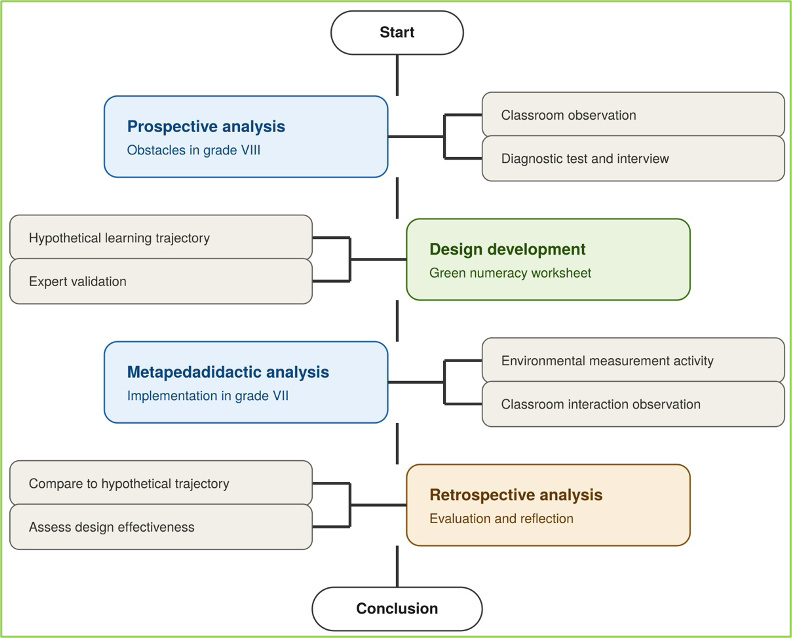
Students still experience learning obstacles in understanding the concepts of triangles and quadrilaterals, particularly in distinguishing base and height, applying area formulas to non-routine problems, and connecting learning with real-life contexts, resulting in a gap between procedural and conceptual knowledge. This study aims to describe the learning obstacles experienced by students in understanding the concepts of triangles and quadrilaterals, and to design and test the effectiveness of a green numeracy-based didactic design in improving students’ conceptual understanding. This study employed a descriptive qualitative approach with a Didactical Design Research (DDR) design consisting of prospective, metapedadidactic, and retrospective analysis stages. Participants were 33 seventh-grade and 32 eighth-grade students at a private Islamic junior high school in East Lombok Regency, aged 12–14 years, selected through purposive sampling. Instruments included a semi-structured interview guide, an observation sheet, a five-item written test, and a document checklist. Data were analyzed using a qualitative descriptive approach with didactic analysis, involving data reduction, data display, linkage with the Theory of Didactical Situations, triangulation, and conclusion drawing. The results showed that students experienced ontogenic, epistemological, and didactical obstacles, reflected in a gap between memorized formulas and conceptual understanding; following the implementation of the green numeracy-based didactic design, significant improvements occurred in conceptual understanding, learning engagement, and student confidence; and learning that connected real-world measurement with the surrounding environment was shown to encourage students to construct understanding independently rather than merely repeating formulas. This study concludes that the green numeracy-based didactic design effectively addresses learning obstacles in triangles and quadrilaterals. Future researchers are recommended to expand the participant pool, extend the implementation duration, and integrate technology as well as more diverse environmental contexts.
Downloads
References
Ahmad, M., & Wilkins, S. (2024). Purposive sampling in qualitative research: A framework for the entire journey. Quality & Quantity, 59(2), 1461–1479. https://doi.org/10.1007/s11135-024-02022-5
Akar, N., & Işıksal-Bostan, M. (2024). The didactic transposition of quadrilaterals: The case of 5th grade in Turkey. International Journal of Mathematical Education in Science and Technology, 55(3), 628–649. https://doi.org/10.1080/0020739X.2021.2022228
Ayan-Civak, R., Baktemur, G., & Işıksal-Bostan, M. (2021). Pre-service middle school mathematics teachers’ (mis)conceptions of definitions, classifications, and inclusion relations of quadrilaterals. European Journal of Science and Mathematics Education, 9(4), 183–198. https://doi.org/10.30935/scimath/11206
Bintara, I. A., & Prabawanto, S. (2024). Learning obstacles of junior high school students on the concept of triangle. KnE Social Sciences, 9(13), 500–509. https://doi.org/10.18502/kss.v9i13.15952
Delamontano, E., Endyana, C., Winoto, Y., & Novianti, E. (2025). Developing environmental numeracy materials through problem-based learning and contextual mathematics for young learners. Mimbar Sekolah Dasar, 12(3), 510–525. https://doi.org/10.53400/mimbar-sd.v12i3.89170
Durmaz, A., & Işıksal Bostan, M. (2022). Pre-service teachers’ knowledge regarding the area of triangle. European Journal of Science and Mathematics Education, 10(2), 208–224. https://doi.org/10.30935/scimath/11716
Ekawati, R., Kohar, A. W., Siswono, T. Y. E., Lukito, A., Yang, K.-L., & Nisa, K. (2023). Mathematics teacher educators’ noticing of pedagogical content knowledge on hierarchical classification of quadrilateral. Infinity Journal, 12(2), 261–274. https://doi.org/10.22460/infinity.v12i2.p261-274
Fardian, F., Suryadi, D., & Fauzi, A. (2024). Didactical design research in mathematics education: A bibliometric analysis. Infinity Journal, 13(1), 1–18. https://doi.org/10.22460/infinity.v13i1.19823
Genc, M., & Ergan, S. (2022). Teaching geometry through didactical situations: The case of the triangle inequality. Acta Didactica Napocensia, 15(2), 123–141. https://doi.org/10.24193/adn.15.2.8
Guo, W. (2022). Exploratory case study on solving word problems involving triangles by pre-service mathematics teachers in a regional university in Australia. Mathematics, 10(20), 3786. https://doi.org/10.3390/math10203786
Hariyani, M., Herman, T., Suryadi, D., & Prabawanto, S. (2022). Exploration of student learning obstacles in solving fraction problems in elementary school. International Journal of Educational Methodology, 8(3), 505–515. https://doi.org/10.12973/ijem.8.3.505
Hendriyanto, A., Suryadi, D., Juandi, D., Dahlan, J. A., Hidayat, R., Wardat, Y., Sahara, S., & Muhaimin, L. H. (2024). The didactic phenomenon: Deciphering students’ learning obstacles in set theory. Journal on Mathematics Education, 15(2), 517–544. https://doi.org/10.22342/jme.v15i2.pp517-544
Hortelano, J. C., & Prudente, M. (2024). Effects of the theory of didactical situations’ application in mathematics education: A metasynthesis. Journal of Pedagogical Research, 8(3), 246–262. https://doi.org/10.33902/JPR.202426908
Isnawan, M. G., Suryadi, D., & Turmudi, T. (2022). How do secondary students develop the meaning of fractions? A hermeneutic phenomenological study. Beta: Jurnal Tadris Matematika, 15(1), 1–19. https://doi.org/10.20414/betajtm.v15i1.496
Lindenbauer, E., Infanger, E. M., & Lavicza, Z. (2024). Enhancing mathematics education through collaborative digital material design: Lessons from a national project. European Journal of Science and Mathematics Education, 12(2), 276–296. https://doi.org/10.30935/scimath/14161
Lutfi, M. K., Juandi, D., & Jupri, A. (2021). Students’ ontogenic obstacle on the topic of triangle and quadrilateral. Journal of Physics: Conference Series, 1806(1), 012108, 1–6. https://doi.org/10.1088/1742-6596/1806/1/012108
Marfuah, M., Suryadi, D., & Turmudi, T. (2023). Mathematics teachers’ interviewing strategies for diagnosing students’ learning obstacles. JPI (Jurnal Pendidikan Indonesia), 12(2), 325–339. https://doi.org/10.23887/jpiundiksha.v12i2.57042
Marfuah, M., Suryadi, D., Turmudi, T., & Isnawan, M. G. (2022). Providing online learning situations for in-service mathematics teachers’ external transposition knowledge during COVID-19 pandemic: Case of Indonesia. Electronic Journal of e-Learning, 20(1), 69–84. https://doi.org/10.34190/ejel.20.1.2388
Naufal, M. A., Abdullah, A. H., Osman, S., Abu, M. S., Ihsan, H., & Rondiyah. (2021). Reviewing the Van Hiele model and the application of metacognition on geometric thinking. International Journal of Evaluation and Research in Education, 10(2), 401–411. https://doi.org/10.11591/ijere.v10i2.21185
Nopriana, T., Herman, T., & Martadiputra, B. A. P. (2023). Digital didactical design: The role of learning obstacles in designing combinatorics digital module for vocational students. International Journal of Interactive Mobile Technologies, 17(2), 4–23. https://doi.org/10.3991/ijim.v17i02.34293
Nursyahidah, F., Albab, I. U., & Mulyaningrum, E. R. (2023). Learning design of quadrilateral STEM-based through lesson study. Eurasia Journal of Mathematics, Science and Technology Education, 19(11), em2352. https://doi.org/10.29333/ejmste/13747
Prabowo, A., Suryadi, D., Dasari, D., Juandi, D., & Junaedi, I. (2022). Learning obstacles in the making of lesson plans by prospective mathematics teacher students. Education Research International, 2022, Article 2896860. https://doi.org/10.1155/2022/2896860
Ramdhani, M. A., Suryadi, D., & Turmudi, T. (2023). Analisis kesalahan konseptual dan prosedural siswa melalui desain didaktis [Analysis of students’ conceptual and procedural errors through didactic design]. Infinity Journal, 12(2), 211–224. https://doi.org/10.22460/infinity.v12i2.18372
Shahidayanti, T., Prahmana, R. C. I., & Fran, F. A. (2024). Integrating ethno-realistic mathematics education in developing three-dimensional instructional module. Journal of Honai Math, 7(3), 379–400. https://doi.org/10.30862/jhm.v7i3.698
Sidik, G. S., Suryadi, D., & Turmudi. (2021). Learning obstacle on addition and subtraction of primary school students: Analysis of algebraic thinking. Education Research International, 2021, 1–10. https://doi.org/10.1155/2021/5935179
Soneta, V., & Prabawanto, S. (2024). Learning obstacles in the concept of quadrilateral constructed areas. KnE Social Sciences, 2024(12), 561–568. https://doi.org/10.18502/kss.v9i13.15959
Suryadi, D., Herman, T., & Prabawanto, S. (2022). Didactical obstacles in mathematics learning. Journal of Physics: Conference Series, 2157(1), 012034. https://doi.org/10.1088/1742-6596/2157/1/012034
Taquette, S. R., & Souza, L. M. B. M. (2022). Ethical dilemmas in qualitative research: A critical literature review. International Journal of Qualitative Methods, 21. https://doi.org/10.1177/16094069221078731
Vale, I., & Barbosa, A. (2023). Active learning strategies for an effective mathematics teaching and learning. European Journal of Science and Mathematics Education, 11(3), 573–588. https://doi.org/10.30935/scimath/13135
Vásquez, C., Alsina, Á., Seckel, M. J., & García-Alonso, I. (2023). Integrating sustainability in mathematics education and statistics education: A systematic review. Eurasia Journal of Mathematics, Science and Technology Education, 19(11), em2357. https://doi.org/10.29333/ejmste/13809
Yenil, T., Arslan, Ç., & Broutin, M. S. T. (2023). Triangle inequality concept teaching: The theory of didactic situations case. Journal of Pedagogical Research, 7(4), 14–29. https://doi.org/10.33902/jpr.202318961
Downloads
Published
How to Cite
Issue
Section
License
Copyright (c) 2026 Samsuriadi Samsuriadi

This work is licensed under a Creative Commons Attribution-NonCommercial-ShareAlike 4.0 International License.