
Environmental awareness in two grade X classes using problem-based and project-based learning
DOI:
https://doi.org/10.59965/ijmsed.v4i2.338Keywords:
environmental awareness, problem-based learning, project-based learning, quasi-experiment, secondary educationAbstract
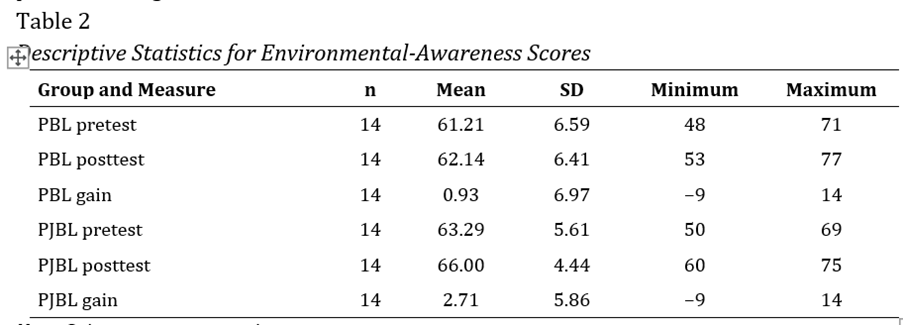
Comparative studies of problem-based learning (PBL) and project-based learning (PJBL) in Indonesian secondary schools have focused mainly on academic achievement, leaving limited evidence on how students’ environmental awareness changes under the two approaches. This study compared changes in environmental awareness during an environmental change unit taught in two Grade X classes at an Indonesian madrasah. Using a quasi-experimental pretest–posttest design, the study analyzed matched questionnaire scores from 28 students, with 14 in each class. Classroom observations provided descriptive evidence of students’ environmental behaviors during instruction. Mean questionnaire scores increased from 61.21 to 62.14 in the PBL class and from 63.29 to 66.00 in the PJBL class. The mean gain was 1.79 points higher in the PJBL class (approximate student-level 95% CI [−3.22, 6.79], p = .470). The PJBL class also received higher ratings on all six observed behavioral indicators. With one class per approach, the differences may reflect classroom characteristics, implementation, or opportunities to display the rated behaviors. The study contributes classroom-level evidence by comparing questionnaire scores with behaviors observed during instruction. It also identifies a priority for future comparisons: assess students from multiple classes per approach using the same behavioral tasks and scoring criteria.
References
Ardoin, N. M., Bowers, A. W., Roth, N. W., & Holthuis, N. (2018). Environmental education and K–12 student outcomes: A review and analysis of research. The Journal of Environmental Education, 49(1), 1–17. https://doi.org/10.1080/00958964.2017.1366155
Ardoin, N. M., Bowers, A. W., & Gaillard, E. (2020). Environmental education outcomes for conservation: A systematic review. Biological Conservation, 241, 108224. https://doi.org/10.1016/j.biocon.2019.108224
Bamberg, S., & Möser, G. (2007). Twenty years after Hines, Hungerford, and Tomera: A new meta-analysis of psycho-social determinants of pro-environmental behaviour. Journal of Environmental Psychology, 27(1), 14–25. https://doi.org/10.1016/j.jenvp.2006.12.002
Barron, B. J. S., Schwartz, D. L., Vye, N. J., Moore, A., Petrosino, A., Zech, L., Bransford, J. D., & The Cognition and Technology Group at Vanderbilt. (1998). Doing with understanding: Lessons from research on problem- and project-based learning. The Journal of the Learning Sciences, 7(3–4), 271–311. https://doi.org/10.1080/10508406.1998.9672056
Bell, S. (2010). Project-based learning for the 21st century: Skills for the future. The Clearing House: A Journal of Educational Strategies, Issues and Ideas, 83(2), 39–43. https://doi.org/10.1080/00098650903505415
Chen, C.-H., & Yang, Y.-C. (2019). Revisiting the effects of project-based learning on students’ academic achievement: A meta-analysis investigating moderators. Educational Research Review, 26, 71–81. https://doi.org/10.1016/j.edurev.2018.11.001
Dochy, F., Segers, M., Van den Bossche, P., & Gijbels, D. (2003). Effects of problem-based learning: A meta-analysis. Learning and Instruction, 13(5), 533–568. https://doi.org/10.1016/S0959-4752(02)00025-7
Faza, F. S., Suwarno, & Sriyanto. (2023). Comparison of problem-based learning and project-based learning models in geography subjects at MA PPPI Miftahussalam Banyumas. International Journal of Education and Literature, 2(2), 144–152. https://doi.org/10.55606/ijel.v2i2.73
Gifford, R., & Nilsson, A. (2014). Personal and social factors that influence pro-environmental concern and behaviour: A review. International Journal of Psychology, 49(3), 141–157. https://doi.org/10.1002/ijop.12034
Gijbels, D., Dochy, F., Van den Bossche, P., & Segers, M. (2005). Effects of problem-based learning: A meta-analysis from the angle of assessment. Review of Educational Research, 75(1), 27–61. https://doi.org/10.3102/00346543075001027
Greenland, S., Senn, S. J., Rothman, K. J., Carlin, J. B., Poole, C., Goodman, S. N., & Altman, D. G. (2016). Statistical tests, P values, confidence intervals, and power: A guide to misinterpretations. European Journal of Epidemiology, 31, 337–350. https://doi.org/10.1007/s10654-016-0149-3
Guo, P., Saab, N., Post, L. S., & Admiraal, W. (2020). A review of project-based learning in higher education: Student outcomes and measures. International Journal of Educational Research, 102, Article 101586. https://doi.org/10.1016/j.ijer.2020.101586
Handley, M. A., Lyles, C. R., McCulloch, C., & Cattamanchi, A. (2018). Selecting and improving quasi-experimental designs in effectiveness and implementation research. Annual Review of Public Health, 39, 5–25. https://doi.org/10.1146/annurev-publhealth-040617-014128
Hines, J. M., Hungerford, H. R., & Tomera, A. N. (1987). Analysis and synthesis of research on responsible environmental behavior: A meta-analysis. The Journal of Environmental Education, 18(2), 1–8. https://doi.org/10.1080/00958964.1987.9943482
Hmelo-Silver, C. E. (2004). Problem-based learning: What and how do students learn? Educational Psychology Review, 16(3), 235–266. https://doi.org/10.1023/B:EDPR.0000034022.16470.f3
Hungerford, H. R., & Volk, T. L. (1990). Changing learner behavior through environmental education. The Journal of Environmental Education, 21(3), 8–21. https://doi.org/10.1080/00958964.1990.10753743
Kokotsaki, D., Menzies, V., & Wiggins, A. (2016). Project-based learning: A review of the literature. Improving Schools, 19(3), 267–277. https://doi.org/10.1177/1365480216659733
Kollmuss, A., & Agyeman, J. (2002). Mind the gap: Why do people act environmentally and what are the barriers to pro-environmental behavior? Environmental Education Research, 8(3), 239–260. https://doi.org/10.1080/13504620220145401
Kormos, C., & Gifford, R. (2014). The validity of self-report measures of proenvironmental behavior: A meta-analytic review. Journal of Environmental Psychology, 40, 359–371. https://doi.org/10.1016/j.jenvp.2014.09.003
Krajcik, J. S., & Blumenfeld, P. C. (2006). Project-based learning. In R. K. Sawyer (Ed.), The Cambridge handbook of the learning sciences (pp. 317-334). Cambridge University Press. https://doi.org/10.1017/CBO9780511816833.020
Loyens, S. M. M., van Meerten, J. E., Schaap, L., & Wijnia, L. (2023). Situating higher-order, critical, and critical-analytic thinking in problem- and project-based learning environments: A systematic review. Educational Psychology Review, 35, Article 39. https://doi.org/10.1007/s10648-023-09757-x
Markula, A., & Aksela, M. (2022). The key characteristics of project-based learning: How teachers implement projects in K–12 science education. Disciplinary and Interdisciplinary Science Education Research, 4, Article 2. https://doi.org/10.1186/s43031-021-00042-x
Savery, J. R. (2006). Overview of problem-based learning: Definitions and distinctions. Interdisciplinary Journal of Problem-Based Learning, 1(1), 9–20. https://doi.org/10.7771/1541-5015.1002
Sitohang, A. L., & Damanik, M. R. S. (2024). Differences in geography learning outcomes with PBL (problem based learning) and PjBL (project based learning) models at SMA Negeri 10 Medan. JPG (Jurnal Pendidikan Geografi), 11(2), 56–65. https://doi.org/10.20527/jpg.v11i2.19041
Stern, P. C. (2000). New environmental theories: Toward a coherent theory of environmentally significant behavior. Journal of Social Issues, 56(3), 407–424. https://doi.org/10.1111/0022-4537.00175
van de Wetering, J., Leijten, P., Spitzer, J., & Thomaes, S. (2022). Does environmental education benefit environmental outcomes in children and adolescents? A meta-analysis. Journal of Environmental Psychology, 81, Article 101782. https://doi.org/10.1016/j.jenvp.2022.101782
Vickers, A. J., & Altman, D. G. (2001). Analysing controlled trials with baseline and follow up measurements. BMJ, 323(7321), 1123–1124. https://doi.org/10.1136/bmj.323.7321.1123
Walker, A., & Leary, H. (2009). A problem based learning meta analysis: Differences across problem types, implementation types, disciplines, and assessment levels. Interdisciplinary Journal of Problem-Based Learning, 3(1), 12–43. https://doi.org/10.7771/1541-5015.1061
Wijnia, L., Noordzij, G., Arends, L. R., Rikers, R. M. J. P., & Loyens, S. M. M. (2024). The effects of problem-based, project-based, and case-based learning on students’ motivation: A meta-analysis. Educational Psychology Review, 36, Article 29. https://doi.org/10.1007/s10648-024-09864-3
Zhang, L., & Ma, Y. (2023). A study of the impact of project-based learning on student learning effects: A meta-analysis study. Frontiers in Psychology, 14, Article 1202728. https://doi.org/10.3389/fpsyg.2023.1202728
Downloads
Published
Issue
Section
License
Copyright (c) 2026 Nurul Aini, Ahmad Fadli, Siti Wardatul Jannah, Masna Mirasan

This work is licensed under a Creative Commons Attribution-ShareAlike 4.0 International License.


