
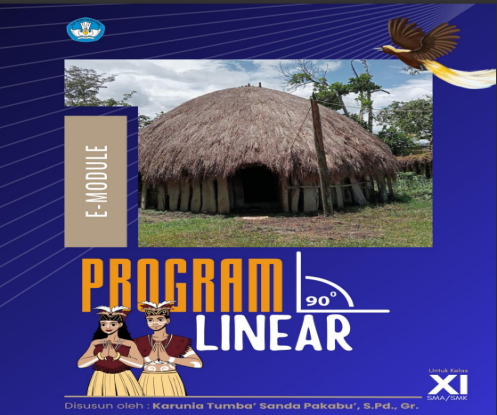
Developing Papuan cultural contextual E-Module learning devices in linear programs to improve students' mathematical problem-solving skills
DOI:
https://doi.org/10.59965/ijmsed.v2i1.107Keywords:
Papuan Culture, E-Module, Problem Solving Skills, Linear ProgramAbstract
Using e-modules in learning has improved students' mathematical problem-solving abilities. However, the design of e-modules that integrate local culture is still rarely developed. This study aims to create a contextual e-module that reflects the culture of the Papuan community at State Vocational School I Agribusiness and Agrotechnology Nduga. This study used research and development (R&D) methods with the ADDIE model, which includes the stages of Analysis, Design, Development, Implementation, and Evaluation. The participants in this study included material, language, media experts, teachers, and eleventh-grade students. Qualitative data were collected through respondent suggestions, and quantitative data were obtained through validation questionnaires and student testing. The analysis results showed that the Papuan cultural contextual e-module was valid, with percentages of 77.33% from material experts, 73.33% from language experts, and 68.88% from media experts. Teacher and student responses showed excellent practicality, with averages of 93.33% from teachers and 85.28% from students. In addition, the pre-test and post-test results showed a significant improvement in students' mathematical problem-solving abilities, with the KKM achievement level reaching 95.5% and a significance value (Sig. 2-tailed) < 0.001. Therefore, the contextual e-module based on Papuan culture can be an effective supplementary teaching material in mathematics learning, especially in linear programming material.
References
Abdulrahim, N. A., & Orosco, M. J. (2020). Culturally responsive mathematics teaching: A research synthesis. The Urban Review, 52(1), 1-25. https://doi.org/10.1007/s11256-019-00509-2
Almarashdi , HS, & Jarrah, AM (2023). Assessing tenth-grade students' mathematical literacy skills in solving PISA problems. Social Sciences, 12 (1), 33. https://doi.org/10.3390/socsci12010033
Aini, AQ, Leksono, SM, & Kurniasih, S. (2024). Validity of research-based e-modules on conservation themes towards environmental literacy attitudes of junior high school students. BIO-INOVED: Journal of Biology-Educational Innovation, 6 (1), 89-97. http://dx.doi.org/10.20527/bino.v6i1.17664
Akbar, S. D. (2013). Learning device instruments. Bandung: PT Remaja Rosdakarya.
Ananda, E. R., & Wandini, R. R. (2022). Analisis kemampuan literasi matematika siswa ditinjau dari self efficacy siswa. Jurnal Obsesi: Jurnal Pendidikan Anak Usia Dini, 6(5).
Arruabarrena, R., Sánchez, A., Domínguez, C., & Jaime, A. (2021). A novel taxonomy of student-generated video styles. International Journal of Educational Technology in Higher Education, 18, 1-20
Bakker, A., Cai, J., & Zenger, L. (2021). Future themes of mathematics education research: An international survey before and during the pandemic. Educational Studies in Mathematics, 107(1), 1-24. https://doi.org/10.1007/s10649-021-10049-w
Bhat, G. M., Bhat, I. H., Shahdad, S., Rashid, S., Khan, M. A., & Patloo, A. A. (2022). Analysis of feasibility and acceptability of an e‐learning module in anatomy. Anatomical Sciences Education, 15(2), 376-391. https://doi.org/10.1002/ase.2096
Cai, T., Wallace, S., Rezvanian, T., Dobres, J., Kerr, B., Berlow, S., ... & Bylinskii, Z. (2022, June). Personalized font recommendations: Combining ml and typographic guidelines to optimize readability. In Proceedings of the 2022 ACM Designing Interactive Systems Conference (pp. 1-25). https://doi.org/10.1145/3532106.3533457
Crompton, H., Jones, M. V., Sendi, Y., Aizaz, M., Nako, K., Randall, R., & Weisel, E. (2024). Examining technology use within the ADDIE framework to develop professional training. European Journal of Training and Development, 48(3/4), 422-454. https://doi.org/10.1108/EJTD-12-2022-0137
Dhumal, A. R., Kulkarni, A. P., & Ambhore , N. H. (2023). A comprehensive review on thermal management of electronic devices. Journal of Engineering and Applied Science , 70 (1), 140. DOI: 10.1186/s44147-023-00309-2
El-Sabagh, H. A. (2021). Adaptive e-learning environment based on learning styles and its impact on development students' engagement. International Journal of Educational Technology in Higher Education, 18(1), 53. https://doi.org/10.1186/s41239-021-00289-4
Felici, J. (2011). The complete manual of typography: a guide to setting perfect type. Adobe Press.
Firman, F., & Mirnawati, M. (2023, August). How to develop scientific writing techniques teaching materials with the development of the Borg & Gall model. In AIP Conference Proceedings (Vol. 2805, No. 1). AIP Publishing. https://doi.org/10.1063/5.0148011
Nixon, M. P., Momotaz, F., Smith, C., Smith, J. S., Sendak, M., Polage, C., & Silverman, J. D. (2024). From Pre-test and Post-test Probabilities to Medical Decision Making. medRxiv. https://bmcmedinformdecismak.biomedcentral.com/articles/10.1186/s12911-024-02610-3
Gufran, G., & Mataya, I. (2020). Pemanfaatan e-modul berbasis smartphone sebagai media literasi masyakarat. JISIP (Jurnal Ilmu Sosial dan Pendidikan), 4(2). http://dx.doi.org/10.58258/jisip.v4i2.1060
Handog, S., & Aliazas, J. V. Adaptive (2024) E-Learning Module In Teaching Physical Science For Improved Student Engagement And Critical Thinking Skills. International Journal for Science and Advance Research in Technology, 10(3), 808-828.
Herlina, E., & Abidin, Z. (2024). Development of interactive e-modules to improve students’ scientific literacy abilities: A literature review. Jurnal Mangifera Edu, 8(2), 74-87. https://doi.org/10.31943/mangiferaedu.v8i2.181
Hershman, R., Share, D. L., Weiss, E. M., Henik, A., & Shechter, A. (2024). Insights from Eye Blinks into the Cognitive Processes Involved in Visual Word Recognition. Journal of cognition, 7(1). https://doi.org/10.5334%2Fjoc.343
Holm, J., & Kajander, A. (2024) Lessons Learned about Effective Professional Development: Two Contrasting Case Studies International Journal of Education in Mathematics, Science and Technology (IJEMST). https://doi.org/10.29333/iejme
Islahiyah, I., Pujiastuti, H., & Mutaqin, A. (2021). Pengembangan e-modul dengan model pembelajaran berbasis masalah untuk meningkatkan kemampuan pemecahan masalah matematis siswa. AKSIOMA: Jurnal Program Studi Pendidikan Matematika, 10(4), 2107-2118. https://doi.org/10.24127/ajpm.v10i4.3908
Kafadar, K. (2021). Statistical significance, P-values, and replicability. The Annals of Applied Statistics , 15 (3), 1081-1083. https://doi.org/10.1214/21-AOAS1500
Lanzani, G. (2022). Correlation made simple: Applications to salience and regret theory. The Quarterly Journal of Economics , 137 (2), 959-987. https://doi.org/10.1093/qje/qjab041
Latif, NS, & Talib, A. (December 2021). Development of ethnomathematics e-module based on local wisdom to improve students' cultural and citizenship literacy. In International Conference on Mathematics Education Studies (ICoESM 2021) (pp. 112-120). Atlantis Press. https://doi.org/10.2991/assehr.k.211211.020
Lestari , FD, Syahbana, A., & Retta, AM (2022). Development of Linear Programming E-Modules Based on Students' Conceptual Understanding. Kreano, Journal of Creative-Innovative Mathematics , 13 (2), 234-245. https://orcid.org/0000-0001-7265-524X
Mamakou, X.J., Zaharias, P., & Milesi, M. (2024). Measuring customer satisfaction in e-commerce: The impact of e-service quality and user experience. International Journal of Quality & Reliability Management, 41 (3), 915-943. https://doi.org/10.1108/IJQRM-07-2021-0215
Matthews, R. (2021). The p-value statement, five years on. Significance , 18 (2), 16-19. https://doi.org/10.1111/1740-9713.01505
Maqsood, M., Zahid, A., Asghar, T., & Shahbaz, M. (2024). Issues in Teaching English in Cultural Context. Migration Letters, 21 (S4), 1020-1027. https://doi.org/10.59670/ml.v21iS4.7411
Marlena , N., Patrikha, FD, & Dwijayanti, R. (2022). Electronic Modules in Indonesian Higher Education: Conceptualization, Development and Application. AL-ISHLAH: Journal of Education, 14 (3), 3943-3954. https://doi.org/10.35445/alishlah.v14i3.1473
Maryani, S., Astalini, A., & Kurniawan, DA (2022). Analysis of student needs for the development of innovative e-module learning media on linear equations of mathematical physics. Journal of Innovative Education , 4 (1), 164-172. http://dx.doi.org/10.51278/aj.v4i1.344
Meaney, T., & Trinick, T. (2020). Indigenous students in mathematics education. Encyclopedia of mathematics education, 369-373. . DOI: 10.1007/978-3-030-15789-0_76
Mesra, R. (2023). Research & development dalam pendidikan. https://doi.org/10.31219/osf.io/d6wck
Poernomo, E., Kurniawati, L., & Atiqoh, K. S. N. (2021). Studi literasi matematis. ALGORITMA: Journal of Mathematics Education, 3(1), 83-100. http://dx.doi.org/10.15408/ajme.v3i1.20479
Okpatrioka, O. (2023). Research and development (R&D) penelitian yang inovatif dalam pendidikan. Dharma Acariya Nusantara: Jurnal Pendidikan, Bahasa dan Budaya, 1(1), 86-100. https://doi.org/10.47861/jdan.v1i1.154
Raharjo, H., Haqq, AA, & Larsari, VN (2023). Empowering Students in the Digital Era: Analysis of the Influence of Interactive E-Modules on Digital Mathematics Communication. International Journal of Mathematics and Mathematics Education, 132-149. https://doi.org/10.56855
Rahman , L., Silaban, R., & Nurfajriani, N. (2023, January). Effectiveness of using professional flip pdf-assisted chemistry e-modules in improving learning outcomes and motivating students. In AIP Conference Proceedings (Vol. 2642, No. 1). AIP Publishing. https://doi.org/10.1063/5.0110063
Restiana , S., Agustina, R., Rahman, J., Ananda, R., & Witarsa, R. (2022). National Education Process Standards: Implementation and Analysis of Mathematics Teacher Components at Muhammadiyah Elementary School 027 Batubelah. MASALIQ , 2 (4), 489-504
Russell , J.L., DiNapoli, J., & Murray, E. (2022). Documenting professional learning focused on the application of high-quality learning materials in mathematics: the AIM–TRU learning cycle. International Journal of STEM Education , 9 (1), 46.
Santos-Trigo, M. (2024). Problem solving in mathematics education: exploring its foundations and current research-practice trends. ZDM–Mathematics Education , 1-12. https://doi.org/10.1007/s11858-024-01578-8
Sohail, M., Mohsin, Z., & Khaliq, S. (2021, July). User satisfaction with AI-powered customer relationship management chatbot. In International Conference on Human-Computer Interaction (pp. 279-287). Cham: Springer International Publishing. https://doi.org/10.1007/978-3-030-90176-9_36
Situmorang, M., Yustina, Y., & Syafii, W. (2020). Development of e-modules using kvisoft flipbook maker through problem-based learning models to increase learning motivation. Journal of Educational Sciences , 4 (4), 834. https://doi.org/10.31258/jes.4.4.p.834-848
Solehah, H., & Setiawan, D. (2023). Kurikulum merdeka dan penilaian pembelajaran matematika dalam membangun generasi matematika yang kompeten (studi literatur). Jurnal Pendidikan Tambusai, 7(3), 23929-23940. https://doi.org/10.31004/jptam.v7i3.10406
Spatioti , A.G., Kazanidis , I., & Pange , J. (2022). A comparative study of ADDIE instructional design models in distance education. Information , 13 (9), 402. https ://doi.org/10.3390/info13090402
Suryawan, I. P. P., Sudiarta, I. G. P., & Suharta, I. G. P. (2023). Students' Critical Thinking Skills in Solving Mathematical Problems: Systematic Literature Review. Indonesian Journal Of Educational Research and Review, 6(1), 120-133. https://doi.org/10.23887/ijerr.v6i1.56462
Sriyanti, A., Wahyuni, S., Latuconsina, N. K., & Amin, R. (2022). Pengembangan E-Modul berbantuan software Sigil dengan pendekatan kontekstual pada materi program linear peserta didik kelas XI. Jurnal Cendekia: Jurnal Pendidikan Matematika, 6(1), 300-313. https://doi.org/10.31004/cendekia.v6i1.1070
Syahmani, S., Rahmatilah, J., Winarti, A., Kusasi, M., Iriani, R., & Prasetyo, YD (2022). Development of Ethnoscience-Based Guided Inquiry Learning Modules to Improve Students' Problem-Solving Skills in Chemistry Learning. Journal of Educational and Cultural Research Innovation, 3 (4), 670-682. https://doi.org/10.46843/jiecr.v3i4.363
Tafazoli, D. (2024). Guest editorial: SHOCKING culture: the interaction between language, technology, and culture. Journal of Multicultural Education, 18 (1/2), 1-5. https://www.emerald.com/insight/content/doi/10.1108/JME-06-2024-240/full/html
Taufan, M., Dejarlo, J. O., Rosa, A. J., Hidayat, R., & Sunanto, E. (2024). Involving students and prospective mathematics teachers through the use of the Think Pair Share design: The impact on increasing students' activeness and learning outcomes in plane geometry. International Journal of Didactic Mathematics in Distance Education, 1(1), 47-53. https://doi.org/10.33830/ijdmde.v1i1.7876
Widoyoko, E. P. (2015). Penilaian Hasil Pembelajaran di Sekolah. Yogyakarta:Pustaka Pelajar
Wizhar, A, B., Yunianta, H, N, T,. & Setyadi, D. (2023). Development of side space building e-modules flat with codular application as. 7(1), 416–426. https://doi.org/10.31100/histogram.v7i1.2548
Ying Lo, T (2023) Investigation of Culturally Integrated Mathematics Remedial Module on Indigenous Students' Learning Outcomes, international journal of teaching. Education and learning. https://doi.org/10.20319/pijtel.2023.72.180195
Yusmar, F., & Fadilah, R. E. (2023). Analisis rendahnya literasi sains peserta didik indonesia: Hasil PISA dan faktor penyebab. LENSA (Lentera Sains): Jurnal Pendidikan IPA, 13(1), 11-19. https://doi.org/10.24832/jpnk.v4i1.1157
Zulmaulida, R., Saputra, E., Munir, M., Zanthy, L. S., Wahnyuni, M., Irham, M., & Akmal, N. (2021). Problematika pembelajaran matematika. Yayasan Penerbit Muhammad Zaini
Downloads
Published
How to Cite
Issue
Section
License
Copyright (c) 2024 Karunia Tumba Sanda Pakabu*, Sudirman, Thesa Kandaga, Camilo Andrés Rodríguez-Nieto, Jenisus O. Dejarlof

This work is licensed under a Creative Commons Attribution-ShareAlike 4.0 International License.


