
The influence of the problem solving learning model on students' self-confidence and learning outcomes in mathematics learning
DOI:
https://doi.org/10.59965/pijme.v4i1.288Keywords:
Problem Solving Learning Model;, Self-Confidence, Learning Outcomes, InfluenceAbstract
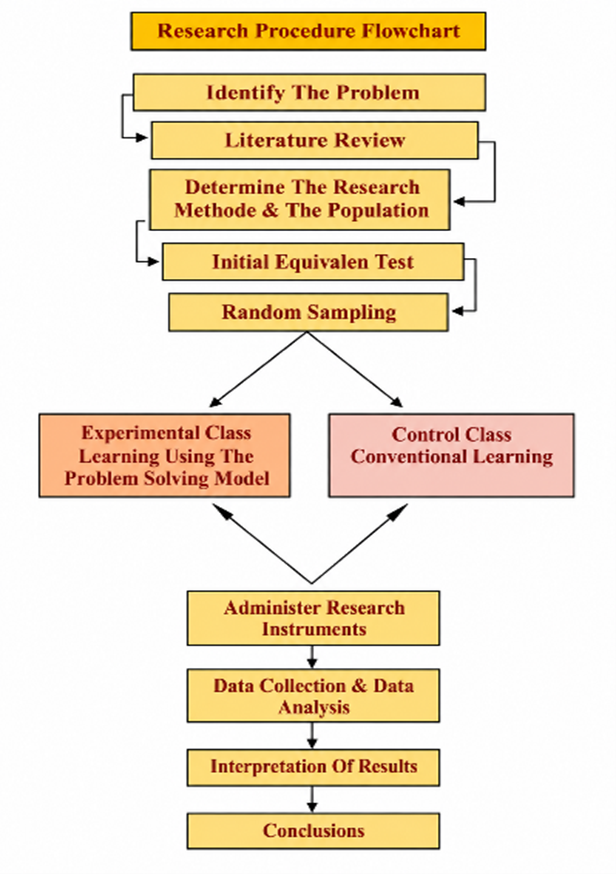
This study was motivated by the low mathematics learning outcomes and self-confidence of eleventh grade students. Most students have not reached the minimum completion limit of 75. In addition, the learning process is still teacher-centered so that students tend to feel bored, lack focus, and lack confidence in solving mathematical problems. This study aims to determine the effect of the Problem-Solving learning model on self-confidence and mathematics learning outcomes. The design of this study is a static group comparison design. Participants were selected using a random sampling technique, with class XI F2 as the control class and class XI F3 as the experimental class. The research instruments used were a self-confidence questionnaire and a mathematics learning outcome test. Data were analyzed using a t-test with the help of SPSS software at a significance level of 0.05. The results showed that the Problem-Solving learning model had a significant effect on students’ self-confidence, as indicated by a significance value of 0.004 <0.05. In addition, the Problem-Solving learning model also had a significant effect on students’ mathematics learning outcomes with a significance value of 0.015 <0.05. Thus, it can be concluded that the application of the Problem-Solving learning model is able to improve self-confidence and mathematics learning outcomes. As a recommendation, the Problem-Solving learning approach is suggested as one of the strategic choices in mathematics education to increase students’ self-confidence and learning achievements, and can be considered for application to various materials and different levels of education.
Downloads
References
Alturki, U., & Aldraiweesh, A. (2023). The factors influencing 21st century skills and problem-solving skills: the acceptance of blackboard as sustainable education. Sustainability, 15(17), 12845. https://doi.org/10.3390/su151712845
Amry, Z., & Syahputra, H. (2020). Contribution of mathematical anxiety, learning motivation and self-confidence to student’s mathematical Problem-Solving. Budapest International Research and Critics in Linguistics and Education (BirLE) Journal, 3(4), 1759–1772. https://doi.org/10.33258/birle.v3i4.1343
Aprisal, & Abadi, A. M. (2018). Improving students’ mathematical reasoning and self-efficacy through Missouri Mathematics Project and problem-solving. Beta: Jurnal Tadris Matematika, 11(2), 191–208. https://doi.org/10.20414/betajtm.v11i2.206
Azzahra, L., & Nurhanurawati. (2024). Problem-solving analysis in solving HOTS problems judging from self-confidence. Desimal: Jurnal Matematika, 7(2), 359–372. https://doi.org/10.24042/djm.v7i2.22675
Bendol, R. L., & Jr, R. H. D. (2025). Students’ confidence in mathematics: A comprehensive literature review. Indonesian Journal of Multidisciplinary Research, 5(1), 187–196. https://doi.org/10.17509/ijomr.v5i1.82065
Brand, C., Hartmann, C., Loibl, K., & Rummel, N. (2023). Do students learn more from failing alone or in groups? Insights into the effects of collaborative versus individual Problem-Solving in productive failure. Instructional Science, 51(6), 953–976. https://doi.org/10.1007/s11251-023-09619-7
Boadu, S. K., & Boateng, F. O. (2024). Enhancing students’ achievement in mathematics education in the 21st century through technology integration, collaborative learning, and student motivation: The mediating role of student interest. Eurasia Journal of Mathematics, Science and Technology Education, 20(11), em2534. https://doi.org/10.29333/ejmste/15622
Clemente, J. M., & Ypon, A. Q. (2024). Enhancing mathematics self-efficacy: Intervention strategies and effectiveness – a systematic review. IMJRISE International Multidisciplinary Journal of Research for Innovation, Sustainability, and Excellence, 1(2), 274–280. https://doi.org/10.5281/zenodo.11156710
Dermawan, D. A., Siagian, P., & Sinaga, B. (2020). Analysis of students’ mathematical Problem-Solving ability in terms of student learning styles with models problem based learning. Budapest International Research and Critics in Linguistics and Education (BirLE) Journal, 4(1), 337–344. https://doi.org/10.33258/birle.v4i1.1607
Efwan, N. S., Afriansyah, E. A., Luritawaty, I. P., Arwadi, F., & Yadav, D. K. (2024). The level of students' mathematical creative thinking skills as measured by their self-confidence. International Journal of Didactic Mathematics in Distance Education, 1(2), 125–136. https://doi.org/10.33830/ijdmde.v1i2.9355
Gillies, R. M. (2017). Promoting academically productive student dialogue during collaborative learning. International Journal of Educational Research, 85, 1–12. https://doi.org/10.1016/j.ijer.2017.07.014
Hendriana, H., Johanto, T., & Sumarmo, U. (2018). The role of problem-based learning to improve students’ mathematical problem-solving ability. Journal on Mathematics Education, 9(2), 291–300. https://doi.org/10.22342/jme.9.2.5394.291-300
Isnawan, M. G., Belbase, S., & Yanuarto, W. N. (2024). Implementation of a hybrid mathematics module to minimize students' learning obstacles when interpreting fractions. International Journal of Didactic Mathematics in Distance Education, 1(2), 83–101. https://doi.org/10.33830/ijdmde.v1i2.9555
Kharroubi, S., & El Mediouni, A. (2024). Conceptual review: Cultivating learner autonomy through self-directed learning & self-regulated learning: A socio-constructivist exploration. International Journal of Language and Literary Studies, 6(2), 276–296. https://doi.org/10.36892/ijlls.v6i2.1649
Korkor, S., & Bonyah, E. (2024). Investigating pre-tertiary students' mistakes in solving algebraic word problems: Insights from Asutifi North District, Ghana. International Journal of Didactic Mathematics in Distance Education, 1(2), 137–146. https://doi.org/10.33830/ijdmde.v1i2.9185
Krisnadi, E., & Kandaga, T. (2024). Fostering prospective teachers’ disposition: A lesson study in linear programming topics embedded by technology. Polyhedron International Journal in Mathematics Education, 2(1), 10–17. https://doi.org/10.59965/pijme.v2i1.104
Kurnaz, A. (2018). Examining effects of mathematical problem-solving, mathematical reasoning and spatial abilities on gifted students’ mathematics achievement. World Scientific Research, 5(1), 37–43. https://doi.org/10.20448/journal.510.2018.51.37.43
Larenio, M. J. C., & Futalan, M. C. Z. (2025). Assessing 7th-grade students’ math problem-solving skills using Polya’s method. Journal of Interdisciplinary Perspective, 3(8), 63–70. https://doi.org/10.69569/jip.2025.357
Luttenberger, S., Wimmer, S., & Paechter, M. (2018). Spotlight on math anxiety. Psychology Research and Behavior Management, 12, 311–322. https://doi.org/10.2147/prbm.s141421
Mayangsari, C., & Qohar, A. (2025). Enhancing mathematical disposition and learning outcomes through team games tournament: A two-cycle action research on probability instruction in Indonesian secondary education. Polyhedron International Journal in Mathematics Education, 3(2), 110–126. https://doi.org/10.59965/pijme.v3i2.205
Mustikaningsih, D., Yumiati, Y., & Sudirman, S. (2025). Enhancing mathematical communication and learning independence through learning cycle 6E model with dynamic geometry software: A study of vocational high school students. Polyhedron International Journal in Mathematics Education, 3(2), 67–85. https://doi.org/10.59965/pijme.v3i2.262
Naz, B., & Qayyum, A. (2025). Effectiveness of problem-solving as a teaching strategy in enhancing students’ conceptual understanding and critical thinking in mathematics education. Research Journal for Social Affairs, 3(6), 693–702. https://doi.org/10.71317/rjsa.003.06.0500
Nopriana, T., Asnawati, S., Herman, T., Martadiputra, B. A. P., & Dejarlo, J. O. (2024). Investigating ontogenic and didactical obstacles faced by vocational high school students in solving counting rules problems. International Journal of Didactic Mathematics in Distance Education, 1(2), 102–114. https://doi.org/10.33830/ijdmde.v1i2.9524
Ozkal, N. (2019). Relationships between self-efficacy beliefs, engagement and academic performance in math lessons. Cypriot Journal of Educational Sciences, 14(2), 190–200. https://doi.org/10.18844/cjes.v14i2.3766
Parsons, S., Croft, T., & Harrison, M. (2011). Engineering students’ self-confidence in mathematics mapped onto Bandura’s self-efficacy. Engineering Education, 6(1), 52–61. https://doi.org/10.11120/ened.2011.06010052
Pourdavood, R., McCarthy, K., & McCafferty, T. (2020). The impact of mental computation on children’s mathematical communication, Problem-Solving, reasoning, and algebraic thinking. Athens Journal of Education, 7(3), 241–253. https://doi.org/10.30958/aje.7-3-1
Rahayuningdewi, P. D., & Faradillah, A. (2020). How does problem-solving method affect students’ self-confidence and mathematical understanding? Indonesian Journal of Science and Mathematics Education, 3(2), 165–177. https://doi.org/10.24042/ijsme.v3i2.6640
Rahmah, A., & Soro, S. (2022). Analysis of Mathematical Problem-Solving Ability Based on Self-Efficacy and Self-Confidence of Class VIII Junior High School Students. Jurnal Inovasi Pendidikan Matematika, 10(2), 98-106. https://ojs.unm.ac.id/JDM/article/view/34846
Ramadhani, R. (2018). The enhancement of mathematical Problem-Solving ability and self-confidence of students through problem based learning. Jurnal Riset Pendidikan Matematika, 5(1), 127–134. https://doi.org/10.21831/jrpm.v5i1.13269
Sadi, Ö., & Dağyar, M. (2017). High school students’ epistemological beliefs, conceptions of learning, and self-efficacy for learning biology: A study of their structural models. Eurasia Journal of Mathematics, Science & Technology Education, 14(5), 1061–1079. https://doi.org/10.12973/eurasia.2015.1375a
Shimizu, Y. (2022). Relation between mathematical proof Problem-Solving, math anxiety, self-efficacy, learning engagement, and backward reasoning. Journal of Education and Learning, 11(6), 62–75. https://doi.org/10.5539/jel.v11n6p62
Sies, A. A., Sánchez-Román, G., & Juárez-López, J. A. (2025). The impact of augmented reality on the learning of polyhedra: An approach based on didactical engineering and instrumental genesis. Polyhedron International Journal in Mathematics Education, 3(2), 86–109. https://doi.org/10.59965/pijme.v3i2.263
Sudirman, Rodríguez-Nieto, C. A., Hidayat, R., Isnawan, M. G., Pauzan, M., Yumiati, Martadiputra, B. A. P., & Faizah, S. (2026). Operationalizing didactical situation-based online learning to support eighth-grade students’ mathematical reasoning and understanding in geometry: Participatory design research. Journal on Mathematics Education, 17(1), 43–68. https://doi.org/10.22342/jme.v17i1.pp43-68
Tachie, S. A. (2019). Meta-cognitive skills and strategies application: How this helps learners in mathematics problem-solving. Eurasia Journal of Mathematics, Science and Technology Education, 15(5), Article em1674. https://doi.org/10.29333/ejmste/105364
Yıldızlı, H., & Saban, A. (2016). The effect of self-regulated learning on sixth-grade Turkish students’ mathematics achievements and motivational beliefs. Cogent Education, 3(1), 1212456. https://doi.org/10.1080/2331186X.2016.1212456
Zakariya, Y. F. (2022). Improving students’ mathematics self-efficacy: A systematic review of intervention studies. Frontiers in Psychology, 13, Article 986622. https://doi.org/10.3389/fpsyg.2022.986622
Zhou, D., Du, X., Hau, K.-T., Luo, H., Feng, P., & Liu, J. (2020). Teacher–student relationship and mathematical problem-solving ability: Mediating roles of self-efficacy and mathematical anxiety. Educational Psychology, 40(4), 473–489. https://doi.org/10.1080/01443410.2019.1696947
Downloads
Published
How to Cite
Issue
Section
License
Copyright (c) 2026 Zahara Febriyanti Pasaribu, Tasnim Rahmat, Iltavia, Uqwatul Alma Wizsa

This work is licensed under a Creative Commons Attribution-ShareAlike 4.0 International License.


