
Developing and validating an ethnomathematics-based learning module from the traditional house and accessories of the Dayak Bumi Segandu Indramayu Tribe for junior high school students
DOI:
https://doi.org/10.59965/pijme.v4i1.311Keywords:
Ethnomathematics, Custom House, Accessories, Dayak Earth Segandu Indramayu TribeAbstract
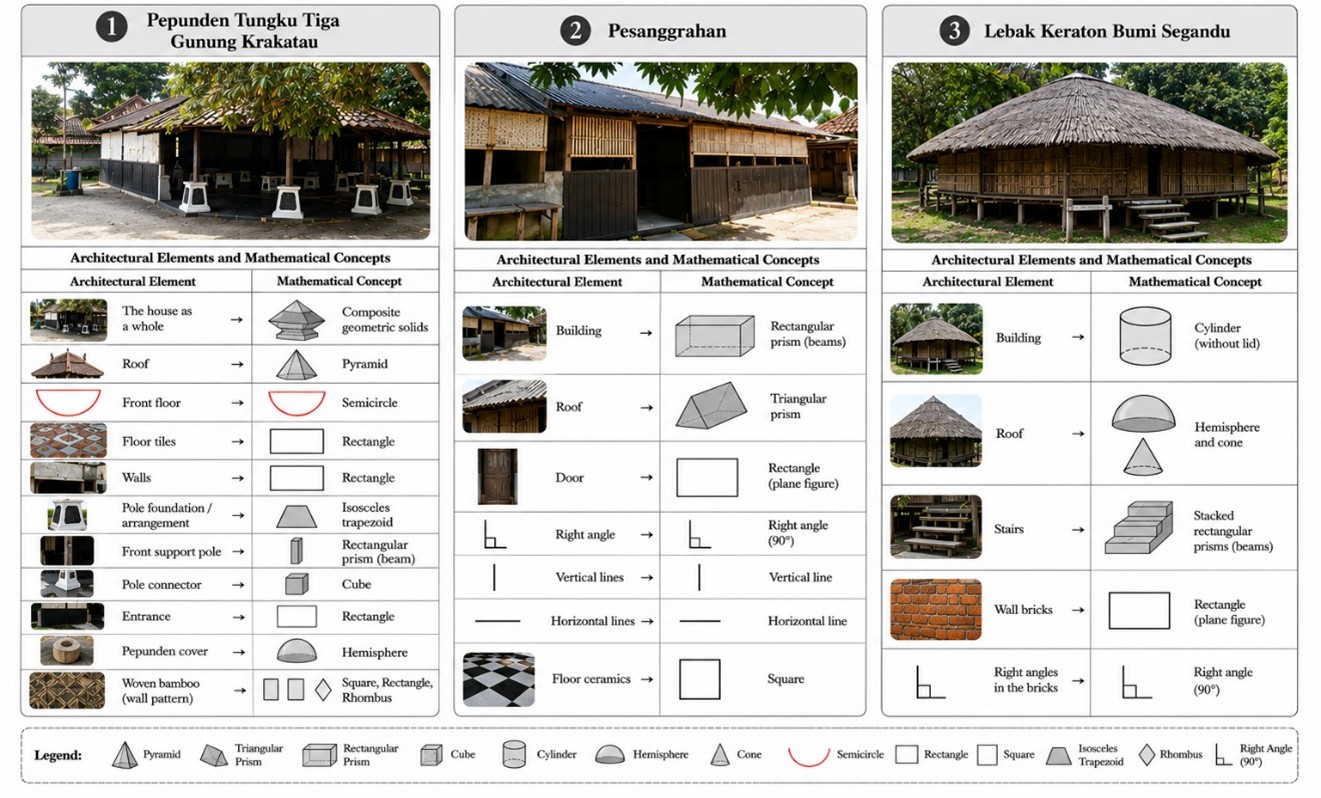
Ethnomathematics research has documented mathematical concepts embedded in various Indonesian cultural artifacts; however, few studies have transformed these findings into validated instructional materials, and the traditional houses and accessories of the Dayak Bumi Segandu Indramayu community remain unexplored in mathematics education literature. This study addressed this gap by combining an ethnographic exploration with the ADDIE development model to design and validate an ethnomathematics-based learning module on three-dimensional geometry for seventh-grade junior high school students. The research was conducted at Padepokan Nyi Ratu Kembar Jaya, Krimun Village, Indramayu Regency. Data were collected through observations, interviews, and documentation involving four purposively selected participants representing the community leadership and members. Qualitative data were analyzed using coding, data reduction, data display, and conclusion drawing assisted by ATLAS.ti 8. The exploration identified mathematical concepts embedded in traditional houses and cultural accessories, including lines, angles, plane figures, and solid figures, which were integrated into the module. Validation by two mathematics education experts yielded an average score of 72.8% (Good), indicating satisfactory conceptual and pedagogical quality, although improvements were recommended for language clarity. Practicality evaluation by two mathematics teachers produced an average score of 95.5% (Strongly Agree), demonstrating high classroom usability. These findings indicate that the cultural heritage of the Dayak Bumi Segandu Indramayu community can be systematically transformed into a valid and practical mathematics learning resource while contributing to the preservation of local knowledge through school mathematics.
Downloads
References
Abdullah, A. H., & Zakaria, E. (2013). The effects of Van Hiele’s phases of learning geometry on students’ degree of acquisition of Van Hiele levels. Procedia - Social and Behavioral Sciences, 102, 251–266. https://doi.org/10.1016/j.sbspro.2013.10.740
Abdullah, A. S. (2016). Ethnomathematics in perspective of Sundanese culture. Journal on Mathematics Education, 8(1), 1–16. https://doi.org/10.22342/jme.8.1.3877.1-16
Alex, J., & Mammen, K. J. (2018). Students’ understanding of geometry terminology through the lens of Van Hiele theory. Pythagoras, 39(1), 1–8. https://doi.org/10.4102/pythagoras.v39i1.376
Apsari, P. N., & Rizki, S. (2018). Android-based mathematics learning media on linear program material. Axioma: Jurnal Program Studi Pendidikan Matematika, 7(1), 161–170. https://doi.org/10.24127/ajpm.v7i1.1357
Asmianto, Wahyuningsih, S., Azizah, Qohar, A., & Atan, N. A. (2024). Design of geometry e-module for junior high school students based on gamification using the ADDIE model. AIP Conference Proceedings, 3049(1), 030004. https://doi.org/10.1063/5.0195629
Burger, W. F., & Shaughnessy, J. M. (1986). Characterizing the Van Hiele levels of development in geometry. Journal for Research in Mathematics Education, 17(1), 31–48. https://doi.org/10.2307/749317
Deda, Y. N., Disnawati, H., Tamur, M., & Rosa, M. (2024). Global trend of ethnomathematics studies of the last decade: A bibliometric analysis. Infinity Journal, 13(1), 233–250. https://doi.org/10.22460/infinity.v13i1.p233-250
Dolores-Flores, C., Rivera-López, M. I., & García-García, J. (2019). Exploring mathematical connections of pre-university students through tasks involving rates of change. International Journal of Mathematical Education in Science and Technology, 50(3), 369–389. https://doi.org/10.1080/0020739X.2018.1507050
Faqih, A., Nurdiawan, O., & Setiawan, A. (2021). Development of interactive multimedia learning media traditional cooking tools based on ethnomathematics. Mosharafa: Journal of Mathematics Education, 10(2), 301–310.
García-García, J., & Dolores-Flores, C. (2018). Intra-mathematical connections made by high school students in performing Calculus tasks. International Journal of Mathematical Education in Science and Technology, 49(2), 227–252. https://doi.org/10.1080/0020739X.2017.1355994
García-García, J., & Dolores-Flores, C. (2019). Pre-university students’ mathematical connections when sketching the graph of derivative and antiderivative functions. Mathematics Education Research Journal, 33, 1–22. https://doi.org/10.1007/s13394-019-00286-x
García-García, J., & Dolores-Flores, C. (2020). Exploring pre-university students’ mathematical connections when solving Calculus application problems. International Journal of Mathematical Education in Science and Technology, 52(6), 912–936. https://doi.org/10.1080/0020739X.2020.1729429
Hariastuti, R. M., Budiarto, M. T., & Manuharawati, M. (2019). From culture to classroom: Study ethnomathematics in house of Using Banyuwangi. International Journal of Trends in Mathematics Education Research, 2(2), 76–80. https://doi.org/10.33122/ijtmer.v2i2.60
Hatisaru, V. (2023). Mathematical connections – a growing construct. International Journal of Mathematical Education in Science and Technology, 55(3), 1–22. https://doi.org/10.1080/0020739X.2023.2283346
Imswatama, A., & Lukman, H. S. (2018). The effectiveness of mathematics teaching material based on ethnomathematics. International Journal of Trends in Mathematics Education, 1(1), 35–38. https://doi.org/10.33122/ijtmer.v1i1.11
Majeed, B. H., & Jawad, L. F. (2021). Tactical thinking and its relationship with solving mathematical problems among mathematics department students importance of research. International Journal of Emerging Technologies in Learning, 16(9), 247–262. https://doi.org/10.3991/ijet.v16i09.22203
Muhtadi, D., Sukirwan, Warsito, & Prahmana, R. C. I. (2017). Sundanese ethnomathematics: Mathematical activities in estimating, measuring, and making patterns. Journal on Mathematics Education, 8(2), 185–198. https://doi.org/10.22342/jme.8.2.4055.185-198
Nuryadi, Waluya, S. B., & Kharisudin, I. (2023). Analysis of effectiveness of ethnomathematics-based subject specific pedagogy viewed from students’ mathematics understanding. AIP Conference Proceedings, 2614(1), 040107. https://doi.org/10.1063/5.0127884
Orey, D. C., & Rosa, M. (2021). Ethnomodelling as a glocalization process of mathematical practices through cultural dynamism. The Mathematics Enthusiast, 18(3), 439–468. https://doi.org/10.54870/1551-3440.1533
Pais, A. (2011). Criticisms and contradictions of ethnomathematics. Educational Studies in Mathematics, 76(2), 209–230. https://doi.org/10.1007/s10649-010-9289-7
Patri, S. F. D., & Heswari, S. (2021). Development of ethnomathematic-based on mathematics e-module to improve students’ logical thinking skills. AIP Conference Proceedings, 2330(1), 040005. https://doi.org/10.1063/5.0043250
Pathuddin, H., & Mariani, A. (2023). Ethnomathematics of pananrang: A guidance of traditional farming system of the Buginese community. Journal on Mathematics Education, 14(2), 205–224. https://doi.org/10.22342/jme.v14i2.pp205-224
Prahmana, R. C. I., Arnal-Palacián, M., Risdiyanti, I., & Ramadhani, R. (2023). Trivium curriculum in Ethno-RME approach: An impactful insight from ethnomathematics and realistic mathematics education. Jurnal Elemen, 9(1), 298–316. https://doi.org/10.29408/jel.v9i1.7262
Prahmana, R. C. I., & D’Ambrosio, U. (2020). Learning geometry and values from patterns: Ethnomathematics on the batik patterns of Yogyakarta, Indonesia. Journal on Mathematics Education, 11(3), 439–456. https://doi.org/10.22342/jme.11.3.12949.439-456
Purniati, T., Juandi, D., & Suhaedi, D. (2022). Ethnomathematics study: Learning geometry in the mosque ornaments. International Journal on Advanced Science, Engineering and Information Technology, 12(5), 2096–2104. https://doi.org/10.18517/ijaseit.12.5.17063
Rodríguez-Nieto, C. A., & Alsina, Á. (2022). Networking between ethnomathematics, STEAM education, and the globalized approach to analyze mathematical connections in daily practices. EURASIA Journal of Mathematics, Science and Technology Education, 18(3), em2085. https://doi.org/10.29333/ejmste/11710
Rodríguez-Nieto, C. A., Rodríguez-Vásquez, F. M., & Font, V. (2020). A new view about connections: The mathematical connections established by a teacher when teaching the derivative. International Journal of Mathematical Education in Science and Technology. https://doi.org/10.1080/0020739X.2020.1799254
Rodríguez-Nieto, C. A., Rodríguez-Vásquez, F. M., & García-García, J. (2021). Exploring university Mexican students’ quality of intra-mathematical connections when solving tasks about derivative concept. EURASIA Journal of Mathematics, Science and Technology Education, 17(9), em2006. https://doi.org/10.29333/ejmste/11160
Sari, A. K., Budiarto, M. T., & Ekawati, R. (2022). Ethnomathematics study: Cultural values and geometric concepts in the traditional “tanean-lanjang” house in Madura – Indonesia. JRAMathEdu (Journal of Research and Advances in Mathematics Education), 7(1), 46–54. https://doi.org/10.23917/jramathedu.v7i1.15660
Satria, E., & Sopandi. (2019). Applying RADEC model in science learning to promoting students’ critical thinking in elementary school. Journal of Physics: Conference Series, 1321(3). https://doi.org/10.1088/1742-6596/1321/3/032102
Sudirman, Rodríguez-Nieto, C. A., & Bonyah, E. (2024). Integrating ethnomathematics and ethnomodeling in institutionalization of school mathematics concepts: A study of fishermen community activities. Journal on Mathematics Education, 15(3), 835–858. https://doi.org/10.22342/jme.v15i3.pp835-858
Sugiarto, E., Syarif, M. I., Mulyono, K. B., bin Othman, A. N., & Krisnawati, M. (2025). How is ethnopedagogy-based education implemented? A case study on the heritage of batik in Indonesia. Cogent Education, 12(1), 2466245. https://doi.org/10.1080/2331186X.2025.2466245
Turmuzi, M., Suharta, I. G. P., & Suparta, I. N. (2023). Ethnomathematical research in mathematics education journals in Indonesia: A case study of data design and analysis. EURASIA Journal of Mathematics, Science and Technology Education, 19(1), em2220. https://doi.org/10.29333/ejmste/12836
Umbara, U., Prabawanto, S., & Jatisunda, M. G. (2023). Combination of mathematical literacy with ethnomathematics: How to perspective Sundanese culture. Infinity Journal, 12(2), 393–414. https://doi.org/10.22460/infinity.v12i2.p393-414
Umbara, U., Wahyudin, W., & Prabawanto, S. (2021). Exploring ethnomathematics with ethnomodeling methodological approach: How does Cigugur Indigenous people using calculations to determine good day to build houses. EURASIA Journal of Mathematics, Science and Technology Education, 17(2), 1–19. https://doi.org/10.29333/ejmste/9673
Utami, N. W., Sayuti, S. A., & Jailani. (2019). Math and mate in Javanese Primbon: Ethnomathematics study. Journal on Mathematics Education, 10(3), 341–356. https://doi.org/10.22342/jme.10.3.7611.341-356
Witzel, B., Riccomini, P., & Schneider, E. (2008). Implementing CRA with secondary students with learning disabilities in mathematics. Intervention in School and Clinic, 43(5), 270–276. https://doi.org/10.1177/1053451208314734
Downloads
Published
How to Cite
Issue
Section
License
Copyright (c) 2026 Nandang Nandang, Mochammad Taufan, Mellawaty Mellawaty, Runisah Runisah, Ratna Sri Rahayu, Ronaldo Rafael Olivero-Acuña, Jenisus O. Dejarlo

This work is licensed under a Creative Commons Attribution-ShareAlike 4.0 International License.


