
From gong to geometry: Developing and testing Gameland, a Javanese gamelan-based digital worksheet for Grade 5 plane figures
DOI:
https://doi.org/10.59965/pijme.v4i2.329Keywords:
Gameland Digital Worksheet, Ethnomathematics, Geometry Concept Understanding, Self-Directed LearningAbstract
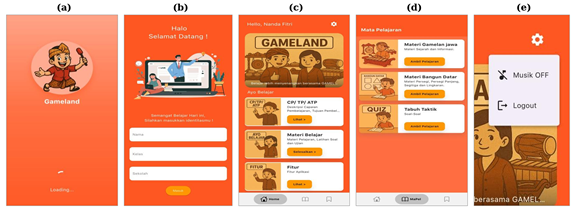
Plane-geometry instruction in Indonesian elementary schools often relies on printed worksheets with limited cultural relevance or support for independent learning. This design and development study created Gameland, an Android-based digital worksheet integrating Javanese gamelan instruments and carving motifs into geometry tasks, and evaluated its validity, practicality, and effectiveness for Grade 5 students’ conceptual understanding and self-directed learning (SDL). Following ADDIE, six requirements informed the application’s navigation and interface. Features included culturally contextualized materials, videos, enrichment quizzes, and five tiered quiz levels with worked explanations. Content and media experts rated Gameland valid (79.60% and 68.75%), while six students rated it very practical (88.50%). Their feedback informed readability revisions. A quasi-experimental non-equivalent control-group trial compared Gameland with printed worksheets in two intact classes (n = 22 each). Pretest scores did not differ significantly (p = .439). The experimental class showed higher normalized gains (0.62 versus 0.40; p < .001, d = 2.21), particularly among students with lower initial scores, and higher post-intervention SDL (79.91 versus 67.45; p < .001, d = 1.96). These findings support Gameland’s validity, practicality, and potential educational value. However, the non-randomized, single-school design limits causal inference and generalizability, requiring further confirmation through stronger research designs conducted across diverse school settings.
Downloads
References
Adriani, F., Waluya, S. B., & Masduki, L. R. (2026). Self-regulated learning and critical thinking in socio-emotionally differentiated problem-based learning: A mixed-methods study in Indonesian junior secondary mathematics. International Journal of Mathematics and Sciences Education, 4(1), 1–12. https://doi.org/10.59965/ijmsed.v4i1.285
Ainiyah, R., Rusmayadi, M., & Bahri, S. (2025). Why geometry feels difficult: A phenomenological inquiry into junior high school students’ learning experiences in Indonesia. Panicgogy International Journal, 3(2), 80–93. https://doi.org/10.59965/pij.v3i2.177
Aulia, P., Sugiarni, R., & Rodríguez-Nieto, C. A. (2025). Development and validation of ethnomathematics-based worksheets integrating Sundanese Pupuh for enhancing number pattern learning in Indonesian secondary schools. Polyhedron International Journal in Mathematics Education, 3(2), 139–152. https://doi.org/10.59965/pijme.v3i2.275
Basri, H., García-García, J., Rodríguez-Nieto, C. A., Rifanda, A. R., & Indahwati, R. (2025). GeoGebra-assisted discovery learning: An effective strategy to enhance elementary students’ interest in learning plane area measurement. International Journal of Didactic Mathematics in Distance Education, 2(1), 1–15. https://doi.org/10.33830/ijdmde.v2i1.11272
Branch, R. M. (2009). Instructional design: The ADDIE approach. Springer. https://doi.org/10.1007/978-0-387-09506-6
Broadbent, J., & Poon, W. L. (2015). Self-regulated learning strategies & academic achievement in online higher education learning environments: A systematic review. The Internet and Higher Education, 27, 1–13. https://doi.org/10.1016/j.iheduc.2015.04.007
BSKAP. (2024). Keputusan Kepala Badan Standar, Kurikulum, dan Asesmen Pendidikan Nomor 032/H/KR/2024 tentang Capaian Pembelajaran pada Pendidikan Anak Usia Dini, Jenjang Pendidikan Dasar, dan Jenjang Pendidikan Menengah pada Kurikulum Merdeka. Kementerian Pendidikan, Kebudayaan, Riset, dan Teknologi.
Clements, D. H., & Battista, M. T. (1992). Geometry and spatial reasoning. In D. A. Grouws (Ed.), Handbook of research on mathematics teaching and learning (pp. 420–464). Macmillan.
Cohen, J. (1988). Statistical power analysis for the behavioral sciences (2nd ed.). Lawrence Erlbaum Associates.
Coletta, V. P., & Steinert, J. J. (2020). Why normalized gain should continue to be used in analyzing preinstruction and postinstruction scores on concept inventories. Physical Review Physics Education Research, 16(1), Article 010108. https://doi.org/10.1103/PhysRevPhysEducRes.16.010108
D’Ambrosio, U. (1985). Ethnomathematics and its place in the history and pedagogy of mathematics. For the Learning of Mathematics, 5(1), 44–48.
Delacre, M., Lakens, D., & Leys, C. (2017). Why psychologists should by default use Welch’s t-test instead of Student’s t-test. International Review of Social Psychology, 30(1), 92–101. https://doi.org/10.5334/irsp.82
Dent, A. L., & Koenka, A. C. (2016). The relation between self-regulated learning and academic achievement across childhood and adolescence: A meta-analysis. Educational Psychology Review, 28(3), 425–474. https://doi.org/10.1007/s10648-015-9320-8
Fajri, H. M., Marini, A., & Suyono. (2025). Trends and patterns in realistic mathematics education research in elementary schools: A bibliometric approach. Social Sciences & Humanities Open, 12, Article 101730. https://doi.org/10.1016/j.ssaho.2025.101730
Fujita, T., & Jones, K. (2007). Learners’ understanding of the definitions and hierarchical classification of quadrilaterals: Towards a theoretical framing. Research in Mathematics Education, 9(1–2), 3–20. https://doi.org/10.1080/14794800008520167
Hake, R. R. (1998). Interactive-engagement versus traditional methods: A six-thousand-student survey of mechanics test data for introductory physics courses. American Journal of Physics, 66(1), 64–74. https://doi.org/10.1119/1.18809
Hattie, J., & Timperley, H. (2007). The power of feedback. Review of Educational Research, 77(1), 81–112. https://doi.org/10.3102/003465430298487
Higgins, K., Huscroft-D’Angelo, J., & Crawford, L. (2019). Effects of technology in mathematics on achievement, motivation, and attitude: A meta-analysis. Journal of Educational Computing Research, 57(2), 283–319. https://doi.org/10.1177/0735633117748416
Johnson, P. O., & Neyman, J. (1936). Tests of certain linear hypotheses and their application to some educational problems. Statistical Research Memoirs, 1, 57–93.
Khairunnisa, I. A., Mairing, J. P., Sudirman, S., & Rodríguez-Nieto, C. A. (2025). Integrating cultural contexts into mathematics: Effects of culture-based worksheets on students’ mastery of geometric transformations. Polyhedron International Journal in Mathematics Education, 3(1), 1–10. https://doi.org/10.59965/pijme.v3i1.167
Knowles, M. S. (1975). Self-directed learning: A guide for learners and teachers. Association Press.
Kyeremeh, P., Awuah, F. K., & Dorwu, E. (2023). Integration of ethnomathematics in teaching geometry: A systematic review and bibliometric report. Journal of Urban Mathematics Education, 16(2), 68–89. https://doi.org/10.21423/jume-v16i2a519
Lakens, D. (2013). Calculating and reporting effect sizes to facilitate cumulative science: A practical primer for t-tests and ANOVAs. Frontiers in Psychology, 4, Article 863. https://doi.org/10.3389/fpsyg.2013.00863
Nurmiati, N., Wahyuningrum, E., Sudirman, S., & Nà, T. L. (2026). Contextual learning integrated with gamification: Effects on mathematical connection ability and learning motivation in ratio and proportion. International Journal of Mathematics and Sciences Education, 4(1), 13–37. https://doi.org/10.59965/ijmsed.v4i1.309
Prahmana, R. C. I., & Istiandaru, A. (2021). Learning sets theory using shadow puppet: A study of Javanese ethnomathematics. Mathematics, 9(22), Article 2938. https://doi.org/10.3390/math9222938
Richey, R. C., & Klein, J. D. (2007). Design and development research: Methods, strategies, and issues. Lawrence Erlbaum Associates.
Riduwan. (2012). Skala pengukuran variabel-variabel penelitian. Alfabeta.
Rosa, M., & Orey, D. C. (2011). Ethnomathematics: The cultural aspects of mathematics. Revista Latinoamericana de Etnomatemática, 4(2), 32–54.
Shadish, W. R., Cook, T. D., & Campbell, D. T. (2002). Experimental and quasi-experimental designs for generalized causal inference. Houghton Mifflin.
Sugiarni, R., Zulnaidi, H., Ningsih, D. N., Hakim, R. R., & Setiawan, E. (2026). Integrating Pandanwangi ethnomathematics into e-worksheets to support numeracy in online mathematics learning. International Journal of Didactic Mathematics in Distance Education, 3(2), 184–209. https://doi.org/10.33830/ijdmde.v3i2.14462
Sumarmo, U. (2016). Pedoman pemberian skor pada beragam tes kemampuan matematika. Pustaka Mandiri.
Sunzuma, G., & Maharaj, A. (2019). Teacher-related challenges affecting the integration of ethnomathematics approaches into the teaching of geometry. Eurasia Journal of Mathematics, Science and Technology Education, 15(9), Article em1744. https://doi.org/10.29333/ejmste/108457
van de Pol, J., Volman, M., & Beishuizen, J. (2010). Scaffolding in teacher–student interaction: A decade of research. Educational Psychology Review, 22(3), 271–296. https://doi.org/10.1007/s10648-010-9127-6
van Hiele, P. M. (1986). Structure and insight: A theory of mathematics education. Academic Press.
Vojkůvková, I. (2012). The van Hiele model of geometric thinking. In WDS’12 Proceedings of Contributed Papers, Part I (pp. 72–75). Matfyzpress.
Vygotsky, L. S. (1978). Mind in society: The development of higher psychological processes. Harvard University Press.
Wood, D., Bruner, J. S., & Ross, G. (1976). The role of tutoring in problem solving. Journal of Child Psychology and Psychiatry, 17(2), 89–100. https://doi.org/10.1111/j.1469-7610.1976.tb00381.x
Yulizarti, I., Wahyuningrum, E., & Sudirman, S. (2026). Project-based learning integrated with local wisdom: Developing a trigonometry teaching module to enhance HOTS of senior secondary students in Merangin Regency. Panicgogy International Journal, 4(1), 1–15. https://doi.org/10.59965/pij.v4i1.301
Zimmerman, B. J. (2002). Becoming a self-regulated learner: An overview. Theory Into Practice, 41(2), 64–70. https://doi.org/10.1207/s15430421tip4102_2
Downloads
Published
How to Cite
Issue
Section
License
Copyright (c) 2026 Nanda Fitri Nur Rohmah, I Made Sulandra, Sudirman Sudirman, Dharmendra Kumar Yadav

This work is licensed under a Creative Commons Attribution-ShareAlike 4.0 International License.


