
Bayesian hierarchical modeling of factors associated with students’ educational status in less developed areas: A case study of Ghor Province, Afghanistan
DOI:
https://doi.org/10.59965/pijme.v4i2.318Keywords:
Bayesian regression, Bayesian hierarchical model, educational status, statistical modelingAbstract
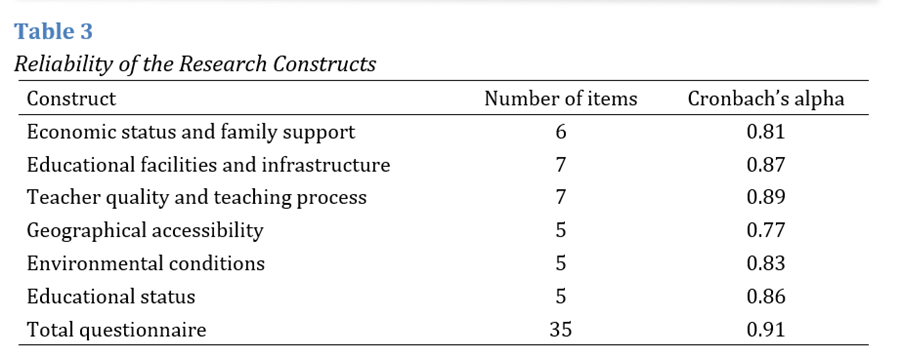
Students’ educational status in remote, data-scarce regions is shaped by several interrelated factors, yet evidence that quantifies these associations together with their uncertainty is scarce. This study examined factors associated with students’ educational status in less developed areas of Ghor Province, Afghanistan, using Bayesian regression and Bayesian hierarchical modeling. A cross-sectional correlational survey was conducted in 2019 with 372 students in Grades 11 and 12 from 32 schools in the Firozkoh, Dawlatyar, and Lal wa Sarjangal districts. A 35-item questionnaire measured economic status and family support, educational facilities and infrastructure, teacher quality and teaching process, geographical accessibility, environmental conditions, and perceived educational status. A single-level Bayesian regression and a Bayesian hierarchical model with school-specific random intercepts and district indicators were fitted, and inference was based on posterior distributions, 95% credible intervals, and Markov chain Monte Carlo diagnostics. All five factors were positively associated with educational status; teacher quality and teaching process showed the largest posterior mean coefficient (0.31; 95% credible interval [0.21, 0.41] in the single-level model), followed by educational facilities and infrastructure (0.26). The hierarchical model indicated between-school heterogeneity (posterior mean between-school standard deviation = 0.28) and showed better expected predictive performance than the single-level model (LOOIC lower by 36.8 points). Because the design was cross-sectional and the sample was a convenience sample, the findings indicate associations rather than causal effects. They nevertheless suggest that teacher quality, school infrastructure, and household, geographical, and environmental conditions deserve attention in educational planning for such regions.
Downloads
References
Bürkner, P.-C. (2017). brms: An R package for Bayesian multilevel models using Stan. Journal of Statistical Software, 80(1), 1–28. https://doi.org/10.18637/jss.v080.i01
Carpenter, B., Gelman, A., Hoffman, M. D., Lee, D., Goodrich, B., Betancourt, M., Brubaker, M., Guo, J., Li, P., & Riddell, A. (2017). Stan: A probabilistic programming language. Journal of Statistical Software, 76(1), 1–32. https://doi.org/10.18637/jss.v076.i01
Depaoli, S., & van de Schoot, R. (2017). Improving transparency and replication in Bayesian statistics: The WAMBS-Checklist. Psychological Methods, 22(2), 240–261. https://doi.org/10.1037/met0000065
Evans, D. K., & Popova, A. (2016). What really works to improve learning in developing countries? An analysis of divergent findings in systematic reviews. The World Bank Research Observer, 31(2), 242–270. https://doi.org/10.1093/wbro/lkw004
Fouskakis, D., Petrakos, G., & Vavouras, I. (2014). A Bayesian hierarchical model for comparative evaluation of teaching quality indicators in higher education (arXiv:1404.1710). arXiv. https://arxiv.org/abs/1404.1710
Gabry, J., Simpson, D., Vehtari, A., Betancourt, M., & Gelman, A. (2019). Visualization in Bayesian workflow. Journal of the Royal Statistical Society Series A: Statistics in Society, 182(2), 389–402. https://doi.org/10.1111/rssa.12378
Gómez-Méndez, I., & Amornbunchornvej, C. (2024). Income, education, and other poverty-related variables: A journey through Bayesian hierarchical models. Heliyon, 10(6).
Kruschke, J. K., & Liddell, T. M. (2018). The Bayesian new statistics: Hypothesis testing, estimation, meta-analysis, and power analysis from a Bayesian perspective. Psychonomic Bulletin & Review, 25(1), 178–206. https://doi.org/10.3758/s13423-016-1221-4
Le, F., Stanford, T. E., Dumuid, D., & Wiley, J. F. (2025). Bayesian multilevel compositional data analysis: Introduction, evaluation, and application. Psychological Methods.
McNeish, D. (2016). On using Bayesian methods to address small sample problems. Structural Equation Modeling: A Multidisciplinary Journal, 23(5), 750–773. https://doi.org/10.1080/10705511.2016.1186549
Montano, V., & Reyes, A. (2026). Beyond course averages: A generalized Bayesian hierarchical framework for course-level learning evaluation. Journal of Learning Theory and Methodology, 7(1), 37–48.
Mosia, M., Egara, F. O., Nannim, F. A., & Basitere, M. (2025). Bayesian hierarchical modelling of student academic performance: The impact of mathematics competency, institutional context, and temporal variability. Education Sciences, 15(2), Article 177. https://doi.org/10.3390/educsci15020177
Mosia, M., Sekonyela, L., Egara, F. O., Nimy, E., Mabokgole, I. M., & Nannim, F. A. (2026). Bayesian hierarchical modelling of academic orientation and advising effects on student retention and progression: Multi-cohort evidence. PLOS One, 21(3), Article e0345001. https://doi.org/10.1371/journal.pone.0345001
Pardo, L., Sosa, J., Torres-Clavijo, J. P., & Arévalo-Arévalo, A. F. (2025). Uncovering latent territorial structure in ICFES Saber 11 performance with Bayesian multilevel spatial models (arXiv:2512.17119). arXiv. https://arxiv.org/abs/2512.17119
Sun, Y. (2026). Using hierarchical Bayesian analysis to identify at-risk students in engineering mathematics prerequisites. Computer Applications in Engineering Education, 34(1), Article e70126. https://doi.org/10.1002/cae.70126
Tilbe, Y. T., & Biru, D. (2026). Determinants of academic performance among public and private middle-level school students in Yabelo Town, Ethiopia: Examining the influence of school, teacher, and leadership factors. Ethiopian Journal of Business and Social Science, 9(1), 18–46.
Tomal, J., Rahmati, S., Boroushaki, S., Jin, L., & Ahmed, E. (2021). The impact of COVID-19 on students’ marks: A Bayesian hierarchical modeling approach. METRON, 79(1), 57–91. https://doi.org/10.1007/s40300-021-00200-1
van de Schoot, R., Depaoli, S., King, R., Kramer, B., Märtens, K., Tadesse, M. G., Vannucci, M., Gelman, A., Veen, D., Willemsen, J., & Yau, C. (2021). Bayesian statistics and modelling. Nature Reviews Methods Primers, 1, Article 1. https://doi.org/10.1038/s43586-020-00001-2
Vehtari, A., Gelman, A., & Gabry, J. (2017). Practical Bayesian model evaluation using leave-one-out cross-validation and WAIC. Statistics and Computing, 27(5), 1413–1432. https://doi.org/10.1007/s11222-016-9696-4
Vehtari, A., Gelman, A., Simpson, D., Carpenter, B., & Bürkner, P.-C. (2021). Rank-normalization, folding, and localization: An improved R ̂ for assessing convergence of MCMC (with discussion). Bayesian Analysis, 16(2), 667–718. https://doi.org/10.1214/20-BA1221
Wafa, M. N., Hussaini, S. A. M., & Pazhman, J. (2020). Evaluation of students’ mathematical ability in Afghanistan’s schools using cognitive diagnosis models. Eurasia Journal of Mathematics, Science and Technology Education, 16(6), Article em1849. https://doi.org/10.29333/ejmste/7834
Wafa, M. N., & Shuja, S. (2024). Optimizing variable selection with Bayesian t-Lasso regression: A comparison of normal-mixture and uniform-mixture representations for outlier data analysis. Polyhedron International Journal in Mathematics Education, 2(1), 17–29.
Wafa, M. N., Zia, Z., & Hussaini, S. A. M. (2023). Regression models according to Birnbaum–Saunders distribution. European Journal of Mathematics and Statistics, 4(6), 24–30.
Downloads
Published
How to Cite
Issue
Section
License
Copyright (c) 2026 Mohmmad Nasim Wafa

This work is licensed under a Creative Commons Attribution-ShareAlike 4.0 International License.


