
Cognitive barriers and Universal Design for Learning support in understanding number concepts in students with intellectual disabilities
DOI:
https://doi.org/10.59965/pijme.v4i2.319Keywords:
Intellectual Disabilities, Universal Design for Learning, Number concepts, Cognitive barriers, Visual mediaAbstract
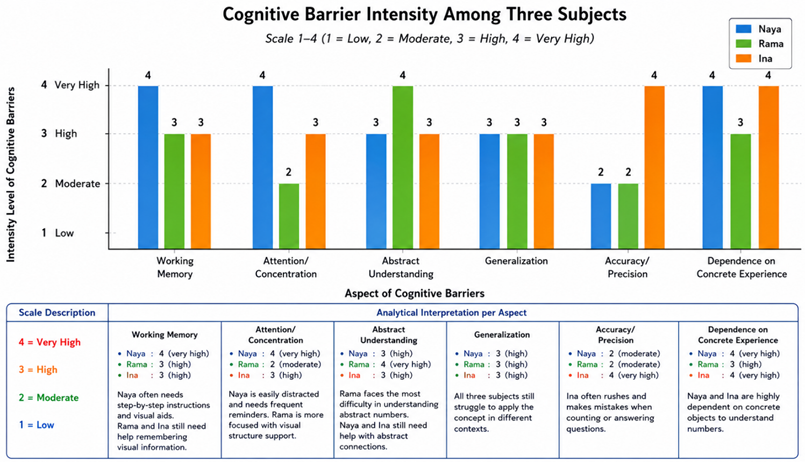
Although Universal Design for Learning (UDL) is widely used to support inclusive instruction, how its principles respond to interacting cognitive barriers during number-concept learning remains insufficiently understood. This study examined the barriers experienced by students with intellectual disabilities and how visual media-assisted UDL supported their understanding. An exploratory qualitative multiple-case study involved three students with moderate intellectual disabilities at an inclusive junior high school in Tangerang City, Indonesia. Data comprised classroom observations, interviews with students and supporting informants, student worksheets, and learning documentation. Analysis followed the interactive model of Miles, Huberman, and Saldaña, combining data condensation, data display, and conclusion drawing and verification with source and method triangulation. Four interrelated themes emerged: limited working memory and attention, difficulty understanding abstract concepts, limited generalization, and reliance on concrete representations. Across the cases, multiple means of representation supported connections between quantities and numerals; multiple means of action and expression allowed students to demonstrate understanding through pointing, matching, and manipulating objects; and multiple means of engagement helped sustain participation through focused tasks and guidance. Difficulties persisted when representations changed or concrete support was reduced. These findings suggest that UDL provided a framework for matching instructional support to individual learning demands rather than eliminating cognitive barriers. The account is context-bound and does not establish causal effects or generalizable improvement.
Downloads
References
Al-Azawei, A., Serenelli, F., & Lundqvist, K. (2016). Universal Design for Learning (UDL): A content analysis of peer-reviewed journal papers from 2012 to 2015. Journal of the Scholarship of Teaching and Learning, 16(3), 39–56. https://doi.org/10.14434/josotl.v16i3.19295
Almeqdad, Q. I., Alodat, A. M., Alquraan, M. F., Mohaidat, M. A., & Al-Makhzoomy, A. K. (2023). The effectiveness of universal design for learning: A systematic review of the literature and meta-analysis. Cogent Education, 10(1), Article 2218191. https://doi.org/10.1080/2331186X.2023.2218191
American Association on Intellectual and Developmental Disabilities. (2021). Intellectual disability: Definition, diagnosis, classification, and systems of supports (12th ed.).
Bellon, E., Fias, W., & De Smedt, B. (2019). More than number sense: The additional role of executive functions and metacognition in arithmetic. Journal of Experimental Child Psychology, 182, 38–60. https://doi.org/10.1016/j.jecp.2019.01.012
Bouck, E. C., Park, J., & Nickell, B. (2017). Using the concrete-representational-abstract approach to support students with intellectual disability to solve change-making problems. Research in Developmental Disabilities, 60, 24–36. https://doi.org/10.1016/j.ridd.2016.11.006
Browder, D. M., Spooner, F., Ahlgrim-Delzell, L., Harris, A. A., & Wakeman, S. (2008). A meta-analysis on teaching mathematics to students with significant cognitive disabilities. Exceptional Children, 74(4), 407–432. https://doi.org/10.1177/001440290807400401
Bruner, J. S. (1966). Toward a theory of instruction. Harvard University Press.
Capp, M. J. (2017). The effectiveness of universal design for learning: A meta-analysis of literature between 2013 and 2016. International Journal of Inclusive Education, 21(8), 791–807. https://doi.org/10.1080/13603116.2017.1325074
CAST. (2018). Universal design for learning guidelines version 2.2. http://udlguidelines.cast.org
Clements, D. H., Lizcano, R., & Sarama, J. (2023). Research and pedagogies for early math. Education Sciences, 13(8), Article 839. https://doi.org/10.3390/educsci13080839
Creswell, J. W., & Poth, C. N. (2018). Qualitative inquiry and research design: Choosing among five approaches (4th ed.). SAGE Publications.
Fuson, K. C. (2019). Relating math words, visual images, and math symbols for understanding and competence. International Journal of Disability, Development and Education, 66(2), 119–132. https://doi.org/10.1080/1034912X.2018.1535109
Kontesa, K., Putri, A. N., Adli, M. D., Damaraini, A., & Lestari, E. P. (2026). Strategi pembelajaran inovatif untuk meningkatkan kemampuan akademik peserta didik disabilitas intelektual di sekolah inklusif [Innovative learning strategies to improve the academic abilities of students with intellectual disabilities in inclusive schools]. Menulis: Jurnal Penelitian Nusantara, 2(1), 346–350. https://doi.org/10.59435/menulis.v2i1.963
Lincoln, Y. S., & Guba, E. G. (1985). Naturalistic inquiry. SAGE Publications.
Meyer, A., Rose, D. H., & Gordon, D. (2014). Universal design for learning: Theory and practice. CAST Professional Publishing.
Miles, M. B., Huberman, A. M., & Saldaña, J. (2014). Qualitative data analysis: A methods sourcebook (3rd ed.). SAGE Publications.
Ok, M. W., Rao, K., Bryant, B. R., & McDougall, D. (2017). Universal design for learning in pre-K to grade 12 classrooms: A systematic review of research. Exceptionality, 25(2), 116–138. https://doi.org/10.1080/09362835.2016.1196450
Patton, M. Q. (2015). Qualitative research and evaluation methods (4th ed.). SAGE Publications.
Pujiaty, E. (2024). Strategi pengelolaan pendidikan inklusif untuk meningkatkan aksesibilitas di sekolah dasar [Inclusive education management strategies to improve accessibility in elementary schools]. Jurnal Tahsinia, 5(2), 241–252. https://jurnal.rakeyansantang.ac.id/tahsinia/article/view/584
Rao, K., Ok, M. W., & Bryant, B. R. (2014). A review of research on universal design educational models. Remedial and Special Education, 35(3), 153–166. https://doi.org/10.1177/0741932513518980
Root, J. R., Browder, D. M., Saunders, A. F., & Lo, Y. (2017). Schema-based instruction with concrete and virtual manipulatives to teach problem solving to students with autism. Remedial and Special Education, 38(1), 42–52. https://doi.org/10.1177/0741932516643592
Schneider, M., & Stern, E. (2010). The cognitive perspective on learning: Ten cornerstone findings. In H. Dumont, D. Istance, & F. Benavides (Eds.), The nature of learning: Using research to inspire practice (pp. 69–90). OECD Publishing. https://doi.org/10.1787/9789264086487-5-en
Spooner, F., Root, J. R., Saunders, A. F., & Browder, D. M. (2019). An updated evidence-based practice review on teaching mathematics to students with moderate and severe developmental disabilities. Remedial and Special Education, 40(3), 150–165. https://doi.org/10.1177/0741932517751055
Sweller, J., van Merriënboer, J. J. G., & Paas, F. (2019). Cognitive architecture and instructional design: 20 years later. Educational Psychology Review, 31(2), 261–292. https://doi.org/10.1007/s10648-019-09465-5
Vygotsky, L. S. (1978). Mind in society: The development of higher psychological processes. Harvard University Press.
Yin, R. K. (2018). Case study research and applications: Design and methods (6th ed.). SAGE Publications.
Yunita, V. M., & Subagya, S. (2025). Hambatan implementasi pendidikan inklusif di Indonesia: Analisis berbasis survei 156 sekolah [Barriers to implementing inclusive education in Indonesia: A survey-based analysis of 156 schools]. Jurnal Basicedu, 9(5), 1549–1558. https://doi.org/10.31004/basicedu.v9i5.10712
Downloads
Published
How to Cite
Issue
Section
License
Copyright (c) 2026 Lutfiah Lutfiah, Sudirman Sudirman, Endang Wahyuningrum, Benilda María Cantillo-Rudas

This work is licensed under a Creative Commons Attribution-ShareAlike 4.0 International License.


