
Self-regulated learning and critical thinking in socio-emotionally differentiated problem-based learning: A mixed-methods study in Indonesian junior secondary mathematics
DOI:
https://doi.org/10.59965/ijmsed.v4i1.285Keywords:
Critical thinking skills, Self-regulated learning, Socio-emotionally differentiated PBL, LKS CeriaAbstract
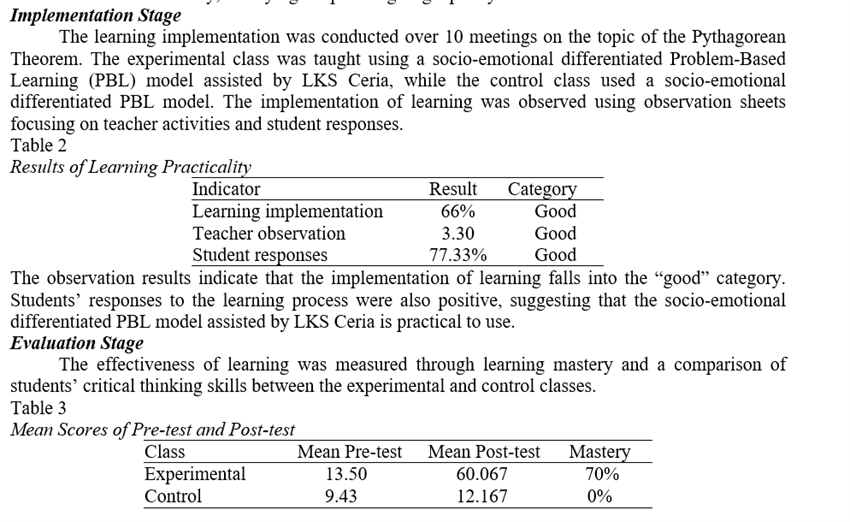
Mathematical critical thinking remains chronically underdeveloped in Indonesian junior secondary classrooms, yet no study has simultaneously integrated socio-emotional differentiation, Problem-Based Learning (PBL), and structured worksheet scaffolding while examining how self-regulated learning (SRL) predicts critical thinking development. This study addressed that gap by evaluating the quality and effectiveness of a socio-emotionally differentiated PBL model assisted by LKS Ceria, and testing SRL as a predictor of critical thinking performance among eighth-grade students. A quasi-experimental nonequivalent control group design with an explanatory sequential mixed-methods component was implemented at SMPN 4 Juwana (2024/2025 academic year; n = 30 per group). Instruments were validated via Aiken's V (mean V = 0.83) and Cronbach's alpha (α = 0.84–0.87). Data were analyzed using Mann-Whitney U, binomial, Chi-square, and bootstrap regression tests. The model satisfied all three quality criteria: instruments were valid and reliable (planning stage), implementation reached 66% with 77.33% positive student responses (implementation stage), and the experimental class achieved 70% classical mastery — significantly exceeding both the control class (0% mastery; U = 108.5, z = −6.21, p < .001, r = .80) and the criterion proportion (binomial p = .041; χ² = 28.46, p < .001). SRL was a significant positive predictor of critical thinking (β = 1.005, SE = 0.313, p = .004, 95% CI [0.387, 1.679]; R² = .42), with performance varying systematically by SRL level. This study contributes an empirically validated, socio-emotionally differentiated PBL framework that simultaneously operationalizes scaffolded worksheet support and SRL-based differentiation as a replicable design for developing mathematical critical thinking in junior secondary mathematics.
References
Asanre, A., Sondlo, A., & Adedeji, A. (2025). Evaluating the impact of the flipped classroom model on senior secondary students’ mathematics achievement: A quasi-experimental study in Nigeria. International Journal of Didactic Mathematics in Distance Education, 2(2), 128–140. https://doi.org/10.33830/ijdmde.v2i2.11774
Astutik, H. S., Rahman, A., & Djam’an, N. (2025). Integration of character education in constructivism-based learning model: Its impact on students’ mathematics learning outcomes. International Journal of Didactic Mathematics in Distance Education, 2(2), 117–127. https://doi.org/10.33830/ijdmde.v2i2.11812
Ayunda, S. N., Lufri, L., & Alberida, H. (2023). Pengaruh model pembelajaran Problem Based Learning (PBL) berbantuan LKPD terhadap kemampuan berpikir kritis peserta didik [The influence of the Problem Based Learning (PBL) learning model assisted by LKPD on students’ critical thinking skills]. Journal on Education, 5(2), 5000–5015. https://doi.org/10.31004/joe.v5i2.1232
Abrenica, E. C. (2025). Problem-based learning: A strategic intervention in enhancing critical and analytical thinking skills of middle school students in mathematics. International Journal of Research and Innovation in Social Science, 9(9), 575–580. https://dx.doi.org/10.47772/IJRISS.2025.90900050
Braun, V., & Clarke, V. (2006). Using thematic analysis in psychology. Qualitative Research in Psychology, 3(2), 77–101. https://doi.org/10.1191/1478088706qp063oa
Cohen, J. (1988). Statistical power analysis for the behavioral sciences (2nd ed.). Lawrence Erlbaum Associates.
Creswell, J. W., & Creswell, J. D. (2018). Research design: Qualitative, quantitative, and mixed methods approaches (5th ed.). SAGE Publications.
Durlak, J. A., Weissberg, R. P., Dymnicki, A. B., Taylor, R. D., & Schellinger, K. B. (2011). The impact of enhancing students’ social and emotional learning: A meta-analysis of school-based universal interventions. Child Development, 82(1), 405–432. https://doi.org/10.1111/j.1467-8624.2010.01564.x
Facione, P. A. (1990). Critical thinking: A statement of expert consensus for purposes of educational assessment and instruction (The Delphi Report). California Academic Press.
Faizah, S., Hassan, A. B., Mashfufah, A., Rahayuningsih, S., Arifin, S., Rofiki, I., Mariani, S., & Sudirman, S. (2026). Investigating students’ critical thinking in solving fractional problems based on higher order thinking skills (HOTS) viewed from self-efficacy and FRISCO model. Ianna Journal of Interdisciplinary Studies, 8(1), 283–297. https://iannajournalofinterdisciplinarystudies.com/index.php/1/article/view/1252
Fanani, M. A., Wafiroh, Z., & Yaqin, M. H. (2024). Penerapan model problem based learning (PBL) dalam pembelajaran berdiferensiasi untuk meningkatkan keterampilan berpikir kritis peserta didik pada pelajaran matematika. Proceeding International Conference on Lesson Study, 1(1), 537–548.
Isharyadi, R., Kusumah, Y. S., Nurjanah, N., & Martadiputra, B. A. P. (2026). Integrating markerless augmented reality into project-based learning to foster spatial reasoning and self-regulated learning in junior high school: A formative evaluation. International Journal of Didactic Mathematics in Distance Education, 3(1), 106–118. https://doi.org/10.33830/ijdmde.v3i1.13945
Liza, L., Mayasari, D., & Sulistri, E. (2023). Analisis kemampuan berpikir kritis ditinjau dari kemandirian belajar siswa dalam pembelajaran IPS kelas V SDN 93 Singkawang [Analysis of critical thinking skills viewed from the perspective of student learning independence in social studies learning for class V at SDN 93 Singkawang]. Autentik: Jurnal Pengembangan Pendidikan Dasar, 7(2), 200–211. https://doi.org/10.36379/autentik.v7i2.285
Michael, B., Arthur, Y. D., & Asare, B. (2025). Influence of peer learning, self-regulatory learning, and mathematics interest on mathematics performance. International Journal of Didactic Mathematics in Distance Education, 2(1), 105–116. https://doi.org/10.33830/ijdmde.v2i1.10313
Muliawanti, S., Wahyuningrum, E., & Sudirman, S. (2026). The effectiveness of differentiated E-LKPD using Liveworksheets on junior high school students’ statistical literacy in data presentation. EduMatSains: Jurnal Pendidikan, Matematika dan Sains, 10(3), 295–310. https://doi.org/10.33541/edumatsains.v10i3.7638
Mulyati, S. (2023). Penggunaan metode problem based learning berbantuan lembar kerja siswa (LKS) terhadap kemampuan berpikir kritis [The use of problem-based learning methods assisted by student worksheets (LKS) on critical thinking skills]. Promosi: Jurnal Program Studi Pendidikan Ekonomi, 11(1), 183-192. https://dx.doi.org/10.24127/pro.v11i1.8386
Mustikaningsih, D., Yumiati, Y., & Sudirman, S. (2025). Enhancing mathematical communication and learning independence through learning cycle 6E model with dynamic geometry software: A study of vocational high school students. Polyhedron International Journal in Mathematics Education, 3(2), 67–85. https://doi.org/10.59965/pijme.v3i2.262
Nieveen, N. (1999). Prototyping to reach product quality. In J. van den Akker, R. M. Branch, K. Gustafson, N. Nieveen, & T. Plomp (Eds.), Design approaches and tools in education and training (pp. 125–135). Springer. https://doi.org/10.1007/978-94-011-4255-7_10
Nurintya, F. H., Zaenuri, Z., & Agoestanto, A. (2025). Kemampuan berpikir kritis matematis ditinjau dari kemandirian belajar melalui model problem based learning terintegrasi STEM berbantuan interactive flat panel [Mathematical critical thinking skills are reviewed from the perspective of learning independence through an integrated STEM problem-based learning model assisted by interactive flat panels]. Jurnal Cendekia: Jurnal Pendidikan Matematika, 9(1), 448–459. https://doi.org/10.31004/cendekia.v9i1.3856
Nurfaidah, N., Pujiastuti, E., Nur Cahyono, A., Sugiman, S., Kharisudin, I., & Korkor, S. (2023). Systematic literature review: Mathematical creative thinking ability reviewed from self-regulated in Project Based Learning (PjBL) model. International Journal of Mathematics and Sciences Education, 1(1), 31–40. https://doi.org/10.59965/ijmsed.v1i1.8
Pintrich, P. R., Smith, D. A. F., Garcia, T., & McKeachie, W. J. (1991). A manual for the use of the Motivated Strategies for Learning Questionnaire (MSLQ). University of Michigan.
Pozas, M., & Letzel, V. (2023). Differentiating instruction: Understanding the key elements for successful teacher development. Teaching and Teacher Education, 126, Article 104099. https://doi.org/10.1016/j.tate.2023.104099
Rahman, M., Akrom, M., & Taufik, M. (2024). The influence of differentiated learning models on the learning outcomes of fifth grade students in mathematics. Polyhedron International Journal in Mathematics Education, 2(1), 1–9. https://doi.org/10.59965/pijme.v2i1.98
Rochmad, R. (2012). Desain model pengembangan perangkat pembelajaran matematika. Kreano: Jurnal Matematika Kreatif-Inovatif, 3(1), 59–72. https://doi.org/10.15294/kreano.v3i1.2613
Safira, A. A., & Darmawan, P. (2025). Empowering students' critical thinking through the integration of statistical board teaching aids and problem-based learning. Polyhedron International Journal in Mathematics Education, 3(1), 45–54. https://doi.org/10.59965/pijme.v3i1.166
Schukajlow, S., & Krug, A. (2024). Trends in mathematics education and insights from a meta-review and bibliometric analysis of review studies. ZDM–Mathematics Education, 56, 165–188. https://doi.org/10.1007/s11858-024-01587-7
Smale-Jacobse, A. E., Meijer, A., Helms-Lorenz, M., & Maulana, R. (2020). Differentiated instruction in secondary education: A systematic review of research evidence. Frontiers in Psychology, 10, Article 2366. https://doi.org/10.3389/fpsyg.2019.02366
Sudirman, S., Rodríguez-Nieto, C. A., Hidayat, R., Isnawan, M. G., Pauzan, M., Martadiputra, B. A. P., & Faizah, S. (2026). Operationalizing didactical situation-based online learning to support eighth-grade students’ mathematical reasoning and understanding in geometry: Participatory design research. Journal on Mathematics Education, 17(1), 43–63. https://doi.org/10.22342/jme.v17i1.pp43-68
Sugiarni, R., Aulia, P., Suryadini, N., Bonyah, E., & Olivero-Acuña, R. R. (2025). Interactive GeoGebra media embedded in student worksheets: A design approach to foster mathematical engagement in 3D geometry. International Journal of Didactic Mathematics in Distance Education, 2(2), 165–178. https://doi.org/10.33830/ijdmde.v2i2.11362
Suparman, S., Juandi, D., & Tamur, M. (2021). Problem-based learning for mathematical critical thinking skills: A meta-analysis. Journal of Education Research and Evaluation, 48(2), 134-144. https://www.jonuns.com/index.php/journal/article/view/521/518
Suryawati, S., Putri, R. M., & Elizar, E. (2025). Bridging algebra and sustainability: Examining the effectiveness of problem-based learning with Wizer.me in SDG 12-contextualized mathematics instruction. International Journal of Mathematics and Sciences Education, 3(2), 105–114. https://doi.org/10.59965/ijmsed.v3i2.171
Vygotsky, L. S. (1978). Mind in society: The development of higher psychological processes. Harvard University Press.
Yanwar, A., & Fadila, A. (2019). Analisis kemampuan berpikir kritis matematis: Dampak pendekatan saintifik ditinjau dari kemandirian belajar Analysis of mathematical critical thinking skills: The impact of the scientific approach from the perspective of learning independence]. Desimal: Jurnal Matematika, 2(1), 9–22. https://doi.org/10.24042/djm.v2i1.3204
Zetriuslita, Z., Suripah, S., Ariawan, R., & Hidayat, R. (2023). Using problem-based learning to promote students’ critical thinking and mathematical problem-solving skills. Jurnal Pendidikan Progresif, 13(2), 281-295. http://dx.doi.org/10.23960/jpp.v13.i2.202311
Zimmerman, B. J. (2000). Self-efficacy: An essential motive to learn. Contemporary Educational Psychology, 25(1), 82–91. https://doi.org/10.1006/ceps.1999.1016
Downloads
Published
How to Cite
Issue
Section
License
Copyright (c) 2026 Fitri Adriani, Stevanus Budi Waluya, Lusi Rachmiazasi Masduki

This work is licensed under a Creative Commons Attribution-ShareAlike 4.0 International License.


