
Microsoft excel-assisted project-based learning for students’ mathematical representation: A classroom action research on data presentation
DOI:
https://doi.org/10.59965/ijmsed.v4i1.307Keywords:
Classroom action research, Mathematical representation ability, Microsoft Excel, Project-Based Learning (PjBL)Abstract
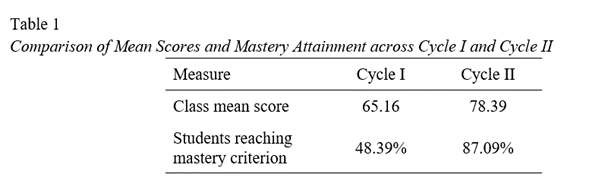
Mathematical representation ability—the capacity to express mathematical ideas through tables, diagrams, symbols, and verbal explanations—is a key competency in mathematics learning. However, Indonesian junior secondary students continue to experience difficulties, particularly in data presentation. This study investigated the effectiveness of Microsoft Excel-assisted Project-Based Learning (PjBL) in improving the mathematical representation ability of 31 seventh-grade students at Madrasah Tsanawiyah Negeri 28 Jakarta, Indonesia. A Classroom Action Research design was conducted in two cycles, each involving planning, action, observation, and reflection. Data were collected through representation-ability tests, classroom observations, semi-structured interviews, and documentation, and analysed using the Miles and Huberman interactive model with source triangulation. Results showed that the mean representation score increased from 65.16 in Cycle I to 78.39 in Cycle II, while the proportion of students achieving the minimum mastery criterion rose from 48.39% to 87.09%. Improvements occurred across all six representation indicators, including presenting data in tables, constructing diagrams, interpreting representations, explaining data, comparing forms of data presentation, and selecting appropriate representations. These findings suggest that integrating PjBL with Microsoft Excel promotes active, contextual, and technology-supported learning that strengthens students’ mathematical representation ability. However, because the study involved a single class of 31 students, the findings represent classroom-specific evidence and should not be statistically generalised to broader student populations.
References
Alfaro-Carvajal, C., & Fonseca-Castro, J. (2016). The conceptual fields theory and its role in Mathematics Education. Uniciencia, 30(1), 17–30. https://doi.org/10.15359/ru.30-1.2
Ayari, M. A., Sellami, A., Santhosh, M. E., Naji, K. K., Al-Ali, A., & Al-Hazbi, S. M. A. (2025). From problems to performance: A systematic review of problem-based learning in K-12 mathematics. Frontiers in Education, 10, Article 1731307. https://doi.org/10.3389/feduc.2025.1731307
Balta, N. (2024). Science students’ attitudes, learning, critical thinking and engagement in project-based learning. Cogent Education, 11(1), Article 2445358. https://doi.org/10.1080/2331186X.2024.2445358
Bell, S. (2010). Project-based learning for the 21st century: Skills for the future. The Clearing House, 83(2), 39–43. https://doi.org/10.1080/00098650903505415
Blumenfeld, P. C., Soloway, E., Marx, R. W., Krajcik, J. S., Guzdial, M., & Palincsar, A. (1991). Motivating project-based learning: Sustaining the doing, supporting the learning. Educational Psychologist, 26(3–4), 369–398. https://doi.org/10.1207/s15326985ep2603&4_8
Bondurant, L. (2024). Incremental growth through professional learning communities of math teachers engaged in action research projects. Education Sciences, 14(10), Article 1104. https://doi.org/10.3390/educsci14101104
Bragdon, D., Pandiscio, E., & Speer, N. (2018). University students’ graph interpretation and comprehension abilities. Investigations in Mathematics Learning, 11(4), 275–290. https://doi.org/10.1080/19477503.2018.1480862
Duval, R. (2006). A cognitive analysis of problems of comprehension in a learning of mathematics. Educational Studies in Mathematics, 61(1–2), 103–131. https://doi.org/10.1007/s10649-006-0400-z
Engelbrecht, J., & Borba, M. C. (2024). Recent developments in using digital technology in mathematics education. ZDM – Mathematics Education, 56(2), 281–292. https://doi.org/10.1007/s11858-023-01530-2
Fitriani, N., Suryadi, D., & Darhim, D. (2018). The students’ mathematical abstraction ability through realistic mathematics education with VBA-Microsoft Excel. Infinity Journal, 7(2), 123–132. https://doi.org/10.22460/infinity.v7i2.p123-132
Friedrich, A., Schreiter, S., Vogel, M., Becker-Genschow, S., Brünken, R., Kuhn, J., Lehmann, J., & Malone, S. (2024). What shapes statistical and data literacy research in K-12 STEM education? A systematic review of metrics and instructional strategies. International Journal of STEM Education, 11(1), Article 51. https://doi.org/10.1186/s40594-024-00517-z
Goldin, G. A. (2014). Mathematical representations. In S. Lerman (Ed.), Encyclopedia of Mathematics Education. Springer. https://doi.org/10.1007/978-94-007-4978-8_103
Gyenyn, M., Adu-Obeng, B., & Arthur, Y. D. (2026). Guided teaching, technology integration, and learner engagement as predictors of mathematical problem-solving ability: A structural equation modeling study. International Journal of Didactic Mathematics in Distance Education, 3(1), 119–136. https://jurnal.ut.ac.id/index.php/ijdmde/article/view/13962
Hamerská, L., Koperová, D., & Rusek, M. (2025). Measuring pre-service chemistry teachers’ graph and table interpretation skills: When performance meets confidence. Chemistry Teacher International, 7(4), 757–778. https://doi.org/10.1515/cti-2025-0022
Herlinawati, H., Marwa, M., Ismail, N., Junaidi, Liza, L. O., & Situmorang, D. D. B. (2024). The integration of 21st century skills in the curriculum of education. Heliyon, 10(15), Article e35148. https://doi.org/10.1016/j.heliyon.2024.e35148
Hidayat, A., & Firmanti, P. (2024). Navigating the tech frontier: A systematic review of technology integration in mathematics education. Cogent Education, 11(1), Article 2373559. https://doi.org/10.1080/2331186X.2024.2373559
Hidayat, A., & Chao, T. (2024). Unleashing mathematics teachers: Insights from a systematic literature review on digital learning in Indonesia. Cogent Education, 12(1), Article 2442868. https://doi.org/10.1080/2331186X.2024.2442868
Hidayat, W., Rohaeti, E. E., Hamidah, I., & Putri, R. I. I. (2023). How can android-based trigonometry learning improve the math learning process? Frontiers in Education, 7, Article 1101161. https://doi.org/10.3389/feduc.2022.1101161
Isharyadi, R., Kusumah, Y. S., Nurjanah, N., & Martadiputra, B. A. P. (2026). Integrating markerless augmented reality into project-based learning to foster spatial reasoning and self-regulated learning in junior high school: A formative evaluation. International Journal of Didactic Mathematics in Distance Education, 3(1), 106–118. https://jurnal.ut.ac.id/index.php/ijdmde/article/view/13945
Jiménez Sierra, Á. A., Ortega Iglesias, J. M., Cabero-Almenara, J., & Palacios-Rodríguez, A. (2023). Development of the teacher’s technological pedagogical content knowledge (TPACK) from the Lesson Study: A systematic review. Frontiers in Education, 8, Article 1078913. https://doi.org/10.3389/feduc.2023.1078913
Jonsson, A., & Svingby, G. (2007). The use of scoring rubrics: Reliability, validity and educational consequences. Educational Research Review, 2(2), 130–144. https://doi.org/10.1016/j.edurev.2007.05.002
Khairunnisak, C., Johar, R., Zubainur, C. M., & Sasalia, P. (2021). Learning trajectory of algebraic expression: Supporting students’ mathematical representation ability. Mathematics Teaching-Research Journal, 13(4), 27–41.
Kholid, M. N., Hendriyanto, A., Sahara, S., Muhaimin, L. H., Juandi, D., Sujadi, I., Kuncoro, K. S., & Adnan, M. (2023). A systematic literature review of Technological, Pedagogical and Content Knowledge (TPACK) in mathematics education: Future challenges for educational practice and research. Cogent Education, 10(2), Article 2269047. https://doi.org/10.1080/2331186X.2023.2269047
Klang, N., Karlsson, N., Kilborn, W., Eriksson, P., & Karlberg, M. (2021). Mathematical problem-solving through cooperative learning — The importance of peer acceptance and friendships. Frontiers in Education, 6, Article 710296. https://doi.org/10.3389/feduc.2021.710296
Lazić, B. D., Knežević, J. B., & Maričić, S. M. (2021). The influence of project-based learning on student achievement in elementary mathematics education. South African Journal of Education, 41(3), 1–10. https://doi.org/10.15700/saje.v41n3a1909
Mertler, C. A. (2021). Action research: Improving schools and empowering educators (6th ed.). SAGE Publications.
Mayangsari, C., Qohar, A., & Faridha, N. (2025). Enhancing mathematical disposition and learning outcomes through Team Games Tournament: A two-cycle action research on probability instruction in Indonesian secondary education. Polyhedron International Journal in Mathematics Education, 3(2), 110–126. https://doi.org/10.59965/pijme.v3i2.205
Morgan, H. (2024). Using triangulation and crystallization to make qualitative studies trustworthy and rigorous. The Qualitative Report, 29(7), 1844–1856. https://doi.org/10.46743/2160-3715/2024.6071
Mustikaningsih, D., Yumiati, Y., & Sudirman, S. (2025). Enhancing mathematical communication and learning independence through learning cycle 6E model with dynamic geometry software: A study of vocational high school students. Polyhedron International Journal in Mathematics Education, 3(2), 67–85. https://doi.org/10.59965/pijme.v3i2.262
Nurfaidah, N., Pujiastuti, E., Cahyono, A. N., Sugiman, S., Kharisudin, I., & Korkor, S. (2023). Systematic literature review: Mathematical creative thinking ability reviewed from self-regulated in Project Based Learning (PjBL) Model. International Journal of Mathematics and Sciences Education, 1(1), 31–40. https://doi.org/10.59965/ijmsed.v1i1.8
Phan, T. T., Duong, H. T., Do, T. T., Trinh, T. P. T., Trinh, T. H., Do, B. C., Tran, T., & Nguyen, T. T. (2022). A bibliometric review on realistic mathematics education in Scopus database between 1972–2019. European Journal of Educational Research, 11(2), 1133–1149. https://doi.org/10.12973/eu-jer.11.2.1133
Pintrich, P. R., & De Groot, E. V. (1990). Motivational and self-regulated learning components of classroom academic performance. Journal of Educational Psychology, 82(1), 33–40. https://doi.org/10.1037/0022-0663.82.1.33
Priyanda, R., Herman, T., Amalia, R., & Ihsan, I. R. (2025). Exploring teachers’ pedagogical reasoning in mathematics education using the TPACK framework. Frontiers in Education, 10, Article 1552760. https://doi.org/10.3389/feduc.2025.1552760
Putra, R. W. Y., Sunyono, S., Haenilah, E. Y., Hariri, H., Sutiarso, S., Nurhanurawati, N., & Supriadi, N. (2023). Systematic literature review on the recent three-year trend mathematical representation ability in Scopus database. Infinity Journal, 12(2), 243–260. https://doi.org/10.22460/infinity.v12i2.p243-260
Qi, C., Zuo, S., & Li, G. (2025). The relationship between project-based learning and mathematics achievement: Mediating roles of attitudes towards cooperation and motivation. Current Psychology, 44, 15781–15794. https://doi.org/10.1007/s12144-025-08319-4
Rehman, N., Huang, X., Mahmood, A., AlGerafi, M. A. M., & Javed, S. (2024). Project-based learning as a catalyst for 21st-century skills and student engagement in the math classroom. Heliyon, 10(23), Article e39988. https://doi.org/10.1016/j.heliyon.2024.e39988
Saha, P. (2022). Effectiveness of in-class excel-based active learning activities for transportation engineering courses. Frontiers in Education, 7, Article 879174. https://doi.org/10.3389/feduc.2022.879174
Schreiter, S., Friedrich, A., Fuhr, H., Vogel, M., Kirschner, S., Nussbaumer, D., & Alfieri, L. (2024). Teaching for statistical and data literacy in K–12 STEM education: A systematic review on teacher variables, teacher education, and impacts on classroom practice. ZDM – Mathematics Education, 56(1), 31–45. https://doi.org/10.1007/s11858-023-01531-1
Smale-Jacobse, A. E., Meijer, A., Helms-Lorenz, M., & Maulana, R. (2019). Differentiated instruction in secondary education: A systematic review of research evidence. Frontiers in Psychology, 10, Article 2366. https://doi.org/10.3389/fpsyg.2019.02366
Sofroniou, A., & Poutos, K. (2016). Investigating the effectiveness of group work in mathematics. Education Sciences, 6(3), Article 30. https://doi.org/10.3390/educsci6030030
Spooner, K. (2024). Using mathematical modelling to provide students with a contextual learning experience of differential equations. International Journal of Mathematical Education in Science and Technology, 55(2), 565–573. https://doi.org/10.1080/0020739X.2023.2244472
Susilawati, W. (2020). Improving students’ mathematical representation ability through challenge-based learning with android applications. Journal of Physics: Conference Series, 1467(1), Article 012010.
Tong, D. H., Uyen, B. P., & Quoc, N. V. A. (2021). The improvement of 10th students’ mathematical communication skills through learning ellipse topics. Heliyon, 7(11), Article e08282. https://doi.org/10.1016/j.heliyon.2021.e08282
Wijayanti, P. S., & Juandi, D. (2024). Student statistical literacy as an initial study for Sekolah Siaga Kependudukan in Indonesia: A systematic literature review. Jurnal Paedagogy, 11(2), 353–363. https://doi.org/10.33394/jp.v11i2.9217
Ziernwald, L., Hillmayr, D., & Holzberger, D. (2022). Promoting high-achieving students through differentiated instruction in mixed-ability classrooms — A systematic review. Journal of Advanced Academics, 33(4), 540–573. https://doi.org/10.1177/1932202X221112931
Yundayani, A., & Alghadari, F. (2024). Reframing multifaceted roles of teachers through developing educational research method design: Design-based classroom action research. International Journal of Mathematics and Sciences Education, 2(2), 60–81. https://doi.org/10.59965/ijmsed.v2i2.134
Downloads
Published
How to Cite
Issue
Section
License
Copyright (c) 2026 Erna Sari Agusta, Desy Setyaningsih

This work is licensed under a Creative Commons Attribution-ShareAlike 4.0 International License.


