
Inquiry under constraint: Fostering junior high school students’ mathematical critical thinking and resilience through an offline guided inquiry e-module
DOI:
https://doi.org/10.59965/pijme.v4i2.337Keywords:
E-module, Guided inquiry, Mathematical critical thinking, Mathematical resilienceAbstract
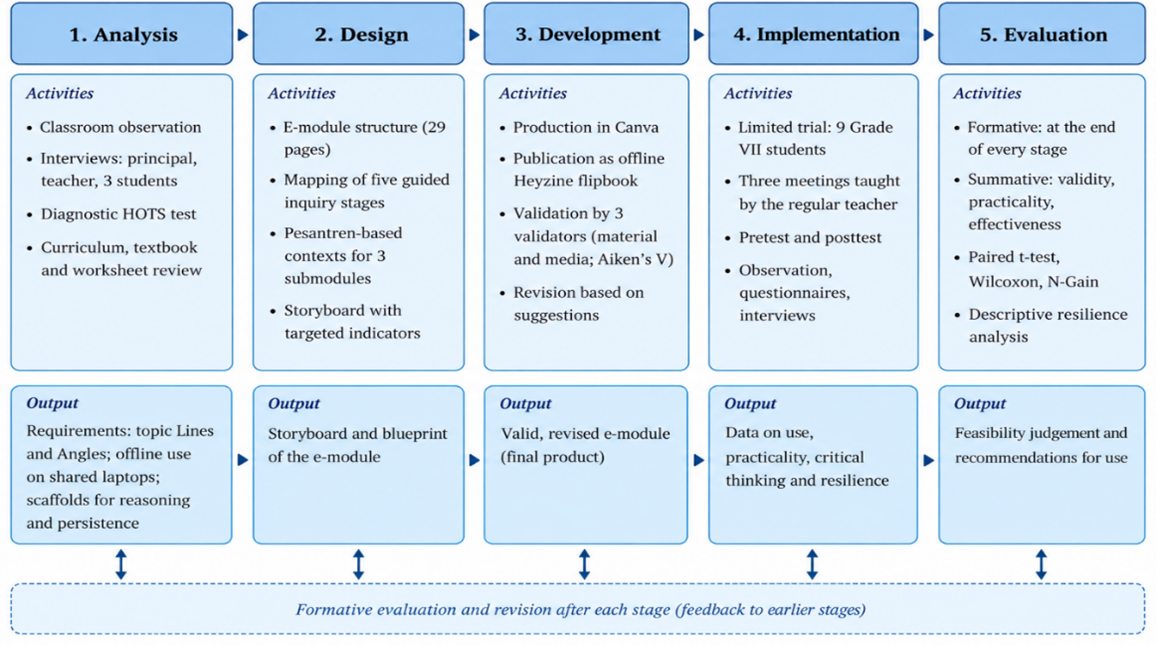
Strengthening mathematical critical thinking and resilience is difficult in schools where digital access is restricted, such as Indonesian Islamic boarding schools (pesantren). This study developed an offline guided inquiry e-module on lines and angles for this setting and examined its validity, practicality, and preliminary effectiveness. Following the ADDIE model, a needs analysis at a pesantren-based junior high school informed a storyboard and a 29-page offline flipbook with three submodules organized around five inquiry stages and contexts from pesantren life. Three validators rated the e-module highly valid (Aiken’s V = 0.937 for material and 0.924 for media), and their feedback led to minor revisions. In a three-meeting one-group pretest–posttest trial with all nine seventh-grade students, observed teacher implementation increased from 63.7% to 82.5% and student engagement from 59.2% to 78.9%, and the teacher (87.5%) and students (84.52%) rated the e-module very practical. Critical thinking scores rose significantly (t(8) = 3.490, p = 0.008, dz = 1.163; mean N-Gain = 0.360), and every student’s resilience score increased (mean 49.33 to 58.22 of 80). Given the small sample and the absence of a comparison group, these results indicate preliminary within-group change rather than causal effects. The study offers a transferable design for offline, inquiry-based digital materials in technology-constrained schools.
Downloads
References
Akkan, S. N., & Horzum, T. (2024). Illuminating the landscape of mathematical resilience: A systematic review. Journal of Pedagogical Research, 8(1), 312–338. https://doi.org/10.33902/JPR.202420093
Alyusfitri, R., Gistituati, N., Yerizon, Fauzan, A., & Yarman. (2024). The effectiveness and relationship of student responses toward learning outcomes using interactive multimedia-based e-modules in elementary schools. International Electronic Journal of Elementary Education, 16(5), 573–584. https://doi.org/10.26822/iejee.2024.354
Arifin, Z., Sukarmin, Saputro, S., & Kamari, A. (2025). The effect of inquiry-based learning on students’ critical thinking skills in science education: A systematic review and meta-analysis. EURASIA Journal of Mathematics, Science and Technology Education, 21(3), Article em2592. https://doi.org/10.29333/ejmste/15988
Basri, H., Purwanto, As’ari, A. R., & Sisworo. (2019). Investigating critical thinking skill of junior high school in solving mathematical problem. International Journal of Instruction, 12(3), 745–758. https://doi.org/10.29333/iji.2019.12345a
Bećirović, S. (2023). Challenges and barriers for effective integration of technologies into teaching and learning. In Digital pedagogy (pp. 123–133). Springer. https://doi.org/10.1007/978-981-99-0444-0_10
Branch, R. M. (2009). Instructional design: The ADDIE approach. Springer. https://doi.org/10.1007/978-0-387-09506-6
BSKAP. (2025). Panduan pembelajaran dan asesmen pendidikan anak usia dini, jenjang pendidikan dasar, dan jenjang pendidikan menengah: Edisi revisi tahun 2025 [Learning and assessment guidelines for early childhood, primary, and secondary education: 2025 revised edition]. Badan Standar, Kurikulum, dan Asesmen Pendidikan, Kementerian Pendidikan Dasar dan Menengah.
Dahal, N., Pant, B. P., Luitel, B. C., Khadka, J., Shrestha, I. M., Manandhar, N. K., & Rajbanshi, R. (2023). Development and evaluation of e-learning courses: Validity, practicality, and effectiveness. International Journal of Interactive Mobile Technologies, 17(12), 40–60. https://doi.org/10.3991/ijim.v17i12.40317
Dermawan, D. D., Wuryandani, W., Herwin, H., Eliza, F., Nurzaman, I., Giwangsa, S. F., Nurdiansah, N., Fadli, R., Sari, S., Jannah, M., & Munawarah. (2025). Improving critical thinking ability in elementary schools with interactive e-modules. Online Journal of Communication and Media Technologies, 15(2), Article e202513. https://doi.org/10.30935/ojcmt/16051
Duran, M., & Dökme, İ. (2016). The effect of the inquiry-based learning approach on student’s critical-thinking skills. EURASIA Journal of Mathematics, Science and Technology Education, 12(12), 2887–2908. https://doi.org/10.12973/eurasia.2016.02311a
Facione, P. A. (1990). Critical thinking: A statement of expert consensus for purposes of educational assessment and instruction. Research findings and recommendations (ED315423). ERIC. https://eric.ed.gov/?id=ED315423
Gyenyn, M., Adu-Obeng, B., & Arthur, Y. D. (2026). Guided teaching, technology integration, and learner engagement as predictors of mathematical problem-solving ability: A structural equation modeling study. International Journal of Didactic Mathematics in Distance Education, 3(1), 119–136. https://jurnal.ut.ac.id/index.php/ijdmde/article/view/13962
Hake, R. R. (1998). Interactive-engagement versus traditional methods: A six-thousand-student survey of mechanics test data for introductory physics courses. American Journal of Physics, 66(1), 64–74. https://doi.org/10.1119/1.18809
Halpern, D. F. (2014). Thought and knowledge: An introduction to critical thinking (5th ed.). Psychology Press.
Isnaini, S., Isnawan, M. G., & Shantika, E. G. (2023). Didactic design for learning social arithmetics based on Islamic values at MTs Mu’allimat NW Anjani. International Journal of Mathematics and Sciences Education, 1(2), 57–63. https://doi.org/10.59965/ijmsed.v1i2.44
Johnston-Wilder, S., & Lee, C. S. (Eds.). (2024). The mathematical resilience book: How everyone can progress in mathematics. Routledge. https://doi.org/10.4324/9781003334354
Kania, N., Kusumah, Y. S., Dahlan, J. A., Nurlaelah, E., Gürbüz, F., & Bonyah, E. (2024). Constructing and providing content validity evidence through the Aiken’s V index based on the experts’ judgments of the instrument to measure mathematical problem-solving skills. REID (Research and Evaluation in Education), 10(1), 64–79. https://doi.org/10.21831/reid.v10i1.71032
Kemendikdasmen. (2025). Naskah akademik pembelajaran mendalam [Academic paper on deep learning]. Kementerian Pendidikan Dasar dan Menengah Republik Indonesia.
Kooken, J., Welsh, M. E., McCoach, D. B., Johnston-Wilder, S., & Lee, C. (2016). Development and validation of the Mathematical Resilience Scale. Measurement and Evaluation in Counseling and Development, 49(3), 217–242. https://doi.org/10.1177/0748175615596782
Lakens, D. (2013). Calculating and reporting effect sizes to facilitate cumulative science: A practical primer for t-tests and ANOVAs. Frontiers in Psychology, 4, Article 863. https://doi.org/10.3389/fpsyg.2013.00863
Lazonder, A. W., & Harmsen, R. (2016). Meta-analysis of inquiry-based learning: Effects of guidance. Review of Educational Research, 86(3), 681–718. https://doi.org/10.3102/0034654315627366
Levine, G., & Parkinson, S. (2014). Experimental methods in psychology. Psychology Press.
Mellawaty, M., Sukestiyarno, Y. L., Zaenuri, & Isnarto. (2023). Level of critical thinking of junior high school students in solving mathematical problems. Polyhedron International Journal in Mathematics Education, 1(1), 53–61. https://doi.org/10.59965/pijme.v1i1.1
Meri, M., Wahyuningrum, E., Sudirman, S., & Bonyah, E. (2026). Contextual teaching and learning assisted by e-modules: Enhancing mathematical communication ability and learning motivation on the Pythagorean theorem. Panicgogy International Journal, 4(1), 65–78. https://doi.org/10.59965/pij.v4i1.313
Miles, M. B., & Huberman, A. M. (1994). Qualitative data analysis: An expanded sourcebook (2nd ed.). SAGE.
Mohd Yusoff, N., & Halim, S. S. (2014). A review of storyboard tools, concepts and frameworks. In P. Zaphiris & A. Ioannou (Eds.), Learning and collaboration technologies: Designing and developing novel learning experiences (Lecture Notes in Computer Science, Vol. 8523, pp. 73–82). Springer. https://doi.org/10.1007/978-3-319-07482-5_8
Muhibban, M., Isnawan, M. G., & Aziz, A. (2023). Android-based didactical design for learning lines and angles: An interpretive didactical design research. Polyhedron International Journal in Mathematics Education, 1(2), 106–118. https://doi.org/10.59965/pijme.v1i2.54
Pakabu, K. T. S., Sudirman, S., Kandaga, T., Rodríguez-Nieto, C. A., & Dejarlo, J. O. (2024). Developing Papuan cultural contextual e-module learning devices in linear programs to improve students’ mathematical problem-solving skills. International Journal of Mathematics and Sciences Education, 2(1), 25–42. https://doi.org/10.59965/ijmsed.v2i1.107
Paul, R., & Elder, L. (2014). Critical thinking: Tools for taking charge of your learning and your life (3rd ed.). Pearson Education.
Pedaste, M., Mäeots, M., Siiman, L. A., de Jong, T., van Riesen, S. A. N., Kamp, E. T., Manoli, C. C., Zacharia, Z. C., & Tsourlidaki, E. (2015). Phases of inquiry-based learning: Definitions and the inquiry cycle. Educational Research Review, 14, 47–61. https://doi.org/10.1016/j.edurev.2015.02.003
Pramasdyahsari, A. S., Setyawati, R. D., Aini, S. N., Nusuki, U., Arum, J. P., Astutik, I. D., Widodo, W., Zuliah, N., & Salmah, U. (2023). Fostering students’ mathematical critical thinking skills on number patterns through digital book STEM PjBL. Eurasia Journal of Mathematics, Science and Technology Education, 19(7), em2297. https://doi.org/10.29333/ejmste/13342
Pulungan, D. A., Retnawati, H., & Jaedun, A. (2022). Mathematical resilience: How students survived in learning mathematics online during the Covid-19 pandemic. Qualitative Research in Education, 11(2), 151–179. https://doi.org/10.17583/qre.9805
Redhana, I. W., Suardana, I. N., Selamat, I. N., Irwanto, Triwiyono, Jalmo, T., & bin Shaharom, M. S. N. (2026). A dimensional analysis of junior high school students’ critical thinking skills. Journal on Efficiency and Responsibility in Education and Science, 19(2), 119–128. https://doi.org/10.7160/eriesj.2026.190202
Sari, R. M. M., Zulnaidi, H., Sopiany, H. N., Hakim, D. L., Ardiyanti, Y., & Yadav, D. K. (2025). Development of digital learning media with Articulate Storyline 3 based on students’ algebraic thinking skills. International Journal of Didactic Mathematics in Distance Education, 2(1), 45–57. https://doi.org/10.33830/ijdmde.v2i1.10305
Secadron Jr, A. C., & Tan, D. A. (2023). Enhancing students’ mathematical resilience and critical thinking skills using e-modules via process-oriented-guided-inquiry-learning approach. American Journal of Educational Research, 11(5), 287–296. https://doi.org/10.12691/education-11-5-6
Setiyani, Waluya, S. B., Sukestiyarno, Y., & Cahyono, A. N. (2022). E-module design using Kvisoft Flipbook application based on mathematics creative thinking ability for junior high schools. International Journal of Interactive Mobile Technologies, 16(4), 116–136. https://doi.org/10.3991/ijim.v16i04.25329
Shadish, W. R., Cook, T. D., & Campbell, D. T. (2002). Experimental and quasi-experimental designs for generalized causal inference. Houghton Mifflin.
Spatioti, A. G., Kazanidis, I., & Pange, J. (2022). A comparative study of the ADDIE instructional design model in distance education. Information, 13(9), 402. https://doi.org/10.3390/info13090402
Su, H. F. H., Ricci, F. A., & Mnatsakanian, M. (2016). Mathematical teaching strategies: Pathways to critical thinking and metacognition. International Journal of Research in Education and Science, 2(1), 190–200. https://ijres.net/index.php/ijres/article/view/100
Sugiarni, R., Zulnaidi, H., Ningsih, D. N., Hakim, R. R., & Setiawan, E. (2026). Integrating Pandanwangi ethnomathematics into e-worksheets to support numeracy in online mathematics learning. International Journal of Didactic Mathematics in Distance Education, 3(2), 184–209. https://doi.org/10.33830/ijdmde.v3i2.14462
Sulasti, S., Alsulami, N. M., Isnawan, M. G., Santosa, F. H., Olivero-Acuña, R. R., & Silgado-Tuñón, D. A. (2026). Exploring senior high school students’ mathematical critical thinking barriers and self-generated solutions: A hermeneutic phenomenological study. Panicgogy International Journal, 4(1), 16–31. https://doi.org/10.59965/pij.v4i1.185
Wicaksana, Y. D., Widoretno, S., & Dwiastuti, S. (2020). The use of critical thinking aspects on module to enhance students’ academic achievement. International Journal of Instruction, 13(2), 303–314. https://doi.org/10.29333/iji.2020.13221a
Wijayanti, A., Dwiningrum, S. I. A., & Saptono, B. (2025). Enhancing digital literacy and science understanding: The impact of a guided inquiry-based flipped classroom in elementary schools. International Journal of Information and Education Technology, 15(7), 1477–1486. https://doi.org/10.18178/ijiet.2025.15.7.2349
Yap, B. W., & Sim, C. H. (2011). Comparisons of various types of normality tests. Journal of Statistical Computation and Simulation, 81(12), 2141–2155. https://doi.org/10.1080/00949655.2010.520163
Downloads
Published
How to Cite
Issue
Section
License
Copyright (c) 2026 Heti Handayani, Yumiati Yumiati, Nia Jusniani

This work is licensed under a Creative Commons Attribution-ShareAlike 4.0 International License.


