
Unveiling the roots of students’ low comprehension of quadratic functions: A hermeneutic phenomenological study in a West Lombok junior high school, Indonesia
DOI:
https://doi.org/10.59965/ijmsed.v4i1.184Keywords:
hermeneutic phenomenology, learning difficulties, quadratic functions, student understanding, thematic analysisAbstract
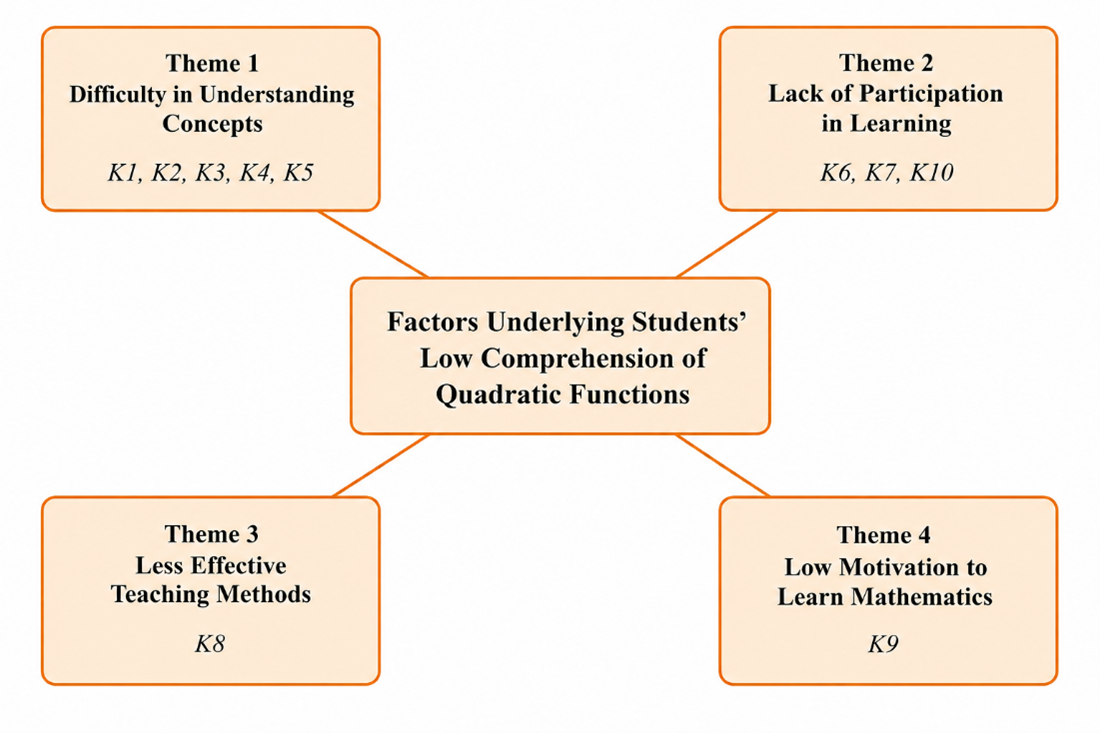
Quadratic functions are a core topic in junior high school mathematics, yet many students continue to struggle to master this material. This study explored, in depth, the factors underlying the low comprehension of quadratic functions among eighth-grade students at a public junior high school in West Lombok Regency, Indonesia. A hermeneutic phenomenological design was used to capture students’ lived experiences and interpretations of their learning difficulties, complemented by thematic analysis to identify recurring patterns across responses. Data were collected through an open-ended questionnaire completed by ten purposively selected students and analyzed following Braun and Clarke’s six-phase thematic analysis, assisted by an artificial intelligence tool (ChatGPT) during initial coding and subsequently verified manually by the researchers. The analysis produced ten initial codes, condensed into five categories and, ultimately, four overarching themes: (1) difficulty in understanding basic concepts, (2) lack of participation in learning, (3) less effective teaching methods, and (4) low motivation to learn mathematics. These findings indicate that students’ struggles with quadratic functions stem not merely from the material’s cognitive complexity but from an interplay of cognitive, behavioral, pedagogical, and affective factors. By foregrounding students’ own voices rather than relying solely on achievement scores, this study offers a more holistic understanding of algebra learning difficulties. It recommends that teachers design more contextual, participatory, and enjoyable instructional strategies, supported by visual and concrete media, to strengthen students’ conceptual understanding of quadratic functions and to inform future intervention-based research.
References
Amis, F. (2006). 88 M in the teaching of mathematics in secondary schools. www.nctm.org.
Anthony, G., & Walshaw, M. (2009). Characteristics of effective mathematics teaching: A view from the West. Journal of Mathematics Education for All, 2(2).
Arcavi, A. (1994). Symbol sense: Informal sense-making in formal mathematics. For the Learning of Mathematics, 14(3), 24–35.
Aydogan Yenmez, A., Erbas, A. K., Alacaci, C., Cakiroglu, E., & Cetinkaya, B. (2017). The evolution of pedagogical knowledge of math teachers as they teach through modeling. International Journal of Education in Mathematics, Science and Technology, 5(4), 317–317. https://doi.org/10.18404/ijemst.296552
Boaler, J. (1998). Open and closed mathematics: Students’ experiences and understanding. Journal for Research in Mathematics Education, 29(1), 41–62.
Braun, V., & Clarke, V. (2006). Using thematic analysis in psychology. Qualitative Research in Psychology, 3(2), 77–101. https://doi.org/10.1191/1478088706qp063oa
Creswell, J. W. (2007). Qualitative inquiry & research design: Choosing among five approaches (2nd ed.). Sage Publications.
Cuoco, A. L., Goldenberg, E. P., & Mark, J. (1996). Habits of mind: An organizing principle for mathematics curricula. Journal of Mathematical Behavior, 15(4), 375–402.
Deci, E. L., & Ryan, R. M. (1985). Intrinsic motivation and self-determination in human behavior. Plenum Press.
McNeil, N. M., Weinberg, A., Hattikudur, S., Stephens, A. C., Asquith, P., Knuth, E. J., & Alibali, M. W. (2010). A is for apple: Mnemonic symbols impede the interpretation of algebraic expressions. Journal of Educational Psychology, 102(3), 625–634. https://doi.org/10.1037/a0019105
Skinner, B. F. (2005). Science and human behavior. B.F. Skinner Foundation. http://www.bfskinner.org/books4sale.asp
Steinberg, L. (2005). Cognitive and affective development in adolescence. Trends in Cognitive Sciences, 9(2), 69–74. https://doi.org/10.1016/j.tics.2004.12.005
Thurm, D., & Barzel, B. (2022). Teaching mathematics with technology: A multidimensional analysis of teachers’ beliefs. Educational Studies in Mathematics, 109(1), 41–63. https://doi.org/10.1007/s10649-021-10072-x
Tomlinson, C. A. (2001). How to differentiate instruction in a blended-ability classroom (2nd ed.). Association for Supervision and Curriculum Development.
van Manen, M. (1990). Researching lived experience: Human science for an action sensitive pedagogy. State University of New York Press.
Ydo, Y. (2020). Inclusive education: Global priority, collective responsibility. Prospects, 49(3–4), 97–101. https://doi.org/10.1007/s11125-020-09520-y
Downloads
Published
How to Cite
Issue
Section
License
Copyright (c) 2026 Siti Maemunah, Evana Gina Shantika, Indrawati Indrawati, Muhamad Galang Isnawan, Naif Mastoor Alsulami

This work is licensed under a Creative Commons Attribution-ShareAlike 4.0 International License.


