
Generative artificial intelligence in university mathematics teaching: Theorems-in-action inferred from practicing professors’ discourse
DOI:
https://doi.org/10.59965/ijmsed.v4i2.323Keywords:
Generative artificial intelligence, Theorems-in-action, University mathematics professorsAbstract
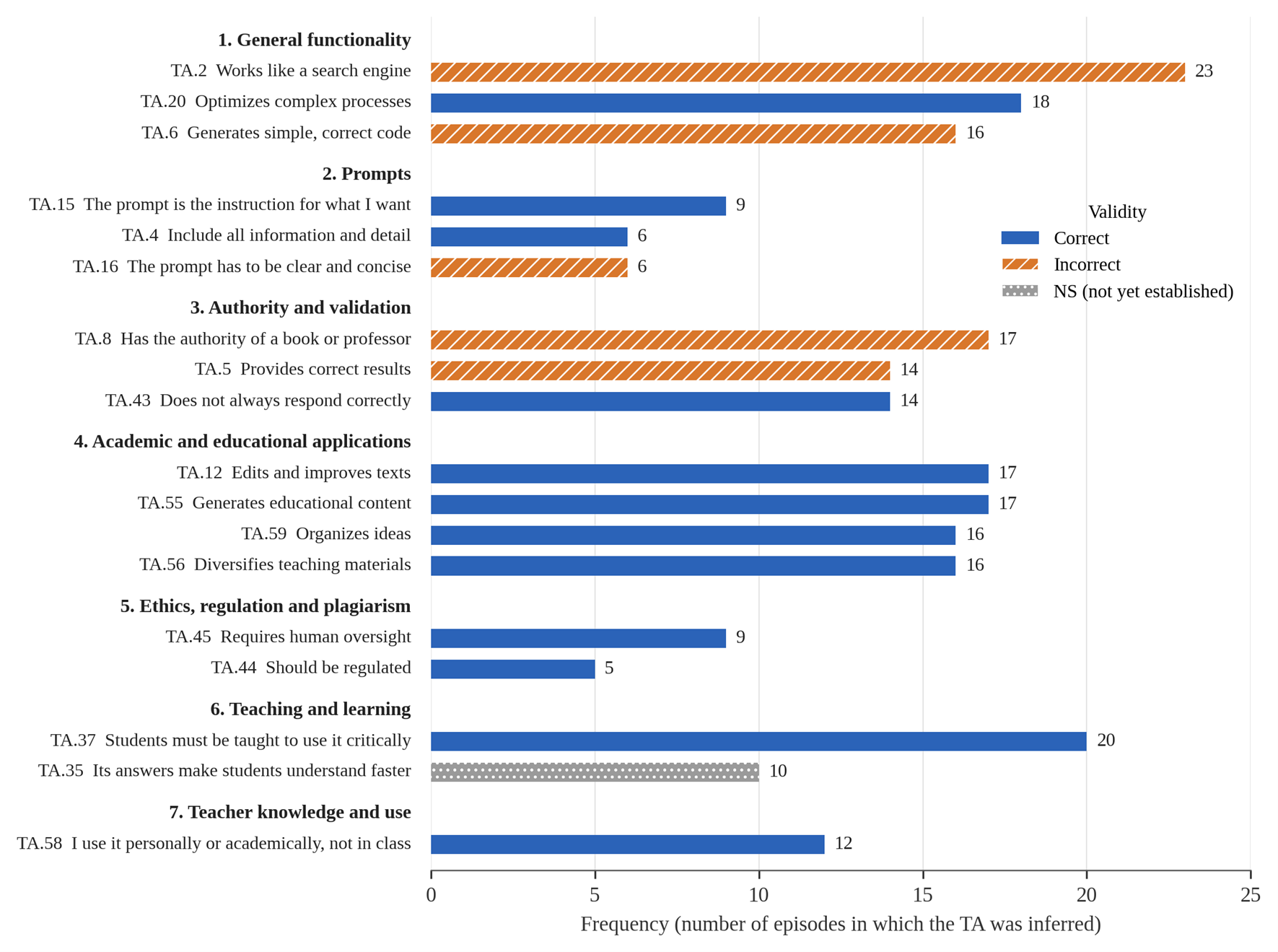
This article examines how university professors who teach mathematics conceptualize and use Generative Artificial Intelligence (GenAI) chatbots such as ChatGPT and Gemini, as expressed in their interview discourse. Drawing on the Theory of Conceptual Fields, the study adopts a qualitative, exploratory case-study design bounded to ten practicing professors from the academic units of Mathematics, Physics, Light and Matter Science and Technology (LUMAT), and Engineering at a public university in Mexico. Semi-structured interviews were segmented into episodes, from which theorems-in-action (TA) were inferred by one researcher, reviewed by a second researcher, and agreed upon by the research team; the resulting 68 TA were grouped into seven categories and judged as correct, incorrect, or not yet established in light of current literature on GenAI. The findings reveal the coexistence of contradictory theorems-in-action: some reflect schemes built through experience with search engines (GenAI provides correct results), while others are more appropriate for the use of these technologies (GenAI does not always respond correctly). Furthermore, although most professors report using GenAI for personal or professional tasks, its reported pedagogical integration into the classroom remains limited. These results suggest that professional development for mathematics teachers should go beyond instrumental training and explicitly address the theorems-in-action that guide the use of GenAI, particularly those concerning the verification of its outputs.
References
Alsharidah, M., & Alkramiti, A. (2024). Teachers’ perceptions towards using artificial intelligence in mathematics education. Amazonia Investiga, 13(84), 43–60. https://doi.org/10.34069/AI/2024.84.12.3
Bastani, H., Bastani, O., Sungu, A., Ge, H., Kabakcı, Ö., & Mariman, R. (2025). Generative AI without guardrails can harm learning: Evidence from high school mathematics. Proceedings of the National Academy of Sciences, 122(26), Article e2422633122. https://doi.org/10.1073/pnas.2422633122
Bender, E. M., Gebru, T., McMillan-Major, A., & Shmitchell, S. (2021). On the dangers of stochastic parrots: Can language models be too big? In Proceedings of the 2021 ACM Conference on Fairness, Accountability, and Transparency (pp. 610–623). Association for Computing Machinery. https://doi.org/10.1145/3442188.3445922
Castillo, D. I., Mendoza, S. M., & Gómez, A. J. (2025). Percepción y uso de la inteligencia artificial de los estudiantes de la licenciatura en matemáticas. Estudios y Perspectivas Revista Científica y Académica, 5(1), 3530–3549. https://doi.org/10.61384/r.c.a.v5i1.1067
Corica, A., Parra, V., Figueroa, P., Schiaffino, S., & Godoy, D. (2025). Análisis y comparación de respuestas aportadas por IA generativa y por profesores de matemática a un problema de geometría euclidiana. Educación Matemática, 37(1), 127–160. https://doi.org/10.24844/EM3701.05
Corica, A., Parra, V., Sureda, P., Schiaffino, S., & Godoy, D. (2024). Fractal de Koch: Análisis de respuestas de IA generativa y un profesor de matemática. Revista Iberoamericana de Tecnología en Educación y Educación en Tecnología, (37), 89–99. https://doi.org/10.24215/18509959.37.e8
Díaz, J. P. (2025). Más allá de los algoritmos: Desafíos y percepciones docentes sobre la inteligencia artificial generativa en la enseñanza virtual. Revista de Investigación en Tecnologías de la Información, 13(29), 141–153. https://doi.org/10.36825/RITI.13.29.012
Ellis, A. R., & Slade, E. (2023). A new era of learning: Considerations for ChatGPT as a tool to enhance statistics and data science education. Journal of Statistics and Data Science Education, 31(2), 128–133. https://doi.org/10.1080/26939169.2023.2223609
Ertmer, P. A. (2005). Teacher pedagogical beliefs: The final frontier in our quest for technology integration? Educational Technology Research and Development, 53(4), 25–39. https://doi.org/10.1007/BF02504683
Fereday, J., & Muir-Cochrane, E. (2006). Demonstrating rigor using thematic analysis: A hybrid approach of inductive and deductive coding and theme development. International Journal of Qualitative Methods, 5(1), 80–92. https://doi.org/10.1177/160940690600500107
Frieder, S., Pinchetti, L., Chevalier, A., Griffiths, R.-R., Salvatori, T., Lukasiewicz, T., Petersen, P. C., & Berner, J. (2023). Mathematical capabilities of ChatGPT. Advances in Neural Information Processing Systems, 36, 27699–27744
Gao, J., Pi, R., Zhang, J., Ye, J., Zhong, W., Wang, Y., Hong, L., Han, J., Xu, H., Li, Z., & Kong, L. (2023). G-LLaVA: Solving geometric problem with multi-modal large language model (arXiv:2312.11370). arXiv. https://doi.org/10.48550/arXiv.2312.11370
Hernández, R., Fernández, C., & Baptista, P. (1997). Metodología de la investigación (3rd ed.). Panamericana Formas e Impresos.
Huang, H., Shen, X., Wang, S., Liu, D., & Wang, H. (2024). Verbalized probabilistic graphical modeling with large language models (arXiv:2406.05516). arXiv. https://doi.org/10.48550/arXiv.2406.05516
Huang, L., Yu, W., Ma, W., Zhong, W., Feng, Z., Wang, H., Chen, Q., Peng, W., Feng, X., Qin, B., & Liu, T. (2025). A survey on hallucination in large language models: Principles, taxonomy, challenges, and open questions. ACM Transactions on Information Systems, 43(2), Article 42. https://doi.org/10.1145/3703155
Kang, Y. J. (2024). A study on the didactical application of ChatGPT for mathematical word problem solving. Communications of Mathematical Education, 38(1), 49–67. https://doi.org/10.7468/jksmee.2024.38.1.49
Kwon, O. N., Oh, S. J., Yoon, J. E., Lee, K. Y., Shin, B. C., & Jeong, W. (2023). Analyzing mathematical performances of ChatGPT: Focusing on the solution of national assessment of educational achievement and the college scholastic ability test. Communications of Mathematical Education, 37(2), 233–256. https://doi.org/10.7468/jksmee.2023.37.2.233
La Fontaine, G. (2024). Sobre loros estocásticos: Una mirada a los modelos grandes de lenguaje. Lógoi. Revista de Filosofía, (45), 75–87. https://doi.org/10.62876/lr.vi45.6480
Lee, G. M., Lee, Y. J., & Kim, H. J. (2023). Analysis of adaptive learning in Korea’s AI mathematics learning platforms. Journal of the Korean School Mathematics Society, 26(3), 245–268. https://doi.org/10.30807/ksms.2023.26.3.004
Lee, Y. J. (2023). An analysis of pre-service teachers’ mathematics lesson design using ChatGPT. Communications of Mathematical Education, 37(3), 497–516. https://doi.org/10.7468/jksmee.2023.37.3.497
Lincoln, Y. S., & Guba, E. G. (1985). Naturalistic inquiry. SAGE.
Lo, L. S. (2023). The CLEAR path: A framework for enhancing information literacy through prompt engineering. The Journal of Academic Librarianship, 49(4), Article 102720. https://doi.org/10.1016/j.acalib.2023.102720
Malterud, K., Siersma, V. D., & Guassora, A. D. (2016). Sample size in qualitative interview studies: Guided by information power. Qualitative Health Research, 26(13), 1753–1760. https://doi.org/10.1177/1049732315617444
Miao, F., & Holmes, W. (2023). Guidance for generative AI in education and research. UNESCO. https://unesdoc.unesco.org/ark:/48223/pf0000386693
Mishra, P., & Koehler, M. J. (2006). Technological pedagogical content knowledge: A framework for teacher knowledge. Teachers College Record, 108(6), 1017–1054. https://doi.org/10.1111/j.1467-9620.2006.00684.x
Mishra, P., Warr, M., & Islam, R. (2023). TPACK in the age of ChatGPT and generative AI. Journal of Digital Learning in Teacher Education, 39(4), 235–251. https://doi.org/10.1080/21532974.2023.2247480
Morán-Ortega, S.-A., Ruiz-Tirado, S.-G., Simental-López, L.-M., & Tirado-López, A.-B. (2024). Barreras de la inteligencia artificial generativa en estudiantes de educación superior: Percepción docente. Revista de Investigación en Tecnologías de la Información, 12(25), 26–37. https://doi.org/10.36825/RITI.12.25.003
O’Connor, C., & Joffe, H. (2020). Intercoder reliability in qualitative research: Debates and practical guidelines. International Journal of Qualitative Methods, 19. https://doi.org/10.1177/1609406919899220
Parra, V., Sureda, P., & Corica, A. (2024). Teoría de situaciones didácticas e inteligencia artificial: Diseño de propuestas para enseñar las nociones de muestra y población en educación secundaria. Uno: Revista de Didáctica de las Matemáticas, (104), 43–50.
Parra, V., Sureda, P., Corica, A., Schiaffino, S., & Godoy, D. (2024). Can generative AI solve geometry problems? Strengths and weaknesses of LLMs for geometric reasoning in Spanish. International Journal of Interactive Multimedia and Artificial Intelligence, 8(5), 65–74.
Piantadosi, S. T., & Hill, F. (2022). Meaning without reference in large language models (arXiv:2208.02957). arXiv. https://doi.org/10.48550/arXiv.2208.02957
Ramírez, A., & Casillas, M. A. (2024). Percepciones docentes sobre la inteligencia artificial generativa: El caso mexicano. Revista Paraguaya de Educación a Distancia (REPED), 5(2), 44–55. https://doi.org/10.56152/reped2024-dossierIA1-art4
Selwyn, N., Rivera-Vargas, P., Passeron, E., & Miño-Puigcercos, R. (2022). ¿Por qué no todo es (ni debe ser) digital? Interrogantes para pensar sobre digitalización, datificación e inteligencia artificial en educación. In P. Rivera-Vargas, R. Miño-Puigcercos, & E. Passeron (Eds.), Educar con sentido transformador en la universidad (pp. 137–147). Octaedro.
Shah, C., & Bender, E. M. (2022). Situating search. In Proceedings of the 2022 Conference on Human Information Interaction and Retrieval (CHIIR ’22) (pp. 221–232). Association for Computing Machinery. https://doi.org/10.1145/3498366.3505816
Sigman, M., & Bilinkis, S. (2023). Artificial: La nueva inteligencia y el contorno de lo humano. Debate.
Silgado-Tuñón, D. A., & López-Flores, J. I. (2025a). Inteligencia artificial generativa en la educación superior: Una revisión sistemática. Unión – Revista Iberoamericana de Educación Matemática, 21(73). https://union.fespm.es/index.php/UNION/article/view/1709
Silgado-Tuñón, D. A., & López-Flores, J. I. (2025b). Inteligencia artificial generativa en el aula: ¿Aliada o amenaza para la enseñanza de las matemáticas? Revista Electrónica Tecnologías Emergentes en la Educación, 2(1), 53–66. https://doi.org/10.71713/retee.v2i1.3512
Silgado-Tuñón, D. A., López-Flores, J. I., & García, C. C. (2025). IA, discapacidad y docencia inclusiva: Una reflexión desde el DUA y el TPACK. Revista Electrónica Tecnologías Emergentes en la Educación, 2(2), 72–90. https://doi.org/10.71713/retee.v2i2.3728
Silgado-Tuñón, D. A., Sureda, P., López-Flores, J. I., & Magallanes, E. (2025). Exploring university mathematics professors’ perceptions and use of GenAI: A conceptual fields approach. Amazonia Investiga, 14(86), 250–263. https://doi.org/10.34069/AI/2025.86.02.19
Socorro, J. (2024). Actitudes del profesorado ante el uso y manejo de la inteligencia artificial generativa (IAG) de modo eficiente. Revista Científica de Salud y Desarrollo Humano, 5(3), 1183–1213. https://doi.org/10.61368/r.s.d.h.v5i3.325
Song, X., Mak, J., & Chen, H. (2025). Teachers’ and learners’ perceptions about implementation of AI tools in elementary mathematics classes. SAGE Open, 15(2). https://doi.org/10.1177/21582440251334545
Stake, R. E. (1995). The art of case study research. SAGE.
Sureda, P., & Otero, M. R. (2011). Nociones fundamentales de la teoría de los campos conceptuales. Revista Electrónica de Investigación en Educación en Ciencias, 6(1), 124–138.
Sureda, P., & Otero, M. R. (2013). Un estudio sobre el proceso de conceptualización de la función exponencial. Educación Matemática, 25(2), 89–118. http://www.revista-educacion-matematica.com/descargas/Vol25-2.pdf
Sureda, P., & Otero, M. R. (2014). La conceptualización de la función exponencial y los sistemas de representación. In La teoría de los campos conceptuales y la conceptualización en el aula de matemática y física (pp. 33–45). Dunken.
Sureda, P., Corica, A., Parra, V., Godoy, D., & Schiaffino, S. (2024). La evaluación en educación matemática: Aportes de chatbots y futuros profesores de matemática. Edutec. Revista Electrónica de Tecnología Educativa, (89), 64–83. https://doi.org/10.21556/edutec.2024.89.3243
Sureda, P., Parra, V., Corica, A. R., Godoy, D., & Schiaffino, S. (2025). On the role of generative AI in fractals teaching: Solutions and class proposals designed by chatbots and mathematics teachers. International Journal of Education in Mathematics, Science and Technology, 13(5), 1298–1316. https://doi.org/10.46328/ijemst.5713
Vergnaud, G. (1990). La théorie des champs conceptuels. Recherches en Didactique des Mathématiques, 10(2–3), 133–170.
Vergnaud, G. (2007). ¿En qué sentido la teoría de los campos conceptuales puede ayudarnos para facilitar aprendizaje significativo? Investigações em Ensino de Ciências, 12(2), 285–302.
Vergnaud, G. (2009). The theory of conceptual fields. Human Development, 52(2), 83–94. https://doi.org/10.1159/000202727
Vergnaud, G. (2013). Pourquoi la théorie des champs conceptuels? Journal for the Study of Education and Development, 36(2), 131–161.
Wardat, Y., Tashtoush, M. A., AlAli, R., & Jarrah, A. M. (2023). ChatGPT: A revolutionary tool for teaching and learning mathematics. EURASIA Journal of Mathematics, Science and Technology Education, 19(7). https://doi.org/10.29333/ejmste/13272
White, J., Fu, Q., Hays, S., Sandborn, M., Olea, C., Gilbert, H., Elnashar, A., Spencer-Smith, J., & Schmidt, D. C. (2023). A prompt pattern catalog to enhance prompt engineering with ChatGPT (arXiv:2302.11382). arXiv. https://doi.org/10.48550/arXiv.2302.11382
Wineburg, S., & McGrew, S. (2019). Lateral reading and the nature of expertise: Reading less and learning more when evaluating digital information. Teachers College Record, 121(11), 1–40. https://doi.org/10.1177/016146811912101102
Yin, R. K. (2018). Case study research and applications: Design
Downloads
Published
How to Cite
Issue
Section
License
Copyright (c) 2026 Denilsón Andrés Silgado-Tuñón, Patricia Sureda, José Iván López-Flores, Emmanuel Magallanes Ulloa

This work is licensed under a Creative Commons Attribution-ShareAlike 4.0 International License.


