
The effect of learning intensity on students’ statistics course scores: A multiple regression approach with Ridge regularization
DOI:
https://doi.org/10.59965/pijme.v4i1.294Keywords:
Attendance rates, Learning intensity, Ridge regression, Statistics achievement, Study hoursAbstract
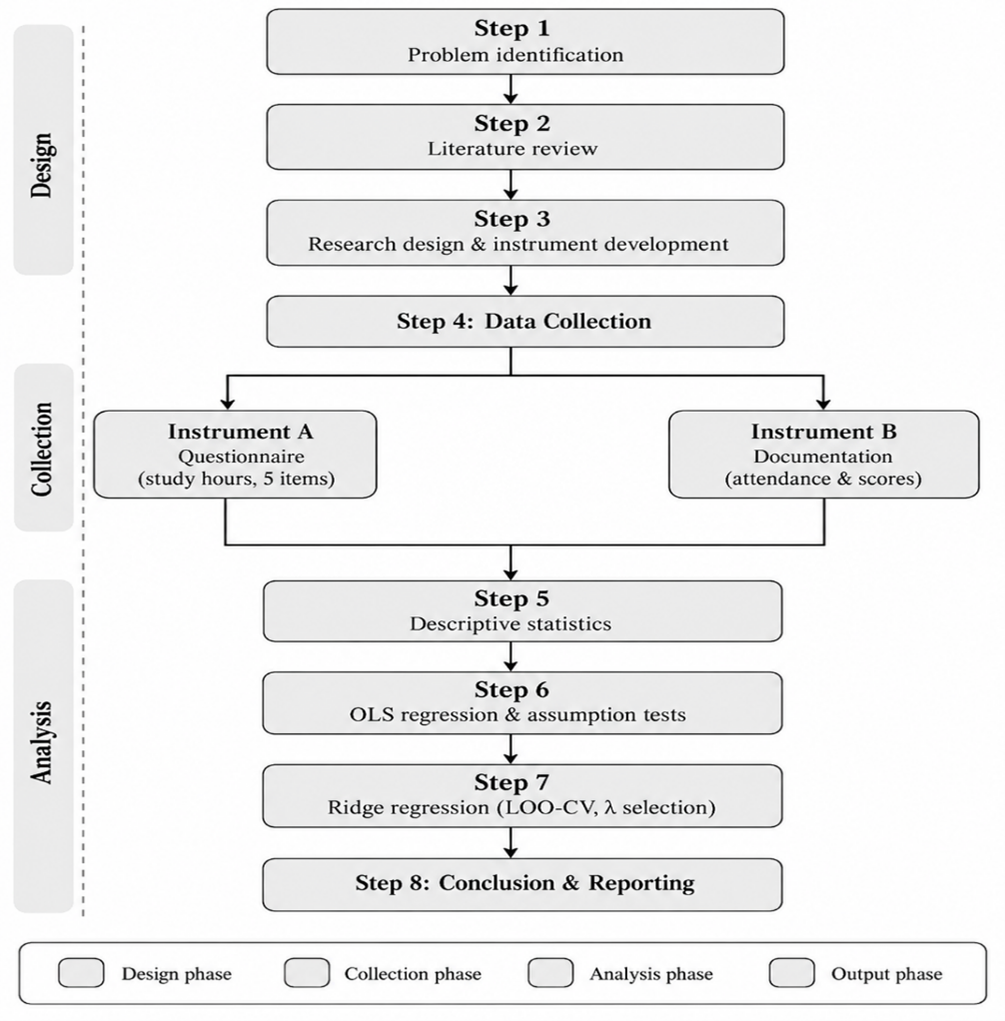
Low achievement in statistics courses is a persistent concern in higher education, yet the contributions of study time and attendance remain underexplored, particularly in Indonesian undergraduate contexts and without correcting for predictor multicollinearity. This study addresses this gap by applying Ridge regularization to estimate the independent effects of daily study hours and attendance rate on statistics course scores among 20 Indonesian undergraduates. Classical OLS assumptions were tested; Ridge regression with Leave-One-Out Cross-Validation was applied when violations occurred. Study hours and attendance jointly explained 97.54% of score variance (R² = 0.975; F = 337.70; p < 0.001); however, severe multicollinearity (VIF = 11.77) destabilized OLS estimates. Ridge regression (λ = 1.0) produced stable coefficients (b₁ = 2.87; b₂ = 0.80) with negligible accuracy loss (R² = 0.974). The near-perfect collinearity of the predictors indicates that study hours and attendance are part of the same underlying construct academic engagement rather than acting through independent pathways. These findings challenge the conventional additive model of learning time and imply that interventions targeting self-regulated learning may be more effective than policies addressing attendance or study time in isolation.
Downloads
References
Arlot, S., & Celisse, A. (2010). A survey of cross-validation procedures for model selection. Statistics Surveys, 4, 40–79. https://doi.org/10.1214/09-SS054
Bandura, A. (1977). Social learning theory. Prentice Hall.
Budé, L., Van De Wiel, M. W. J., Imbos, T., Candel, M. J. J. M., Broers, N. J., & Berger, M. P. F. (2007). Students’ achievements in a statistics course in relation to motivational aspects and study behaviour. Statistics Education Research Journal, 6(1), 5–21. http://www.stat.auckland.ac.nz/~iase/serj/SERJ6(1)_Bude.pdf
Carroll, J. B. (1963). A model of school learning. Teachers College Record, 64(8), 723–733. https://doi.org/10.1177/016146816306400801
Cohen, J. (1988). Statistical power analysis for the behavioral sciences (2nd ed.). Lawrence Erlbaum Associates.
Credé, M., & Kuncel, N. R. (2008). Study habits, skills, and attitudes: The third pillar supporting collegiate academic performance. Perspectives on Psychological Science, 3(6), 425–453. https://doi.org/10.1111/j.1745-6924.2008.00089.x
Credé, M., Roch, S. G., & Kieszczynka, U. M. (2010). Class attendance in college: A meta-analytic review of the relationship of class attendance with grades and student characteristics. Review of Educational Research, 80(2), 272–295. https://doi.org/10.3102/0034654310362998
Creswell, J. W., & Creswell, J. D. (2018). Research design: Qualitative, quantitative, and mixed methods approaches (5th ed.). SAGE Publications.
Cui, Y., Chen, F., Shiri, A., & Fan, Y. (2019). Predictive analytic models of student success in higher education: A review of methodology. Information and Learning Sciences, 120(3–4), 208–227. https://doi.org/10.1108/ILS-10-2018-0104
Ecclestone, K., & Lewis, L. (2014). Interventions for resilience in educational settings: Challenging policy discourses of risk and vulnerability. Journal of Education Policy, 29(2), 195–216. https://doi.org/10.1080/02680939.2013.806678
Ericsson, K. A., Krampe, R. T., & Tesch-Römer, C. (1993). The role of deliberate practice in the acquisition of expert performance. Psychological Review, 100(3), 363–406. https://doi.org/10.1037/0033-295X.100.3.363
Feldon, D. F., Maher, M. A., Hurst, M., & Timmerman, B. (2015). Faculty mentors’, graduate students’, and performance-based assessments of students’ research skill development. American Educational Research Journal, 52(2), 334–370. https://doi.org/10.3102/0002831214549449
Field, A. (2018). Discovering statistics using IBM SPSS statistics (5th ed.). SAGE Publications.
Galli, S., Chiesi, F., & Primi, C. (2017). The relationship between mathematical ability, statistics anxiety and attitudes toward statistics in predicting statistics achievement. Learning and Individual Differences, 56, 58–67. https://doi.org/10.1016/j.lindif.2017.05.001
Green, S. B. (1991). How many subjects does it take to do a regression analysis? Multivariate Behavioral Research, 26(3), 499–510. https://doi.org/10.1207/s15327906mbr2603_7
Greene, W. H. (2018). Econometric analysis (8th ed.). Pearson.
Hair, J. F., Black, W. C., Babin, B. J., & Anderson, R. E. (2019). Multivariate data analysis (8th ed.). Cengage Learning.
Ma, R., & Xiao, L. (2025). Application of deep learning to the development of a prediction model for college students’ learning outcomes. Discover Artificial Intelligence, 6(1), Article 33. https://doi.org/10.1007/s44163-025-00607-z
Marburger, D. R. (2001). Absenteeism and undergraduate exam performance. Journal of Economic Education, 32(2), 99–109. https://doi.org/10.1080/00220480109596094
McMillan, J. H., & Schumacher, S. (2014). Research in education: Evidence-based inquiry (7th ed.). Pearson.
Moore, R. (2006). The importance of admissions scores and attendance to performance in introductory biology. Journal of the First-Year Experience & Students in Transition, 18(1), 83–98.
Onwuegbuzie, A. J., & Wilson, V. A. (2003). Statistics anxiety: Nature, etiology, antecedents, effects, and treatments—a comprehensive review of the literature. Teaching in Higher Education, 8(2), 195–209. https://doi.org/10.1080/1356251032000052447
Paisey, C., & Paisey, N. J. (2004). Student attendance in an accounting programme. Accounting Education, 13(2), 183–204. https://doi.org/10.1080/0963928042000229293
Plant, E. A., Ericsson, K. A., Hill, L., & Asberg, K. (2005). Why study time does not predict grade point average across college students: Implications of deliberate practice for academic performance. Contemporary Educational Psychology, 30(1), 96–116. https://doi.org/10.1016/j.cedpsych.2004.06.001
Ramirez, C., Schau, C., & Emmioğlu, E. S. (2012). The importance of attitudes in statistics education. Statistics Education Research Journal, 11(2), 57–71. https://doi.org/10.52041/serj.v11i2.329
Roediger, H. L., & Butler, A. C. (2011). The critical role of retrieval practice in long-term retention. Trends in Cognitive Sciences, 15(1), 20–27. https://doi.org/10.1016/j.tics.2010.09.003
Romer, D. (1993). Do students go to class? Should they? Journal of Economic Perspectives, 7(3), 167–174. https://doi.org/10.1257/jep.7.3.167
Schneider, M., & Preckel, F. (2017). Variables associated with achievement in higher education: A systematic review of meta-analyses. Psychological Bulletin, 143(6), 565–600. https://doi.org/10.1037/bul0000098
Schwab-McCoy, A. (2019). The state of statistics education research in client disciplines: Themes and trends across the university. Journal of Statistics Education, 27(3), 253–264. https://doi.org/10.1080/10691898.2019.1687369
Tabachnick, B. G., & Fidell, L. S. (2019). Using multivariate statistics (7th ed.). Pearson.
Tibshirani, R. (1996). Regression shrinkage and selection via the lasso. Journal of the Royal Statistical Society: Series B, 58(1), 267–288. https://doi.org/10.1111/j.2517-6161.1996.tb02080.x
Zimmerman, B. J. (2000). Self-efficacy: An essential motive to learn. Contemporary Educational Psychology, 25(1), 82–91. https://doi.org/10.1006/ceps.1999.1016
Downloads
Published
How to Cite
Issue
Section
License
Copyright (c) 2026 Muh. Rusmayadi, Samsuriadi Samsuriadi, Lidaini Lidaini, Muhamad Galang Isnawan, Naif Mastoor Alsulami, Aditya Purnama

This work is licensed under a Creative Commons Attribution-ShareAlike 4.0 International License.


