
Ethnomathematics of sacred movement: Modelling the spatial geometry of Tawaf and Saʿi through the extended theory of mathematical connections
DOI:
https://doi.org/10.59965/pijme.v4i2.335Keywords:
ethnomathematics, extended theory of mathematical connections, sa'i, spatial geometry, tawafAbstract
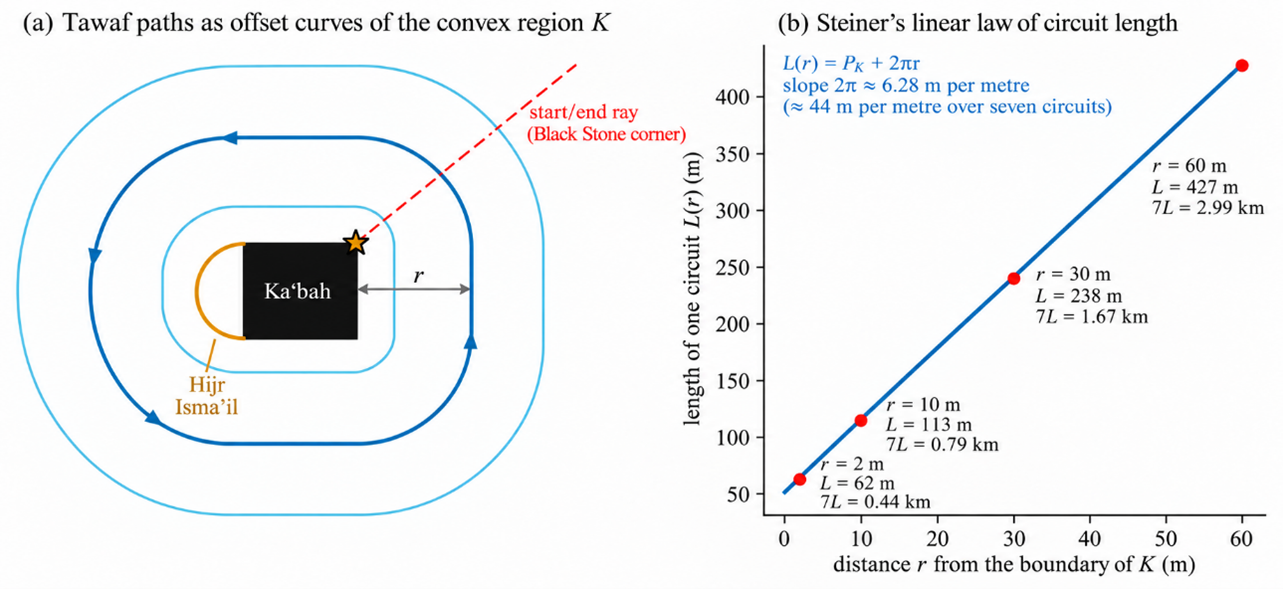
Ethnomathematics research has largely examined static artifacts such as buildings, ornaments, and textiles, while patterned human movement has received little attention. This study analyzed the spatial-geometric and kinematic structure of tawaf and saʿi, the two movement-based pillars of umrah, using the Extended Theory of Mathematical Connections (ETMC) within an emic–etic–dialogical (ethnomodelling) framework. Official manasik guidebooks, scholarly texts, and publicly available visual records were analyzed through document and visual content analysis in three phases: emic description of the prescribed rules, etic geometric and kinematic modelling, and dialogical coding of the connections between them. Tawaf was modelled as a positively oriented closed path with winding number seven around a non-circular convex obstacle formed by the Kaʿbah and Ḥijr Ismāʿīl; by Steiner’s formula, the length of each circuit grows linearly with distance from the Kaʿbah, L(r) = PK + 2πr, regardless of the building’s exact shape. Saʿi was modelled as a reversible open path in which the ritual rule of ending at Marwah follows from the parity of seven one-way passages. The shared emic counting unit, shawṭ, denotes a full period in tawaf but a half period in saʿi. Raml and harwalah add piecewise-uniform motion that supports graphs of motion, distance–displacement reasoning, and an optimization model. All three ETMC categories and all seven intra-mathematical connection types were identified. The study extends ethnomathematics to collective ritual movement, offers a replicable procedure for grounding models in emic rules, and proposes a learning trajectory for geometry education in Islamic schools.
Downloads
References
Alvian, D. N., Agustito, D., Arigiyati, T. A., Harini, E., & Widodo, S. A. (2021). Identifying geometrical objects in Sumur Gumuling Tamansari: An ethnomathematics analysis. Journal of Physics: Conference Series, 1778, Article 012021. https://doi.org/10.1088/1742-6596/1778/1/012021
Amit, M., & Abu Qouder, F. (2017). Weaving culture and mathematics in the classroom: The case of Bedouin ethnomathematics. In M. Rosa, L. Shirley, M. E. Gavarrete, & W. V. Alangui (Eds.), Ethnomathematics and its diverse approaches for mathematics education (pp. 23–50). Springer. https://doi.org/10.1007/978-3-319-59220-6_2
Araiku, J., Somakim, & Pratiwi, W. D. (2020). Ethnomathematics: Utilizing South Sumatra’s cultures to emphasize prospective teachers’ creativity in creating mathematical problem. Journal of Physics: Conference Series, 1581(1), Article 012032. https://doi.org/10.1088/1742-6596/1581/1/012032
Barton, B. (1996). Making sense of ethnomathematics: Ethnomathematics is making sense. Educational Studies in Mathematics, 31(1–2), 201–233. https://doi.org/10.1007/BF00143932
Bishop, A. J. (1988a). Mathematical enculturation: A cultural perspective on mathematics education. Kluwer Academic Publishers. https://doi.org/10.1007/978-94-009-2657-8
Bishop, A. J. (1988b). The interactions of mathematics education with culture. Cultural Dynamics, 1(2), 145–157. https://doi.org/10.1177/092137408800100202
Bonner, J. (2017). Islamic geometric patterns: Their historical development and traditional methods of construction. Springer. https://doi.org/10.1007/978-1-4419-0217-7
Bowen, G. A. (2009). Document analysis as a qualitative research method. Qualitative Research Journal, 9(2), 27–40. https://doi.org/10.3316/QRJ0902027
Burger, W. F., & Shaughnessy, J. M. (1986). Characterizing the van Hiele levels of development in geometry. Journal for Research in Mathematics Education, 17(1), 31–48. https://doi.org/10.2307/749317
Businskas, A. M. (2008). Conversations about connections: How secondary mathematics teachers conceptualize and contend with mathematical connections [Doctoral dissertation, Simon Fraser University].
Cantillo-Rudas, B. M. (2025). Exploring neuro-mathematical connections in the resolution of a contextualized geometric problem. International Journal of Didactic Mathematics in Distance Education, 2(1), 58–80. https://doi.org/10.33830/ijdmde.v2i1.11821
Cantillo-Rudas, B. M., Rodríguez-Nieto, C. A., Font, V., & Rodríguez-Vásquez, F. M. (2024). Mathematical and neuro-mathematical connections activated by a teacher and his student in the geometric problems-solving: A view of networking of theories. Eurasia Journal of Mathematics, Science and Technology Education, 20(10), Article em2522. https://doi.org/10.29333/ejmste/15470
Clements, D. H., & Battista, M. T. (1992). Geometry and spatial reasoning. In D. A. Grouws (Ed.), Handbook of research on mathematics teaching and learning (pp. 420–464). Macmillan.
Cohen, J. (1960). A coefficient of agreement for nominal scales. Educational and Psychological Measurement, 20(1), 37–46. https://doi.org/10.1177/001316446002000104
Crowley, M. L. (1987). The van Hiele model of the development of geometric thought. In M. M. Lindquist (Ed.), Learning and teaching geometry, K–12 (pp. 1–16). National Council of Teachers of Mathematics.
Dabbour, L. M. (2012). Geometric proportions: The underlying structure of design process for Islamic geometric patterns. Frontiers of Architectural Research, 1(4), 380–391. https://doi.org/10.1016/j.foar.2012.08.005
D’Ambrosio, U. (1985). Ethnomathematics and its place in the history and pedagogy of mathematics. For the Learning of Mathematics, 5(1), 44–48.
D’Ambrosio, U. (2006). Ethnomathematics: Link between traditions and modernity. Sense Publishers.
De Gamboa, G., Badillo, E., & Font, V. (2023). Meaning and structure of mathematical connections in the classroom. Canadian Journal of Science, Mathematics and Technology Education, 23(2), 241–261. https://doi.org/10.1007/s42330-023-00281-2
Eli, J. A., Mohr-Schroeder, M. J., & Lee, C. W. (2011). Exploring mathematical connections of prospective middle-grades teachers through card-sorting tasks. Mathematics Education Research Journal, 23(3), 297–319. https://doi.org/10.1007/s13394-011-0017-0
Eli, J. A., Mohr-Schroeder, M. J., & Lee, C. W. (2013). Mathematical connections and their relationship to mathematics knowledge for teaching geometry. School Science and Mathematics, 113(3), 120–134. https://doi.org/10.1111/ssm.12009
Etikan, I., Musa, S. A., & Alkassim, R. S. (2016). Comparison of convenience sampling and purposive sampling. American Journal of Theoretical and Applied Statistics, 5(1), 1–4. https://doi.org/10.11648/j.ajtas.20160501.11
Font, V., & Contreras, A. (2008). The problem of the particular and its relation to the general in mathematics education. Educational Studies in Mathematics, 69(1), 33–52. https://doi.org/10.1007/s10649-008-9123-7
Freudenthal, H. (1983). Didactical phenomenology of mathematical structures. D. Reidel. https://doi.org/10.1007/0-306-47235-X
Fuys, D., Geddes, D., & Tischler, R. (1988). The van Hiele model of thinking in geometry among adolescents. Journal for Research in Mathematics Education. Monograph, 3, i–196. https://doi.org/10.2307/749957
Gerdes, P. (1986). How to recognize hidden geometrical thinking: A contribution to the development of anthropological mathematics. For the Learning of Mathematics, 6(2), 10–12, 17.
Gravemeijer, K. (1999). How emergent models may foster the constitution of formal mathematics. Mathematical Thinking and Learning, 1(2), 155–177. https://doi.org/10.1207/s15327833mtl0102_4
van Hiele, P. M. (1999). Developing geometric thinking through activities that begin with play. Teaching Children Mathematics, 5(6), 310–316. https://doi.org/10.5951/TCM.5.6.0310
Krippendorff, K. (2018). Content analysis: An introduction to its methodology (4th ed.). SAGE Publications. https://doi.org/10.4135/9781071878781
Lakoff, G., & Núñez, R. E. (2000). Where mathematics comes from: How the embodied mind brings mathematics into being. Basic Books.
Leinhardt, G., Zaslavsky, O., & Stein, M. K. (1990). Functions, graphs, and graphing: Tasks, learning, and teaching. Review of Educational Research, 60(1), 1–64. https://doi.org/10.3102/00346543060001001
Lincoln, Y. S., & Guba, E. G. (1985). Naturalistic inquiry. SAGE Publications.
Miles, M. B., Huberman, A. M., & Saldaña, J. (2014). Qualitative data analysis: A methods sourcebook (3rd ed.). SAGE Publications.
National Council of Teachers of Mathematics. (2000). Principles and standards for school mathematics.
Needham, T. (1997). Visual complex analysis. Oxford University Press.
Patton, M. Q. (2002). Qualitative research and evaluation methods (3rd ed.). SAGE Publications.
Prahmana, R. C. I., & D’Ambrosio, U. (2020). Learning geometry and values from patterns: Ethnomathematics on the batik patterns of Yogyakarta, Indonesia. Journal on Mathematics Education, 11(3), 439–456. https://doi.org/10.22342/jme.11.3.12949.439-456
Rodríguez-Nieto, C. A., & Escobar-Ramírez, Y. C. (2022). Conexiones etnomatemáticas en la elaboración del sancocho de guandú y su comercialización en Sibarco, Colombia [Ethnomathematical connections in the preparation of sancocho de guandú and its commercialization in Sibarco, Colombia]. Bolema: Boletim de Educação Matemática, 36(74), 971–1002. https://doi.org/10.1590/1980-4415v36n74a02
Rodríguez-Nieto, C. A., Font, V., Borji, V., & Rodríguez-Vásquez, F. M. (2021). Mathematical connections from a networking theory between extended theory of mathematical connections and onto-semiotic approach. International Journal of Mathematical Education in Science and Technology, 53(9), 2364–2390. https://doi.org/10.1080/0020739X.2021.1875071
Rodríguez-Nieto, C. A., Pabón-Navarro, M. L., Cantillo-Rudas, B. M., Sudirman, S., & Font, V. (2025). The potential of ethnomathematical and mathematical connections in the pre-service mathematics teachers’ meaningful learning when problems-solving about brick-making. Infinity Journal, 14(2), 419–444. https://doi.org/10.22460/infinity.v14i2.p419-444
Rodríguez-Nieto, C. A., Rodríguez-Vásquez, F. M., & Font, V. (2022). A new view about connections: The mathematical connections established by a teacher when teaching the derivative. International Journal of Mathematical Education in Science and Technology, 53(6), 1231–1256. https://doi.org/10.1080/0020739X.2020.1799254
Rodríguez-Nieto, C. A., Rodríguez-Vásquez, F. M., & Font, V. (2023). Combined use of the extended theory of connections and the onto-semiotic approach to analyze mathematical connections by relating the graphs of f and f′. Educational Studies in Mathematics, 114, 63–88. https://doi.org/10.1007/s10649-023-10246-9
Rosa, M., & Orey, D. C. (2011). Ethnomathematics: The cultural aspects of mathematics. Revista Latinoamericana de Etnomatemática, 4(2), 32–54.
Rosa, M., & Orey, D. C. (2013). Ethnomodeling as a research theoretical framework on ethnomathematics and mathematical modeling. Journal of Urban Mathematics Education, 6(2), 62–80. https://doi.org/10.21423/jume-v6i2a195
Rosa, M., & Orey, D. C. (2016). State of the art in ethnomathematics. In M. Rosa, U. D’Ambrosio, D. C. Orey, L. Shirley, W. V. Alangui, P. Palhares, & M. E. Gavarrete (Eds.), Current and future perspectives of ethnomathematics as a program (pp. 11–37). Springer. https://doi.org/10.1007/978-3-319-30120-4_3
Schneider, R. (2014). Convex bodies: The Brunn–Minkowski theory (2nd ed.). Cambridge University Press. https://doi.org/10.1017/CBO9781139003858
Simon, M. A. (1995). Reconstructing mathematics pedagogy from a constructivist perspective. Journal for Research in Mathematics Education, 26(2), 114–145. https://doi.org/10.2307/749205
Trowbridge, D. E., & McDermott, L. C. (1980). Investigation of student understanding of the concept of velocity in one dimension. American Journal of Physics, 48(12), 1020–1028. https://doi.org/10.1119/1.12298
Vithal, R., & Skovsmose, O. (1997). The end of innocence: A critique of “ethnomathematics.” Educational Studies in Mathematics, 34(2), 131–157. https://doi.org/10.1023/A:1002971922833
Wijayanti, A., Aripin, & Ratnaningsih, N. (2026). Ethnomathematics and spatial geometry in traditional architecture and artifacts of Kampung Kuta: An ethnographic study. International Journal of Ethno-Sciences and Education Research, 6(1), 36–41. https://doi.org/10.46336/ijeer.v6i1.1181
Downloads
Published
How to Cite
Issue
Section
License
Copyright (c) 2026 Naif Mastoor Alsulami, Sudirman Sudirman, Muhamad Galang Isnawan, Camilo Andrés Rodríguez-Nieto

This work is licensed under a Creative Commons Attribution-ShareAlike 4.0 International License.


