
Analysis of junior high school students' probabilistic reasoning in solving probability problems as a basis for the development of E-learning probability (E-PROF)
DOI:
https://doi.org/10.59965/ijmsed.v4i2.351Keywords:
Probabilistic reasoning, Probability, Proportional reasoning, E-LearningAbstract
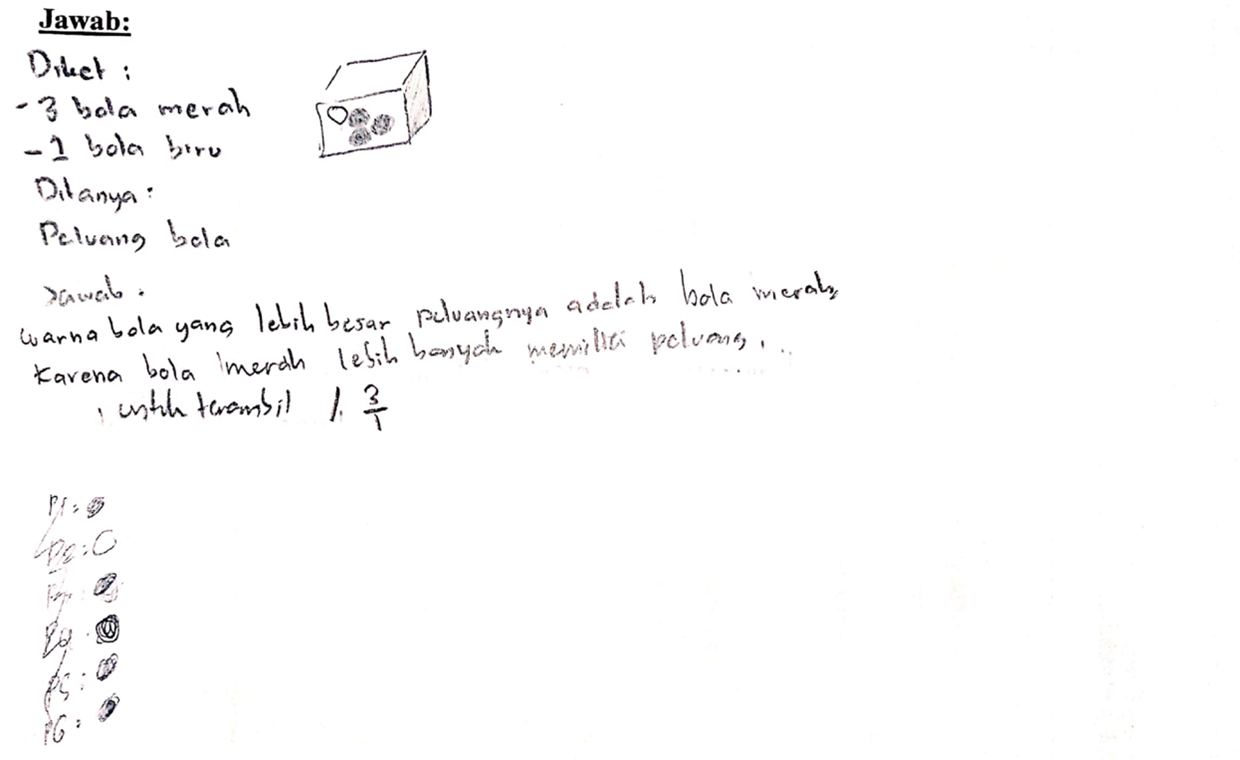
Studies of probabilistic reasoning describe how students use intuition, counts, and formal calculations, while research on digital probability learning examines modeling and multiple representations. The link between a specific reasoning difficulty and the interaction a learner should perform remains under-specified. This descriptive qualitative study examined how Grade 9 students justified single-draw probabilities and used the findings to derive design requirements for E-Learning Probability (E-PROF). Sixteen students completed a written test, and four focal cases representing the Jones framework categories were analyzed through written responses and interview excerpts. The subjective case used intuitive percentages. The transitional case wrote the correct fraction but gave an ambiguous explanation of its meaning. The informal quantitative case counted an added blue ball but retained the original total, whereas the numerical case used the new total for both probabilities. These responses informed four proposed features: visual prediction and counting, prompts for interpreting probability notation, linked visual and symbolic representations, and enrichment through comparisons across compositions. A specific design requirement is to have learners predict and justify the revised denominator and both fractions before viewing the updated representations. The study provides a basis for prototype design and subsequent classroom evaluation.
References
Batanero, C., & Álvarez-Arroyo, R. (2024). Teaching and learning of probability. ZDM – Mathematics Education, 56(1), 5–17. https://doi.org/10.1007/s11858-023-01511-5
Batanero, C., Gea, M. M., & Álvarez-Arroyo, R. (2023). La educación del razonamiento probabilístico. Educação Matemática Pesquisa: Revista do Programa de Estudos Pós-Graduados em Educação Matemática, 25(2), 127–144. https://doi.org/10.23925/1983-3156.2023v25i2p127-144
Begolli, K. N., Dai, T., McGinn, K. M., & Booth, J. L. (2021). Could probability be out of proportion? Self-explanation and example-based practice help students with lower proportional reasoning skills learn probability. Instructional Science, 49(4), 441–473. https://doi.org/10.1007/s11251-021-09550-9
Fa’ani, A. M., Masamah, U., & Marhayati, M. (2022). Level berpikir probabilistik siswa SMPN 4 Kepanjen. Jurnal Axioma: Jurnal Matematika dan Pembelajaran, 7(1), 1–12. https://doi.org/10.56013/axi.v7i1.1187
Jones, G. A., Langrall, C. W., Thornton, C. A., & Mogill, A. T. (1999). Students’ probabilistic thinking in instruction. Journal for Research in Mathematics Education, 30(5), 487–519. https://doi.org/10.2307/749771
Kazak, S., & Pratt, D. (2021). Developing the role of modelling in the teaching and learning of probability. Research in Mathematics Education, 23(2), 113–133. https://doi.org/10.1080/14794802.2020.1802328
Kingston, M., & Twohill, A. (2022). Young children’s use of subjective thinking in response to probabilistic tasks. Statistics Education Research Journal, 21(3), 5. https://doi.org/10.52041/serj.v21i3.8
Post, M., & Prediger, S. (2024). Teaching practices for unfolding information and connecting multiple representations: The case of conditional probability information. Mathematics Education Research Journal, 36(1), 97–129. https://doi.org/10.1007/s13394-022-00431-z
Rubel, L. H. (2007). Middle school and high school students’ probabilistic reasoning on coin tasks. Journal for Research in Mathematics Education, 38(5), 531–556.
Supratman, S., Budayasa, I. K., & Rahaju, E. B. (2025). Probabilistic thinking process in probability problem-solving of a prospective mathematics teacher with field-independent cognitive style based on Polya’s three stages. Educational Process International Journal, 17(1). https://doi.org/10.22521/edupij.2025.17.333
Suwarto, S., Hidayah, I., Rochmad, R., & Masrukan, M. (2023). Intuitive thinking: Perspectives on intuitive thinking processes in mathematical problem solving through a literature review. Cogent Education, 10(2), 2243119. https://doi.org/10.1080/2331186X.2023.2243119
Taram, A., Sukestiyarno, Y. L., Rochmad, & Junaedi, I. (2020). Cooperative learning based on probabilistic thinking profile SMP Muhammadiyah 3 Mlati regency of Sleman. Journal of Physics: Conference Series, 1613(1), 012078. https://doi.org/10.1088/1742-6596/1613/1/012078
van Nooijen, C. C. A., de Koning, B. B., Bramer, W. M., Isahakyan, A., Asoodar, M., Kok, E., van Merrienboer, J. J. G., & Paas, F. (2024). A cognitive load theory approach to understanding expert scaffolding of visual problem-solving tasks: A scoping review. Educational Psychology Review, 36(1), 12. https://doi.org/10.1007/s10648-024-09848-3
Weinhandl, R., Baldinger, S., & Kapplmüller, M. (2025). Educational design characteristics of digital mathematics learning environments from a student perspective. International Journal of Mathematical Education in Science and Technology, 1–27. https://doi.org/10.1080/0020739X.2025.2562275
Weinhandl, R., Baldinger, S., & Riegler, V. (2025). Design characteristics for discovery learning within digital mathematics learning environments from students’ perspectives. International Journal of Science and Mathematics Education, 23(8), 3981–4009. https://doi.org/10.1007/s10763-025-10619-x
Downloads
Published
Issue
Section
License
Copyright (c) 2026 Imam Rofiki, Puguh Darmawan, Siti Faizah, Tuti Mutia, Liny Mardhiyatirrahmah, Sri Wahyuni, Mutiara Sani, Syekha Vivi Alaiya, Feti Okta Lestari, Fahrany Wahyu Andini, Leyna Dwi Agustina

This work is licensed under a Creative Commons Attribution-ShareAlike 4.0 International License.


